





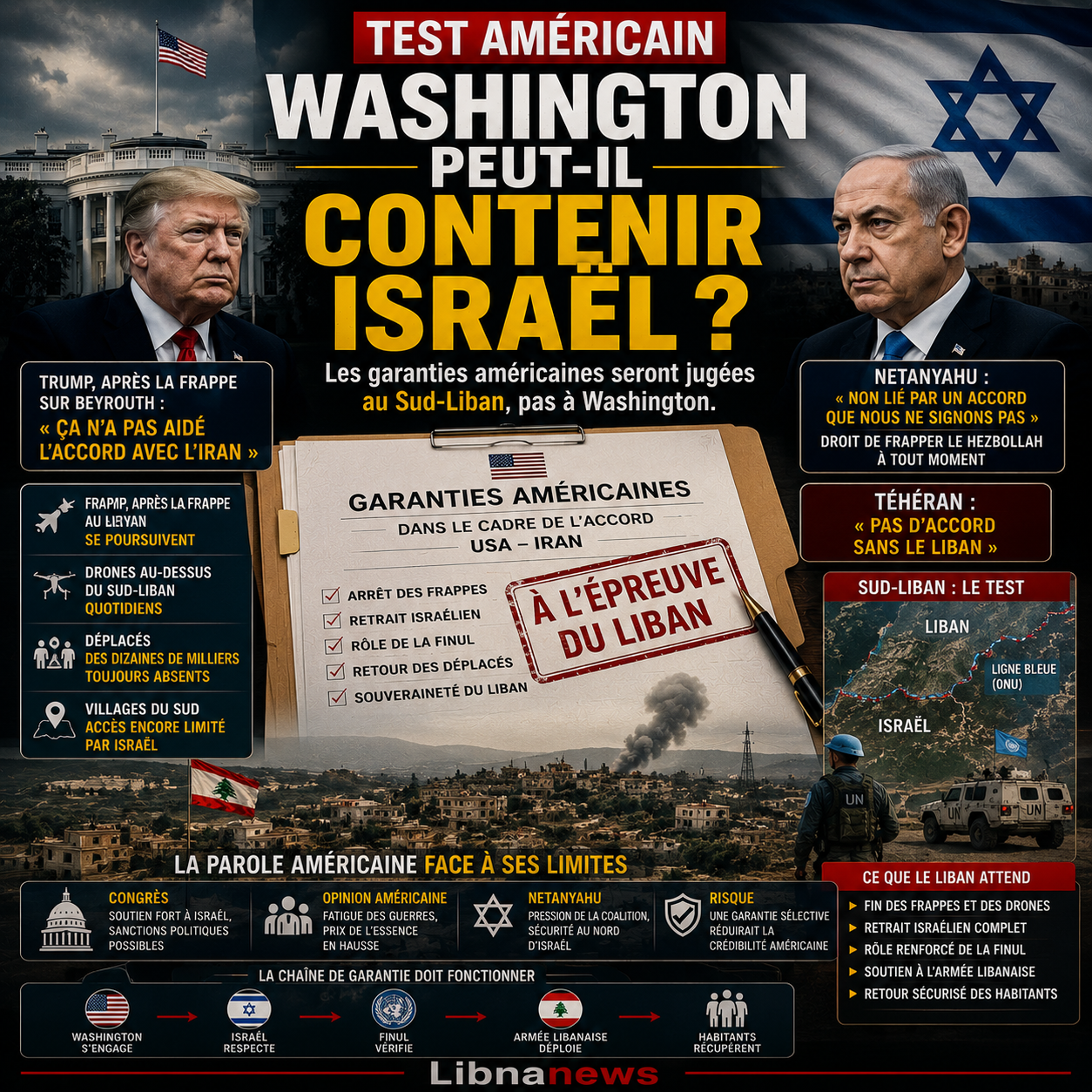
The American guarantees promised under the Washington-Theran agreement will be judged in Lebanon on one specific point: the ability of the United States to contain Israel. For Iran, the stake is clear. A regional ceasefire is of value only if it includes the Lebanese front and ends Israeli strikes. For Israel, logic is the opposite. Benjamin Netanyahu’s government claims that it is not bound by an agreement that it does not sign directly and claims the right to strike Hezbollah whenever a threat is identified. Between these two positions, Washington must demonstrate that its commitments are not just diplomatic. The American guarantees will have to produce visible effects in southern Lebanon, where the inhabitants await Israeli withdrawal, the end of drones and the safe return to the villages.
Iranian critic: Washington promises, Israel strikes
Iranian criticism targets the heart of American credibility. Since the beginning of the negotiations, Tehran claims that American positions remain contradictory as Israeli strikes continue in Lebanon. Iranian officials believe that an agreement with Washington cannot be separated from Israel’s operations against Hezbollah. In their reading, Iran cannot suspend part of its regional pressure if its main Lebanese ally remains under attack. This logic explains Iran’s insistence on including Lebanon in the global ceasefire.
The Israeli strike on the southern suburbs of Beirut gave weight to this criticism. It took place at the time when the last terms of the agreement were discussed. Tehran threatened reprisals and suggested that the continuation of negotiations depended on the cessation of Israeli attacks. Donald Trump reacted with anger against Benjamin Netanyahu. This anger showed that Washington understood the risk. A single Israeli operation could ruin a sequence designed to reopen Ormuz, calm oil prices and open 60 days of technical discussions with Iran.
The issue is therefore not only military. She’s political. If the United States cannot prevent Israel from hitting Lebanon, their guarantees will appear fragile to Tehran. They will also appear insufficient in the eyes of Beirut. Lebanon cannot be content with an agreement that announces the end of the regional war while leaving its territory exposed to unilateral operations. The American promise must therefore be measured at the point where it is most likely to be contested: the southern Lebanese, the evacuated villages and the areas where Israel claims to want to maintain a depth of security.
American guarantees against the Israeli ally
The United States has several tools to influence Israel. The first is political. An American president can publicly report that an Israeli operation is endangering a strategic goal of the United States. This is what Donald Trump did by criticizing the timing of the strike on Beirut. This kind of pressure counts. Israel depends on the relationship with Washington for its security, international image and diplomatic margin. A direct presidential criticism obliges the Israeli government to integrate the cost of its decisions beyond its own internal debate.
The second tool is military. US aid, arms deliveries, ammunition, intelligence, missile defence and operational coordination give Washington significant leverage. The United States may delay certain equipment, condition certain uses, or reduce some of the coordination in operations deemed dangerous to the regional agreement. They can also strengthen liaison mechanisms to prevent a strike in Lebanon from being decided without prior consultation. These tools exist. Their use remains politically sensitive.
The third tool is diplomatic. Washington often protects Israel in international fora. It can also support or block texts in the Security Council, influence European and Arab positions, and frame discussions around the Final, Lebanese Army and Israeli withdrawal. A US guarantee can therefore be achieved through concrete mechanisms: withdrawal schedule, areas verified by the Final, increased role of the Lebanese army, rapid investigation of violations and emergency channel between the parties. The more these mechanisms are written, the less Israel can act in an ambiguous area.
These levers, however, are only valid if Washington agrees to use them. That’s where the test starts. The United States can tell Tehran that Lebanon is included in the agreement, but it must then obtain from Israel a real drop in strikes and clarification of positions in the South. A guarantee that does not produce any visible constraint becomes a formula. It allows you to sign a text, but not to stabilize a front. Lebanon has already paid the price of overly general formulas.
American limits: Congress, electorate and pro-Israeli lobby
The first limit is inner. American policy towards Israel does not depend solely on the White House. Congress, pro-Israeli networks of influence, donors, the media, evangelical elected representatives and a part of the Republican electorate weigh on every decision. Even when the president wants to retain Netanyahu, he must measure the political cost of an open confrontation. Criticism against Israel remains possible, but concrete sanctions are more difficult. Military aid has long-standing institutional support. Breaking this continuity would require a major crisis.
The second limit comes from American public opinion. Today it is more hostile to long wars, more sensitive to the price of gasoline and more critical of certain Israeli decisions. This evolution gives Trump an argument to refuse to clumsy. But it does not automatically create a mandate to impose a breakup on Israel. The president may want to stop the war with Iran without opening an internal political conflict over aid to Israel. It can therefore exert strong pressure in private, while limiting public measures. This ambiguity may suffice to calm a crisis. It is not always enough to guarantee a ceasefire.
The third limit lies in Netanyahu himself. The Israeli Prime Minister has his own electoral logic. Part of Israel’s view remains in favour of continuing operations against Iran, Hezbollah and other Tehran allies. The people of northern Israel are demanding security guarantees. The toughest parties in the coalition demand continued military pressure. So Netanyahu may be tempted to show that he is not allowed to dictate his conduct by Washington. Whenever he considers his political survival threatened, Israeli autonomy increases.
This autonomy creates the central risk. Washington can promise. Israel can interpret. Tehran can argue. Beirut can suffer. The system only works if the United States turns its influence into an applicable rule. Otherwise, the regional agreement will become a text with variable geometry: binding on Iran when it comes to Ormuz and nuclear, but flexible for Israel when it comes to Lebanon. Such asymmetry would be politically untenable for Tehran and dangerous for Lebanon.
South Lebanon as a credibility test
The real test will take place in South Lebanon. People will not ask whether Washington has obtained a satisfactory formula in a memorandum. They will ask if the strikes stop. They’ll ask if the drones disappear. They will ask whether the roads reopen, whether the land becomes accessible and whether families can return without evacuation orders. American guarantees will therefore be evaluated in villages, not in press conferences.
The issue of Israeli withdrawal will be decisive. Israel claims to want to maintain safe areas because of the threat of Hezbollah. Lebanon requires a complete withdrawal from its territory. Iran makes Lebanon part of the regional ceasefire. Hezbollah refuses any truce that would leave Israel free to strike. If Washington fails to obtain at least a cartographic clarification, a withdrawal schedule and a verification mechanism, the ceasefire will remain fragile. Residents will see a foreign presence maintained. Hezbollah will retain its main argument. The Lebanese state will remain weakened.
The yellow line illustrates this difficulty. For Israel, it represents a depth of security. For Lebanon, it is an imposed line, distinct from the United Nations recognized benchmarks. If this line becomes a sustainable reality, American guarantees will be perceived as incapable of restoring Lebanese sovereignty. Washington can say that hostilities have declined. Beirut will respond that villages remain prevented. Local peace is not only measured by the number of strikes. It also measures access to the territory.
The possible role of the Final and the Lebanese Army
To make US guarantees credible, Washington will have to rely on actors on the ground. The Finul has channels, experience and knowledge of the Blue Line. It can observe, report and accompany certain steps. But it cannot impose a withdrawal alone or prevent all violations. It needs a clear mandate, political support and real freedom of movement. A Final reduced to the role of witness will not be enough to guarantee the truce.
The Lebanese Army is the other pillar. It embodies the sovereignty that Beirut wants to restore. It can secure the axes, accompany the return of displaced persons, cooperate with international forces and occupy the space that armed or foreign actors must leave. But she lacks resources. The economic crisis has weakened its capabilities. To ask him to become the main guarantee without financing, equipment and political coverage would be to transfer the problem to an institution already under pressure.
American guarantees must therefore take a material form. They must support the army, strengthen monitoring, finance demining, improve communications and create a rapid response mechanism to violations. They must also establish who speaks to Israel when an incident occurs, who informs Beirut, who contacts the Finul, who documents the facts and who prevents the response. Without this chain, every violation will be judged by the camp that shoots first.
The risk of selective guarantee
The main risk is a selective guarantee. Washington could be very firm on Iranian commitments and much more cautious on Israeli commitments. This asymmetry is classic in regional power relations. Yet it would be dangerous in the current sequence. Iran has accepted the agreement because it believes that it will achieve regional de-escalation including its allies. If Lebanon remains exposed, Tehran will be able to denounce an American failure. Hezbollah may refuse restraint. Lebanese opponents of Hezbollah may also accuse Washington of not protecting the sovereignty he claims to defend.
A selective guarantee would also weaken Joseph Aoun and Nawaf Salam. The President and the Prime Minister call for the return of the state to the South, Israeli withdrawal and exclusive military decision. They need proof that the institutional path protects the country. If the United States cannot contain Israel, Hezbollah supporters will say that only armed deterrence has an effect. If American safeguards work, the state will instead be able to demand an increased role for the army and open up a more serious debate on weapons. American credibility therefore has a direct effect on the internal balance of Lebanon.
The Arab countries will also observe this test. Saudi Arabia, Qatar, Egypt and the Emirates want a more stable Lebanon, but they will not finance reconstruction threatened by recurrent strikes. They will ask that the aid not be used to rebuild what can be destroyed again. They will also call for the State to control borders and infrastructure. If American guarantees do not go against Israel, donors will hesitate. Reconstruction will remain conditional, partial and slow.
What Washington needs to prove
So Washington has to prove four things. First, that the agreement with Iran does not sacrifice Lebanon to a mere drop in oil. Then, that the alliance with Israel does not allow Netanyahu to empty the ceasefire of its substance. Thirdly, that Lebanese sovereignty is not only invoked when it comes to Hezbollah weapons, but also when it comes to Israeli strikes and positions. Finally, that violations will be dealt with through a procedure, not by improvised reactions.
This demonstration involves modest but visible actions. A lasting halt to the deep strikes. A decrease in overflights. A map of the disputed positions. A withdrawal schedule. Expanded access to the Finul. Immediate support to the Lebanese army. A functional emergency channel. Clear public messages to Israel in case of an incident. These actions will not solve all the files. However, they will give the ceasefire a measurable reality.
The most difficult point will be the reaction to the first serious violation. A solid ceasefire is not only judged during the first days of calm. He judges himself in the first incident. If Israel strikes and Washington merely calls for restraint, the American guarantee will appear weak. If Hezbollah shoots and Iran refuses to weigh, Iranian reading will be challenged. If the Lebanese army and the Finul cannot access the site, the mechanism will be discredited. The first crisis will therefore become the real consideration.
American guarantees can stand up to Israel if they become a policy, not just a promise. The United States has the necessary leverage. They have military aid, coordination, diplomatic support and political weight. But they have to agree to pay the cost. Lebanon will be the place where this decision can be seen. In the South, residents will not expect a guarantee theory. They will await the end of the strikes, withdrawal, army patrols, the freedom of movement of the Final and the possibility of rebuilding. It is there, not in the communiqués, that the American word will be measured.