

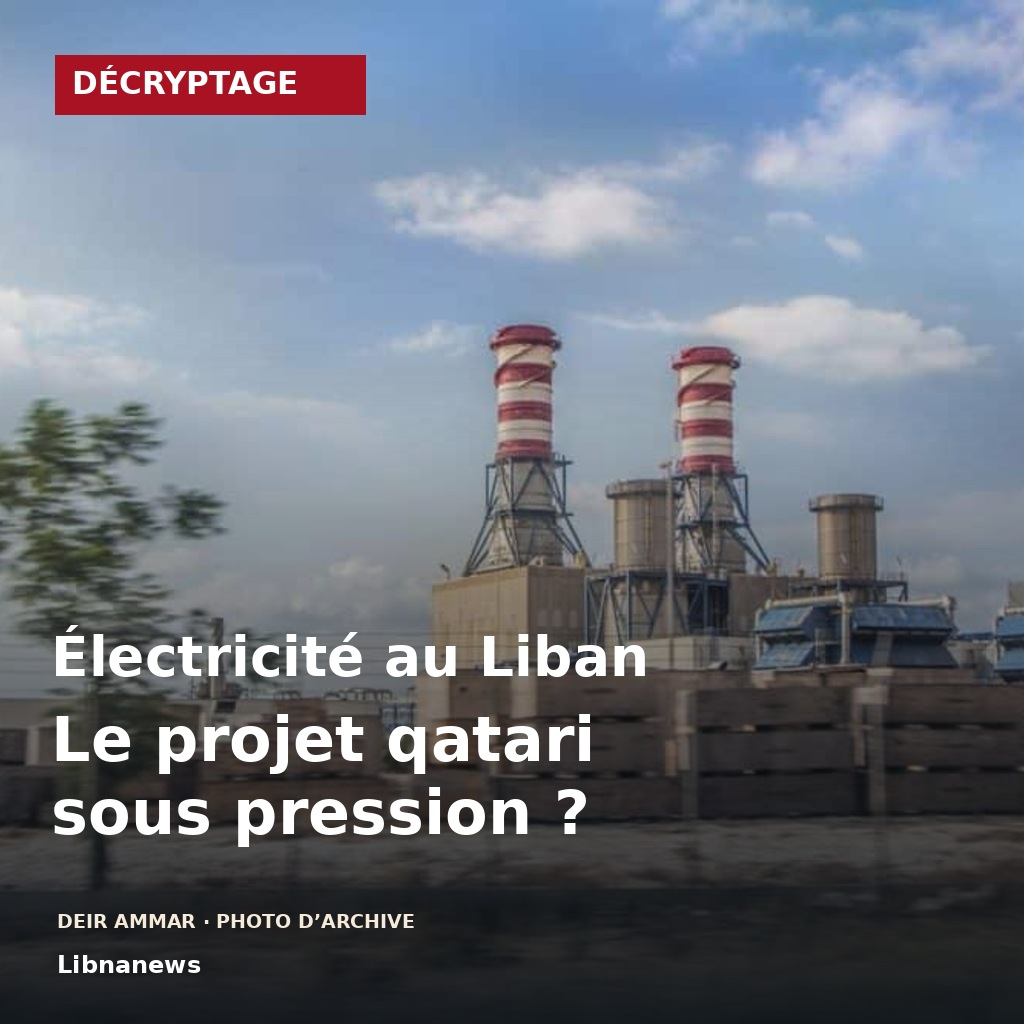
Lebanon has not yet approved the electrical contract under discussion with Qatar. A media story ready for Saudi emissary Yazid bin Farhan a warning linking the project schedule with the Hezbollah weapons file. There are no such conditions in the Lebanese Government’s public decisions: they refer the matter to a negotiation on tariffs and guarantees.
A reported warning, not a written condition
In an episode published on 20 November, Lebanese media Al Mahatta reported, on the basis of unnamed Lebanese political and diplomatic sources, that Prince Yazid bin Farhan had asked several officials not to give their final green light to the Qatari proposal too quickly. According to the account, the representative of Riyadh had invoked the internal and regional situation and placed the issue of Hezbollah’s weapons at the forefront of the difficulties.
In his interviews, the envoy also reportedly brought Hizbullah closer to the Houthis in Yemen by presenting the two movements as armed groups that escape the authority of the States concerned. The same account calls for increased political pressure. He also attributed to Nawaf Salam, after an interview with the prince, an agitation in the face of demands which, according to him, would not be accompanied by concrete measures from Riyadh. Neither a public statement by Salam nor a consulted Saudi report confirm this. It is not established that Riyadh has put an ultimatum, asked Qatar to suspend its project or obtained from Beirut that it delays it.
The Council of Ministers validated a plan, not the Qatari contract
On 13 November, the Lebanese Council of Ministers approved the guidelines presented by the Minister of Energy and Water, Joe Saddi: gas supply, production, transport, distribution and collection of invoices. It was informed of the projects and capacities proposed by Qatar, which cover power plants, facilities for the import and regasification of liquefied natural gas, renewable energy and battery storage. These two acts do not have the same scope: approving an electrical policy is not equivalent to signing all operations that could implement it.
The mandate given to Joe Saddi sets out what remains to be negotiated: the tariff, the guarantees for Lebanon and the form of a government-to-government agreement. The Minister must return to the Council of Ministers with the result of his discussions. One approach would involve private operators to design, build and operate facilities before transferring ownership to the State. As long as the contract, the operator’s remuneration and the guarantees are not terminated, it is not possible to deduct a decrease in the invoice or new hours of current at a given date.
What Doha has confirmed
On 15 November, Nawaf Salam met in Doha with his Qatari counterpart, Mohammed bin Abdelrahman Al-Thani. The Qatari Ministry of Foreign Affairs confirms that discussions focused on energy and economic cooperation, as well as diplomatic efforts to de-escalate the region. It recalls Doha’s support for Lebanon’s sovereignty and its institutions. The communiqué does not mention any final signed contract or disarmament condition.
The Presidency of the Lebanese Council presented a number of points for discussion: access to gas and electricity via Syria, from power plants in Lebanon, a floating storage and regasification unit, and a possible supply agreement for liquefied natural gas over 20 years. The transit through Syria should not be confused with the arrival of gas by sea. The two solutions do not depend on the same infrastructure or agreements. In Deir Ammar, the government is planning in the short term the arrival of gas via the Arab gas pipeline to replace diesel in the existing power plant. This is an approved orientation, not the announcement of a delivery.
On 21 November, the Serail still indicated that these discussions were ongoing. He recalled that, according to his diagnosis, existing plants cannot cover more than one third of the demand, even when the fuel is available. Its target of about 3,500 megawatts concerns the entire national plan, not Qatar’s only proposal. The state of the transmission system and the collection of invoices remain two distinct conditions for transforming production into service.
The weapons file already follows a separate path
At the Council of Ministers on 22 October, Nawaf Salam reaffirmed that the carrying of arms by the authorized forces and the decision on war and peace were the responsibility of the State. At the same meeting, he had announced progress in discussions with Qatar without presenting these two issues as terms of an exchange. The warning attributed to the Saudi emissary concerns, if the story is confirmed, the timing and political context of a Lebanese decision. It is not a public condition of the electrical project.





Comments