

The Democratic Republic of the Congo has crossed the threshold of 11,000 confirmed Ebola cases. The results are 11,042 confirmed infections and 5,387 deaths, according to data from the National Institute of Public Health (INSP) reported by Reuters on November 10. It concerns the epidemic caused by the Bundibugyo virus, declared on 15 May 2026.
The iNSP situation report No. 179 the day of 9 November and was published on 10 November. The figures therefore do not correspond to the only new infections of the day: this is the cumulative epidemic. The 11,042 cases are confirmed cases, not a total of indiscriminately adding suspect, probable and confirmed cases.
An epidemic spread to eight provinces
The crossing of this threshold prolongs a progress documented by health agencies. In its of 10 novemberThe European Centre for Disease Prevention and Control (ECDC) reported 10,990 confirmed cases and 5,354 deaths, based on Congolese data as at 8 November.
World Health Organization (WHO) already described, on november 6, sustained transmission and geographical spread of the epidemic. Its assessment, which was completed as at 3 November, identified cases in 67 health areas spread across eight provinces. The majority of infections were concentrated in Ituri and North Kivu.
This epidemic is the largest ever recorded in the DRC, all Ebola viruses, according to WHO. In particular, the organisation highlights the weight of deaths in communities, which reflects difficulties in early detection and rapid access to care.
No Bundibugyo approved vaccine
The Bundibugyo virus belongs to the Ebola virus group. The distinction is essential to understand the means available: vaccines and treatments developed against Ebola, also known as Zaire, cannot be presented as having established efficacy against Bundibugyo.
At this stage, no vaccine or specific approved treatment against Bundibugyo is available, according to WHO. This does not mean that patients are deprived of care: support care, rapid diagnosis and access to treatment facilities remain essential.
Ongoing clinical trials
However, research is progressing. The Tumaini vaccine trial started on 23 October in Bunia. In particular, it evaluates Ervebo, already used against Zaire virus, to determine its effectiveness against Bundibugyo.
On 4 November, wHO announced the recommendation to add two candidates specifically designed against Bundibugyo: ChAdOx1, developed by Oxford University with the Serum Institute of India, and mRNA-1469, developed by Moderna. Their entry into the test remains subject to national authorisations. Therefore, they are not already registered vaccines.
Therapeutic trials also investigate several drugs, including MBP134 antibodies and remdesvir. Pending their results, the response is based on rapid identification and isolation of cases, follow-up of contacts, prevention of infections in care and secure burials.
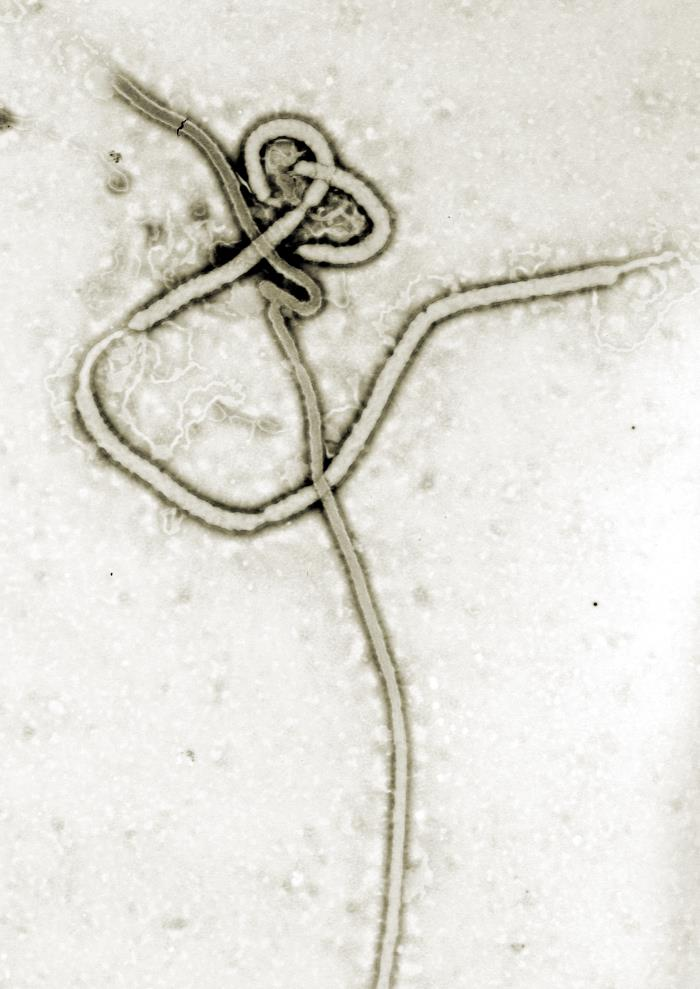
Illustration: electronic micrograph of an Ebola virion made in 1976, CDC / Dr Frederick A. Murphy, PHIL n°1833, public domain. This image does not document the Bundibugyo virus of the current epidemic. Free Source: CDCprotection caps (if present).





Comments