

The succession of UNIFIL raises a practical question: how can a violation be found, documented and processed? The presence of observers, their civil or military status and the flag under which they work do not alone answer this question. To compare the options discussed, one must look at their freedom of movement, their technical means, their protection and the destination of their relations.
The time frame is known. Resolution 2790 provides for the termination of UNIFIL operations on 31 December 2026 and an orderly withdrawal for the following year. The mission recalls at its site that its current role includes supporting the implementation of resolution 1701 and monitoring violations. The continuation of this resolution, however, does not entail the automatic renewal of UNIFIL personnel, vehicles and procedures.
Accessing an incident before the tracks disappear
A verification mission must be able to travel quickly to the scene. A report received from a distance does not always replace direct observation: testimony may diverge, debris is moved and the circumstances of an incident remain contested. Future arrangements should therefore specify accessible areas, notification procedures and escort conditions.
A civilian observer can collect testimonies, compare images and write observations. These functions do not automatically give him the ability to enter a dangerous area. It is necessary to define who ensures its safety and what happens when a party refuses access. A light presence can be credible in its analysis while remaining limited in its field coverage.
Observer is not enough to attribute
Identifying an explosion, identifying its origin and establishing responsibility are three different steps. A solid method must explain which elements have been observed directly, which come from the parties and which remain unverifiable. The independence of a report also depends on the possibility of retaining evidence and publishing its limits.
In any future arrangements, common rules would be needed to date incidents, preserve material elements, compare versions and correct a conclusion. Without these procedures, two parties may invoke the same mechanism while producing incompatible readings of its observations. Political confidence therefore does not exempt a technical protocol.
A reduced presence does not necessarily retain the same capacity
A smaller UN mission could build on institutional experience and liaison mechanisms. But its effectiveness would depend on its actual mandate, funding and resources. Reducing the number of personnel without reviewing tasks can reduce the frequency of patrols or increase travel times. This is a risk to be assessed, not the balance sheet of an already decided mission.
A multinational force would ask other questions: who would command its units, what rules would govern their action and who would arbitrate a disagreement between contributors? The participation of influential powers could have a diplomatic impact. It would not allow the deduction, without text, of a right of intervention or an automatic guarantee of protection.
What happens to a documented violation?
The last step is follow-up. A report may be transmitted to the authorities, discussed in a liaison mechanism or brought before an international body. These circuits do not have the same effects. It is important to know who is asking for an answer, how quickly and with what publicity when the incident remains unresolved.
The debate should thus focus on a complete chain: access, observation, prudent attribution, transmission and follow-up. A mission that produces reliable reports but can no longer access the ground suffers from a first weakness. One mission that observes without getting an answer meets another. It is on this concrete scale that the arrangements can be compared once a mandate and means have been formally proposed.
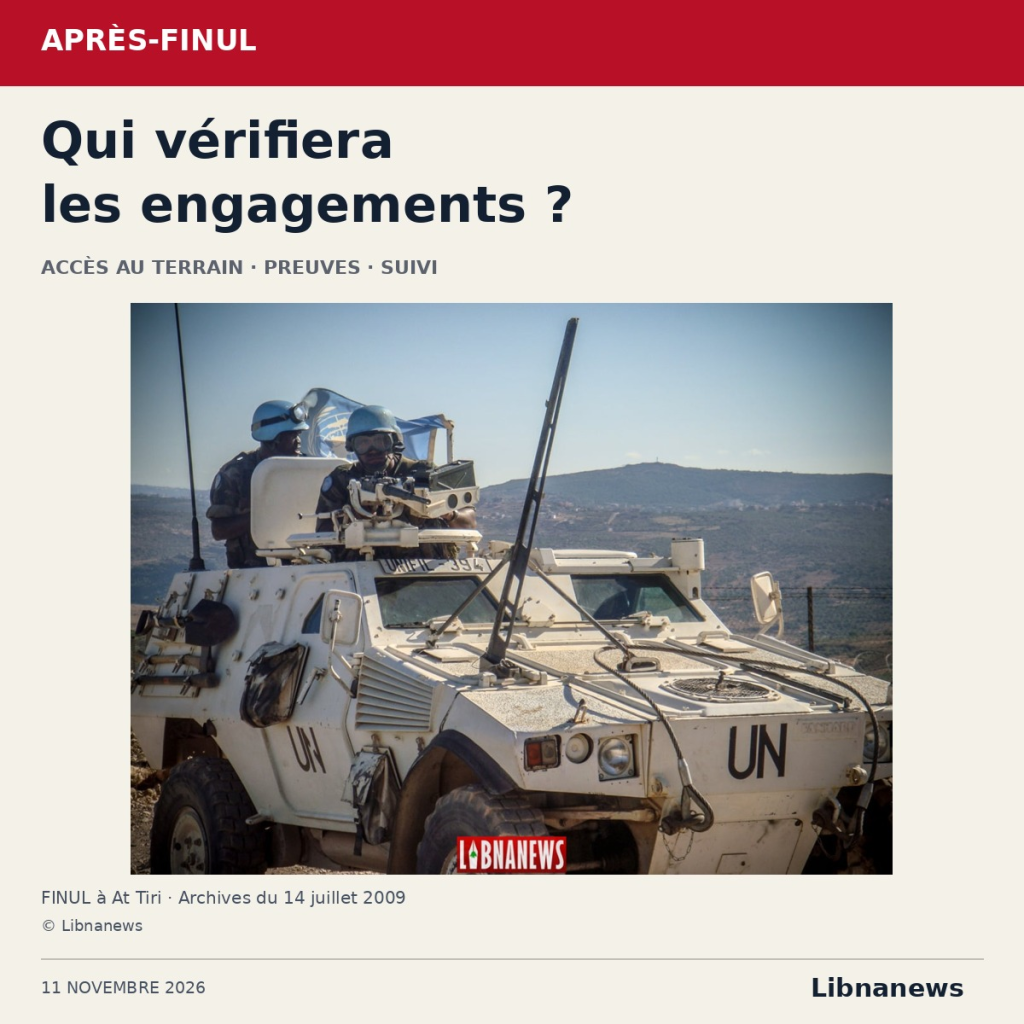
UNIFIL at At Tiri · Archives of 14 July 2009. Integer photo resized proportionally, no cropping or retouching. It does not represent a current operation. © Libnanews





Comments