

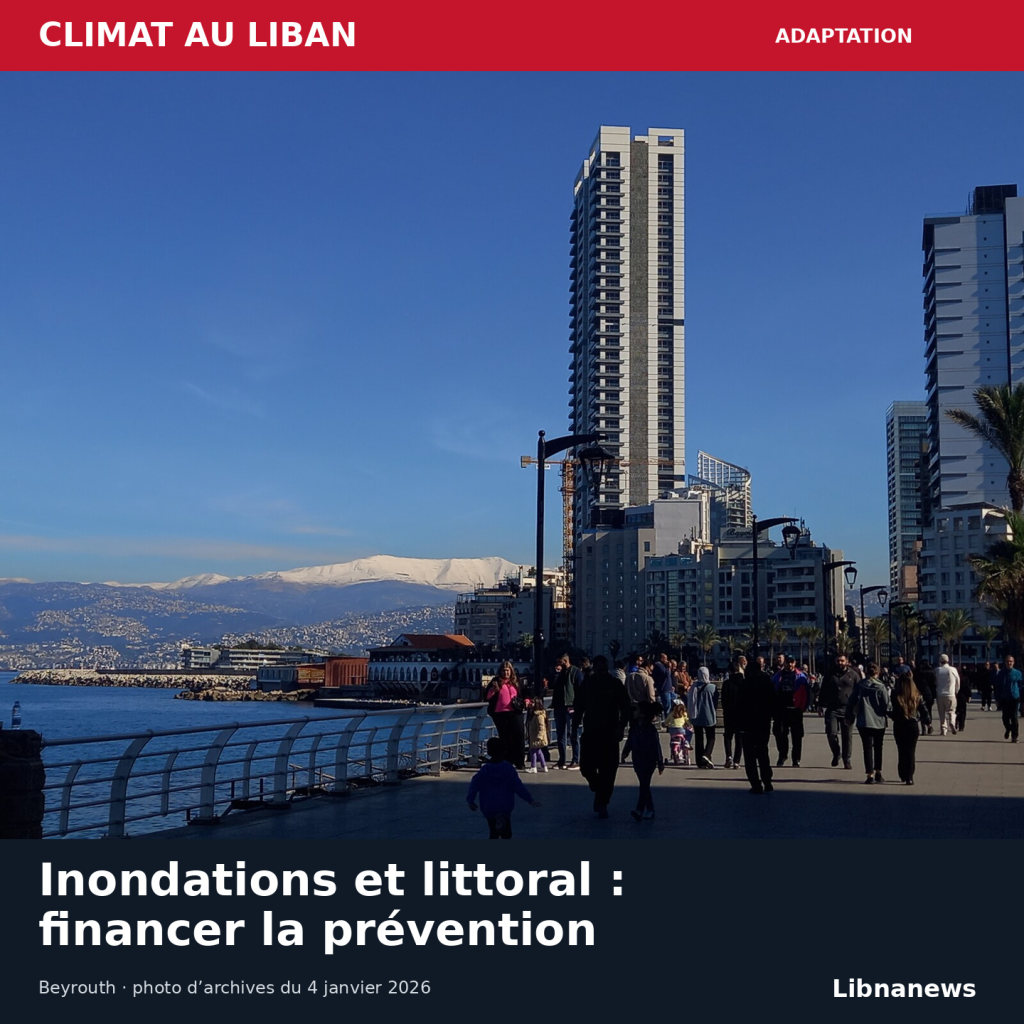
Climate adaptation in Lebanon must also prepare the country for excess water. While COP31 is held in Antalya from 9 to 20 November 2026, adaptation must cover floods, urban runoff and coastal risks. The country has a national framework for 2025-2035. Its challenge now is to translate these guidelines into local diagnostics, usable alerts and funded projects.
The National Adaptation Plan covers eight sectors, including water resources, urban infrastructure and disaster risk reduction. It places flood protection in a broader policy. The water supply and security of the inhabitants during the heavy rains are thus the same preparation of the territory.
Climate adaptation in Lebanon: beyond the shortage
In an interview published on November 10, environmental expert Habib Maalouf recalls that the amount of rain does not explain the damage alone. Urbanisation, asphalt or concrete-covered soils and constructions in low areas increase exposure. Network capacity and institutional readiness are also important.
This distinction avoids too simple a reading of disasters. An intense rain triggers runoff, but its consequences also depend on the road left to the water. Building on a natural flow passage or saturating an area of impermeable surfaces changes this path. Storage requirements for dry periods therefore do not remove those of evacuation and protection during rainy episodes.
For Maalouf, water essential for life and agriculture can become destructive when it exceeds the capacity of infrastructure. His analysis focuses on planning choices as well as climate. It does not automatically assign each Lebanese flood to warming. Such a diagnosis requires observations on the rains, soils and works concerned.
The coastline combines several types of exposure
On the coast, the preparation exceeds the only storm systems. The National Adaptation Plan distinguishes erosion, sea level rise, storm effects and salt water intrusion. These phenomena do not all have the same speed and consequences. Treating them under a single « advanced sea » formula would mask the technical needs of each site.
The erosion concerns loss of land on the shore. Waves and surges can expose the installations during a storm. The salt intrusion affects underground resources and soils. Maalouf underlines the latter threat to drinking water and agriculture in vulnerable coastal territories, without presenting a new measure for a Lebanese municipality.
The Lebanese programme plans to assess the vulnerability of the coastline and its main infrastructure. It also aims to update the integrated coastal zone management strategy. These actions are included in a roadmap: their registration does not demonstrate that the studies are completed or that the protections are already built.
Alert must lead to action
Preparation is not based solely on work. A weather forecast can predict heavy precipitation without sufficient local response. To be useful, the information must reach the people exposed and the services able to act, with understandable instructions.
The World Meteorological Organization describes four complementary components of an early warning system. Risks must be known, phenomena must be observed and predicted, warnings must be transmitted, preparedness and response capabilities must be available. An isolated measuring network thus fulfils only part of the function.
Applied to floods, this logic links forecasting to specific locations: low sectors, exposed axes and essential equipment. It also leads to an examination of the flow of information. Who gets the warning? Who transmits it to the inhabitants? What services should be mobilized? These responsibilities must be defined before water arrives.
Instrument maintenance and team training are part of the cost of alerting. The WMO highlights the difficulties many services face in maintaining their stations and forecasting capabilities. This international observation does not establish an inventory of Lebanese shortcomings. However, it recalls that buying equipment without planning its operation does not guarantee a sustainable service.
Municipalities as a bridge between strategy and inhabitants
A recent initiative seeks to bring national orientations closer to local realities. On 12 October 2026, the Lebanese Red Cross, the Ministry of Environment and the United Nations Development Programme brought together territorial representatives in Jounieh. The meeting focused on more community-sensitive climate policies.
Participants included representatives of governorates, municipal unions, municipalities and local communities. The stated objective was to integrate climate policies into their programmes and strengthen their participation in decision-making. The monitoring of training should also help to identify what is changing in practice and the continuing difficulties.
This work extends an agreement signed on 21 August between the Lebanese Red Cross and UNDP. It aims at better emergency preparedness, early action and coordination. These commitments organise cooperation. They do not constitute a protection certificate for each locality or the announcement of a fully operational national alert system.
Finance preparation without confusing envelopes
The financial question arises from the production of the data. The project to support the National Adaptation Plan and municipal water resource planning covers the period 2023-2027. UNDP has a budget of $1,936,960, with the Green Climate Fund as a lessor and the Ministry of Environment as a partner.
The project includes work on the Nahr el-Kalb basin. It aims to improve knowledge, institutional skills and integration of adaptation into planning. Its presentation mentions assessments of the Metn industrial areas and the apple sector in the upper basin.
This budget corresponds to a specific programme of preparation and support. It does not represent the national cost of flood protection or an amount announced in Antalya for construction. The distinction is that funding studies, selecting interventions and ensuring their implementation are different steps.
Maalouf places effective access to financing at the centre of judgment on climate negotiations. He stressed the risk of putting additional debt on the most vulnerable countries. Discussions on adaptation and financing continue in Antalya. The conference schedule is not sufficient to establish that a new Lebanese envelope is being acquired.
The national roadmap provides for urban risk and drainage performance assessments for 2026-2028. It places sustainable drainage pilot projects by 2029-2032. The follow-up will therefore focus on the actual studies carried out, the selected sites and the resources allocated to them.





Comments