

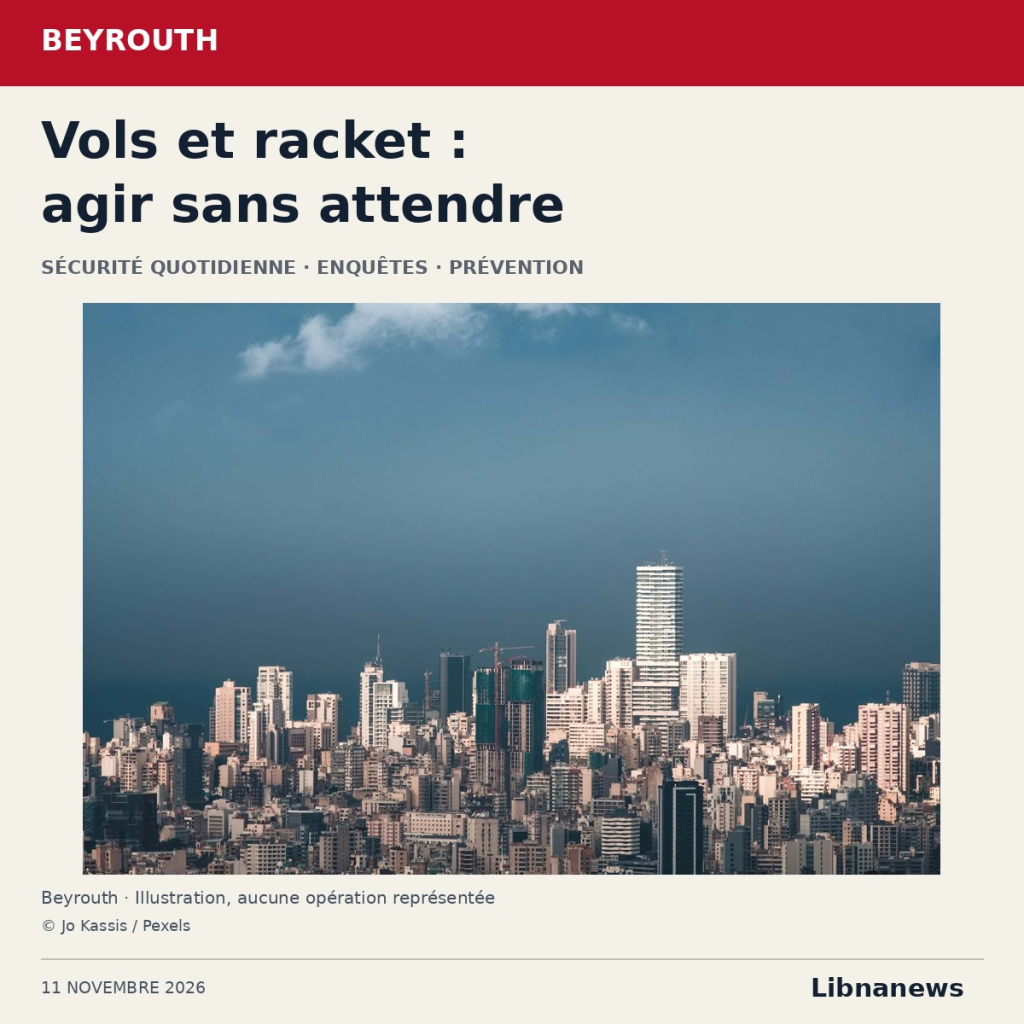
In Beirut, the demands for daily security meet the national debate on weapons. Both cases cross when criminal networks are intimidated or protected. However, they are not confused: to investigate a robbery, to pursue a racket or to dismantle a traffic is a response to specific facts, while political disarmament concerns the organization of power and force.
In An-Nahar on 11 November, MP Ibrahim Mneimneh rejects « security by consent », according to a translation of his remarks into Arabic, and calls for action against theft and racket. The newspaper also reports that an unnamed Hezbollah MP does not oppose drug and robbery operations. This anonymous position is not valid for the entire party.
A political prerequisite discussed
A security source cited by An-Nahar distinguishes its ability to intervene against crime from the issue of full disarmament, which it believes is linked to a political agreement. This assessment describes a reading of the constraints of the field. It does not transform ordinary offences into permissible acts until a national compromise is reached.
The distinction is important for the inhabitants. A victim of theft is awaiting an investigation and a judicial response to his case. It cannot measure the protection it enjoys only by announcing a general objective of a « city without weapons ». Daily security is also seen as the possibility of filing a complaint, providing evidence and obtaining follow-up.
Public communications from the Internal Security Forces regularly report investigations and arrests for theft, fraud or trafficking. These announcements show the existence of police activity. They are not sufficient to establish that crime is declining throughout the capital, due to a lack of comparable series and a constant perimeter.
Specific operations need follow-up
In Al Liwa of 11 November, a column by Maarouf al-Dauk calls for addressing security issues beyond isolated interventions, including motorcycles and flights. This plea raises a question of method: what remains of an operation once the patrols are gone?
In order to assess a public response, a distinction should be made between complaints received, facts clarified, arrests and judicial follow-up. These indicators are not interchangeable. An increase in complaints can also reflect increased confidence in services, while a large number of controls alone do not show a decline in attacks.
The two-wheel traffic calls for the same precision. A vehicle used during a flight may constitute an element of investigation; This does not justify assimilating all drivers to suspects. A traffic measurement must be assessed according to its purpose, proportionality and effects, particularly on those who use a motorcycle to work.
Prevent without designating a population
Al Bina, in its 11 November edition, advocates social prevention and stresses individual responsibility. This approach avoids a frequent shift: assigning delinquency to a nationality, neighbourhood or social condition. An investigation must establish acts and responsibilities, not validate a collective suspicion.
The expected response therefore combines safe presence, judicial treatment and prevention. The debate on arms monopoly remains essential. However, it does not provide an acceptable time frame for deferring action against daily attacks on persons and property. In Beirut, the immediate challenge is to make this action regular, controllable and accessible to the inhabitants.
Beirut · Illustration, no operation represented. Integer photo resized proportionally, no cropping or retouching. It does not represent a current operation. © Jo Kassis / Pexels





Comments