

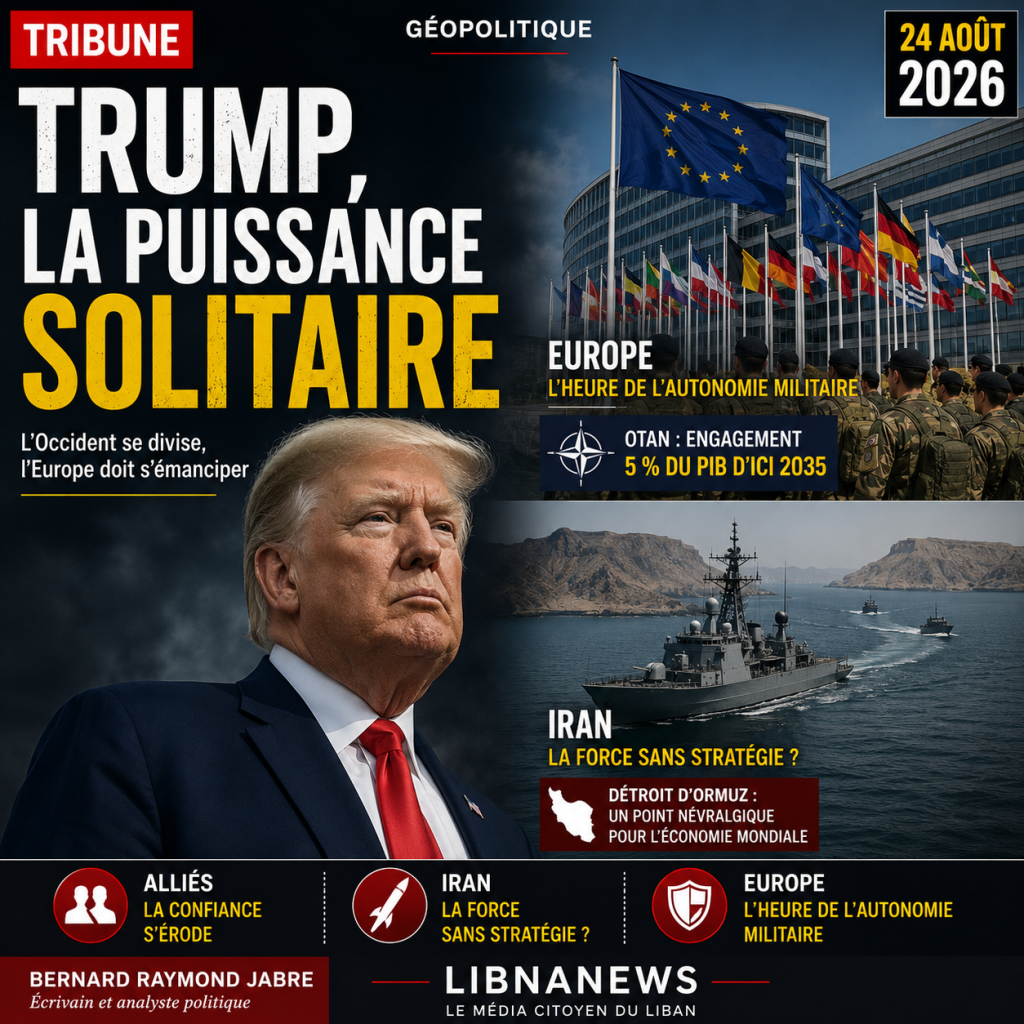
The divided West, the Iranian test and the urgency of a sovereign European defence
Bernard Raymond Jabre
| « Real leadership is not about folding friends. It consists in making them want to stand by your side. » |
Missed opportunity to bring the West together
We wanted to believe Donald Trump could become a leader. Not only the President of the United States, but the political leader of a West that doubts itself, the defender of a free world faced with increasingly secure authoritarian powers of themselves.
Faced with a totalitarian China that still considers Taiwan as a province destined to return, by negotiation or by force, under its control; in the face of a Russia trying to reconstitute around it an area of domination in the name of history, its security and its old influence on Eastern Europe; Finally, in the face of all the powers that recognize in international law only a limit imposed on the weak, America had a special responsibility: to gather.
Donald Trump could have been the one waking up the West. He could have told Europeans that they could no longer delegate their defence to Washington forever. It could have required more effort, courage and responsibility, while solemnly renewing the American commitment to their freedoms. He could have built a sacred union of democracies, not a coalition of vassals under the authority of America, but an alliance of sovereign nations, equal in law, united by their interests, their history, their friendship and a certain idea of human dignity.
He was even right on one essential point: Europe had too long settled in strategic comfort. It devoted its resources to its economic and social model while the United States assumed a disproportionate share of its security. Trump’s pressure has undoubtedly helped to awaken Europeans. At The Hague Summit in 2025, NATO members pledged to gradually increase their defence and security spending to 5% of GDP by 2035. In 2025 and 2026, European allies and Canada significantly increased their military budgets. On this issue, Trump must be recognized for breaking a form of European hypocrisy. An alliance cannot work for a long time if one of its members bears the bulk of the cost while the others claim all the guarantees.
But there are two ways to ask friends more. They can be reminded of their responsibilities by showing them that they are indispensable. Or we can humiliate them until they understand that they are no longer considered friends. Donald Trump too often chose the second way.
When the ally becomes a customer
He sees the alliance as a transaction, loyalty as a debt and friendship as a balance of power. He no longer seems to see US allies as members of a historical community, but as customers whose creditworthiness should be constantly checked. He does not speak to them equal to equal: he demands, threatens, taxes, discounts, and then presents the concession obtained as a personal victory. This behavior can remove some immediate benefits. But it slowly destroys what America took almost a century to build: trust.
One of the most revealing examples is the customs duties imposed on Canada, Europe and other partners. In April 2025, Washington introduced a general tariff of 10%, with higher rates for certain countries and sectors. The subsequent trade compromise with the European Union maintained a US tariff of 15% on many European products and 50% on certain metals. Even when justified in the name of reciprocity, these measures give allies the feeling of being treated almost as economic opponents.
Protectionism can temporarily protect some industries; It does not create a political civilization. By considering any relationship as a market in which America should necessarily gain more than the other, Trump risks turning the world’s first power into an immense, dreaded but less loved fortress. A power surrounded by distrust is already a power more alone.
Even the battle of names reveals something of this worldview. Officially renamed the Gulf of Mexico « Gulf of America » in the United States, re-establishing the name of Mount McKinley instead of Denali, perhaps only symbolic gestures. But symbols are never insignificant in politics. They give the impression that America no longer only wants to defend its interests: it wants to impose its vocabulary on the world. As if naming a space was already enough to morally claim its possession.
Even more serious were the repeated statements on Canada, presented as a possible « 51st State », and on Greenland, the autonomous territory of the Kingdom of Denmark that Trump claimed to want. Even if these remarks are sometimes a provocation or negotiation strategy, they cross a dangerous limit. One cannot denounce China’s claims to Taiwan or Russian ambitions in Eastern Europe while giving the impression that the sovereignty of friendly nations also becomes negotiable when a great power covets their territory.
This is where Trump’s policy meets its fundamental contradiction. He claims to defend a world based on American force, but he weakens the very principle that makes this force legitimate in the eyes of democracies: respect for sovereignty. If Canada can be absorbed because it would be economically dependent, if Greenland can be acquired because it is strategically useful, on what moral foundation tomorrow condemn Beijing when China invokes geographic proximity, history and strategic necessity to seize Taiwan? And what about Moscow when Russia explains that it is only recovering an area that was once under its influence?
Iranian test: strength without strategy
The Iranian question reveals even more brutally the weaknesses of this solitary conception of power. We thought that the US administration had studied the different scenarios at length, assessed Tehran’s response capabilities and prepared, with its allies, all the consequences of a confrontation. On the contrary, the current balance sheet gives the impression of an extraordinary underestimation of the opponent.
Was Iran’s military doctrine seriously analyzed? Have we anticipated the simultaneous use of ballistic missiles, drones, marine mines, anti-ship missiles and these hundreds of small, fast boats — the so-called « mostic boats » — designed not to face the American fleet in front of it, but to harass, disperse and force it to permanently defend an immense maritime space? Was it planned that Iran would use its geography as a weapon and the Strait of Ormuz as a hostage?
Nearly a fifth of the world’s oil and gas traded by sea usually passes through Ormuz. The one who disturbs this passage therefore not only threatens his enemies: he takes hostage the world economy. It directly exposes the Arab Gulf States, their ports, refineries, gas installations, cities and populations. The Gulf monarchies thus become, even when they do not want war, potential battlefields and targets of retaliation.
In Ormuz added the threat of Bab al-Mandeb. Iran does not directly control its shores, but its relations with the Yemeni Houthis offer an indirect means of pressure on this second strategic passage. Between Ormuz, Bab al-Mandeb, the Red Sea and the Suez Canal, it is a considerable part of the world’s energy and trade routes that can be disrupted. By imagining that an initial strike would be enough to neutralize the Iranian problem, it seems to have forgotten that Tehran does not only reason in terms of national territory. He reasoned in networks, relays, militias, straits, strategic depth and war of wear and tear.
Perhaps the great illusion was that Iran was a new Venezuela: an isolated, fragile regime that a few days of military pressure and the beheading of its summit would be enough to bring down. But Iran is not Venezuela. It is an ancient civilization, a country with more than 90 million inhabitants, with a strategic culture, a state apparatus, a military industry and a regional network patiently built for decades.
We can eliminate a leader. The system that produced it is not necessarily destroyed. Heads are changing. Chains of command are being rebuilt. Engineers remain. Know-how is passed on. The death of a leader may temporarily disrupt a regime; It can also strengthen its cohesion, awaken nationalism and convince a whole new generation that the possession of nuclear weapons is the only possible life insurance.
The authoritarian front is drawing closer
Meanwhile, the rapprochements between Iran, Russia, China and North Korea are deepening. It is not yet an integrated alliance comparable to NATO, with a common command and automatic defence obligation. But convergence exists: military cooperation, technology transfers, exchanges of drones, missiles and intelligence, circumvention of sanctions, naval exercises and diplomatic support. Russia and Iran signed a comprehensive strategic partnership treaty in January 2025. The four powers do not need to love or trust each other entirely to understand that they have a better chance of helping each other out against a common opponent.
Serious suspicions already exist about the technical, material or informational assistance provided to Tehran. Not all announced deliveries are publicly verifiable, and caution must be exercised before talking about « secret alliances » as certainty. But the mere fact that this cooperation is now plausible should have entered the centre of American planning. By striking Iran without having previously consolidated Western unity, Washington risks achieving exactly the opposite of the desired result: not the isolation of Tehran, but the acceleration of its integration into an informal front bringing together the main powers hostile to the West.
Even more surprising: who really asked for the opinions of the allies? What in-depth strategic consultation with NATO took place? What common plan has been drawn up with Europe? What protection mechanisms were negotiated with the Gulf countries before they were exposed to Iranian missiles, drones and retaliation?
Consultation does not mean asking permission to exist or to act. To consult, it is to recognize that when an American decision can provoke a regional war, close Ormuz, threaten Bab el-Mandeb, reach Western bases and explode the world energy price, its consequences will not be exclusively American. Allies therefore have the right to be heard before they are ordered to pay, protect, participate or remain silent.
The cost is not limited to military operations. It is found in the price of oil, gas, shipping, insurance and fertilizer. It ends up in European household bills, in the deficits of energy-importing countries and in the price of bread for the poorest populations. FAO has warned that the prolonged disruption of Ormuz could cause a systemic food shock in the coming months. Energy inflation then becomes agricultural inflation: energy increases fertilizers, irrigation, processing and transport; cereals become more expensive; Fragile states become more indebted; hunger and political instability are progressing.
So we have before us, so far, a calamitous record: an Iran struck but not defeated, remaining nuisance capabilities, a strategic strait transformed into a blackmail instrument, exposed Arab States, high demand for US military stocks, tightening opposing alliances and a global economy that pays the bill. A war announced as short becomes a war of wear and tear. A demonstration of force to restore deterrence reveals the limits of force when it is not accompanied by a complete political strategy or a genuine coalition.
Europe in the face of dependence
Vladimir Putin and Chinese leaders probably don’t need Donald Trump to offer them anything directly. All they have to do is see the West divide, Europeans doubt the American word, Canada feel threatened by its own neighbour and Asian allies question the strength of Washington’s commitments. Each crack in the Western alliance is a strategic benefit for Moscow and Beijing. What they should have obtained at the cost of immense efforts, America risks giving them free of charge: a West that no longer fully believes in itself.
NATO still exists. It has even strengthened itself militarily on several levels and its members have reaffirmed their common commitments. It would therefore be excessive to say that Trump has already destroyed it. But a military alliance is not based solely on budgets, missiles and final statements. It rests on an intimate certainty: the day of danger, the other will be there. If this certainty disappears, the covenant remains on paper but begins to empty itself of its substance.
Europe now understands, slowly and painfully, that it can no longer base all its safety on the hypothesis of automatic and eternal American protection. It has embarked on its 2030 military readiness programme and agreed to invest much more in its defence. But increasing national budgets will not be enough. Twenty-seven juxtaposed armies do not form a common power. It needs a real European capability: a coordinated defence industry, a chain of command capable of acting, a more coherent foreign policy, a credible deterrence and a European army that is linked with NATO but capable of intervening when the United States does not want or cannot do so.
We must now go further and form a genuine European military union, powerful enough to protect Europe’s territory, populations, borders, maritime spaces and vital interests, without dependent on anyone — not even the United States. This requires permanent political and military command, joint strategic planning, integrated air and missile defence, autonomous European intelligence, space and cyber capabilities, sufficient ammunition reserves, unified logistics and an industry capable of producing the necessary weapons quickly. This also implies a European reaction force, a common doctrine and an assumed reflection on French and British nuclear deterrence in the service of the security of the continent. As long as Europe depends on another to know whether it will be defended, it will not be fully sovereign. A power that must ask an external power for permission or means to survive is not yet a power.
This military union should not be directed against the United States or intended to dissolve NATO. On the contrary, it would transform a relationship of dependency into a true alliance between equals. America would remain a key friend and partner; It would no longer be the indispensable guarantor without which Europe would be unable to ensure its own security. Friendship becomes healthier when everyone can stand by himself.
Europe must therefore not build this autonomy against America. It must build it because friendship between adult nations cannot rest on the dependence of one and the mood of the other. A strong Europe would be a better ally of the United States than a frightened, divided and militarily incomplete Europe.
Mr Trump, what is a leader?
Trump, the real leadership is not to bend his friends. It consists in making them want to stand by your side.
To be a leader is not to enter into every negotiation by saying: « I win; You shut up and obey. If you refuse, I’ll punish you. This method can work in a real estate transaction where the best price is sought. It does not work long-term in international relations, because nations have memory, identity and dignity. They are neither subsidiaries nor suppliers nor debtors to be called up in an office.
Leadership consists of listening before deciding, consulting before committing, planning before hitting and negotiating before threatening. It consists of understanding the opponent’s thinking, considering his possible answers and preparing not only the first day of the war, but the hundredth, the thousandth and especially the day after.
An alliance of powers is built not on obedience, but on reciprocity. It assumes that everyone accepts the legitimate interests of the other, recognizes his or her sovereignty, considers his or her concerns and participates in a decision that he or she must share the risks. True ally is not the one who always obeys. This is the one who can tell you that you are wrong and that you are still listening.
Friendship between the United States, Canada and Europe was not created by a commercial contract. It was forged in the blood of two world wars. Americans died to free Europe; Canadians, British, French, Poles and so many others fought with them. Later, during the cold war, these nations jointly defended an area of freedom against Soviet totalitarianism. This story creates moral obligations that exceed quarterly accounts, trade deficits and percentages of military expenditures.
Roosevelt and Truman understood that an America surrounded by free allies was more powerful than an America surrounded by submissive vassals. They knew that the respect offered to partners was not a weakness, but a power multiplier. They knew above all that the international order could not be defended by a nation that would claim for itself the territorial and political privileges that it denounced among its opponents.
Solitude is not sovereignty
Donald Trump wants to return his greatness to America. But the greatness of a country is not only measured by what it can impose. It is measured by the trust it inspires, the loyalty it arouses and the world it makes possible around it. By confusing authority with domination, negotiation and intimidation, independence and isolation, Trump could achieve some commercial victories while losing the most valuable geopolitical legacy of the United States: the voluntary alliance of free nations.
Yes, in this world, a nation can ultimately rely only on itself. But this truth must be properly understood. Counting on oneself does not mean living alone, contempting friends or breaking alliances. This means being strong enough to freely choose one’s solidarity, keeping one’s commitments and never placing one’s existence in the hands of a protector who has become unpredictable.
This is the lesson Europe must now learn. And it may also be the one that America will one day have to rediscover: even the greatest power in the world will eventually weaken when it no longer knows how to recognize, listen to and respect its friends.
Bernard Raymond Jabre
Beirut, August 2026
Main factual sources
•White House — Restoring Names That Honor American Greatness
https://www.whitehouse.gov/presidential-actions/2025/01/restoring-names-that-honor-american-greenness/
•White House — US-EU Trade Agreement
https://www.whitehouse.gov/fact-sheets/2025/07/fact-sheet-the-united-states-and-european-union-reach-massive-trade-deal/
•NATO — Defence commitment adopted at the Hague Summit
https://www.nato.int/en/about-us/official-texts-and-resources/official-texts/2025/06/25/the-hague-summit-declaration
•Council of the European Union — Preparation for European defence
https://www.consilium.europa.eu/en/policies/european-defence-readiness/
•U.S. Energy Information Administration — Straits and Strategic Energy Routes
https://www.eia.gov/international/analysis/special-topics/world oil transit Chokepoints
•FAO — Agri-Food Consequences of the Ormuz Strait Crisis
https://www.fao.org/newsroom/detail/strait-of-hormuz-conflict-threatens-global-food-prices-as-fao-warns-time-is-running-out/en
•Presidency of the Russian Federation — Russian-Iranian Strategic Partnership
https://en.kremlin.ru/acts/news/76739
Bernard Raymond Jabre




