

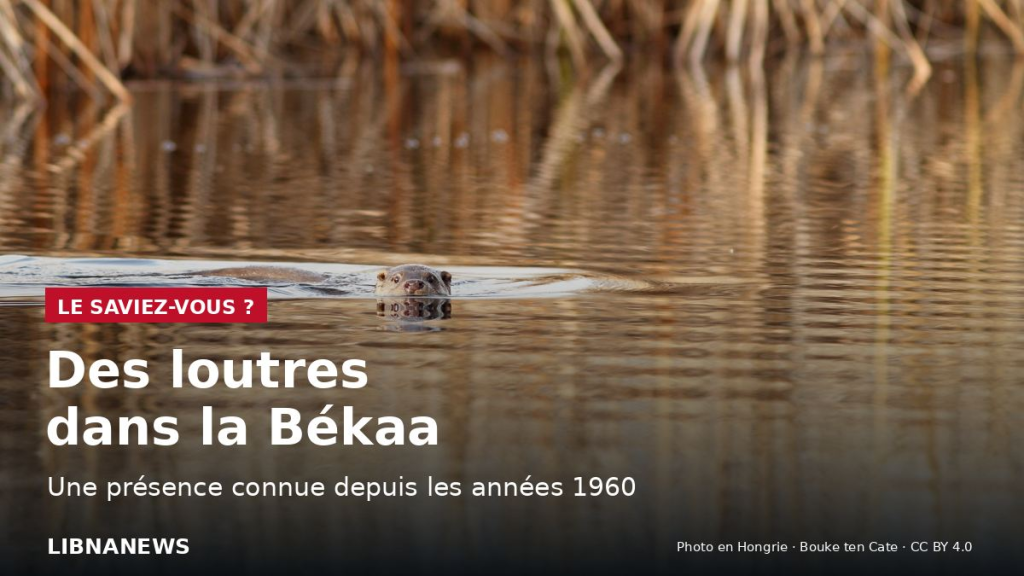
In Aammiq and Anjar, observations date back to the 1960s and 1970s. Videos and then a photographic trap documented the presence of the otter of Eurasia, without allowing to encrypt its population in Lebanon.
In the mid-2000s, restaurants from Anjar showed naturalists videos shot near their trout ponds. There were adult otters coming to get their food. For the owners, they were lost fish. For the Society for the Protection of Nature in Lebanon (SPNL), which was studying the wetlands of Anjar and Kafr Zabad, these images documented a mammal that researchers had rarely seen.
From Aammiq marshes to Anjar basins
In a study published in 2019, SPNL researchers trace a report of the otter of Eurasia in 1967 (Lutra lutra) in the marshes of Aammiq, western Bekaa. One of the authors, Ghassan Ramadan-Jaradi, relates his own observations between 1970 and 1972 when he banded birds at Aammiq and Anjar. He saw the otter in both sectors. In 2013, a photographic trap recorded one near a basin in the Anjar and Kafr Zabad areas.
These observations do not draw a continuous map of its presence. In 1971, the marshes of Aammiq and the stream feeding them were dry in summer. Naturalists have considered that otters have gained areas still in water through the Litani and its tributaries. Both wetlands are linked to the same hydrographic system, but no individual animals could confirm this route.
A filmed otter does not represent a whole population
Prospects in 2014 and 2015 found otters in Anjar without any clues in Aammiq. This contrast gives information about the sites visited on these dates. He does not say whether the otter had left Aammiq long ago or how many animals lived in the valley. Several prints may belong to the same individual; Conversely, the animal can travel on a bank without passing in front of the apparatus.
A study published inEnvironmental Conservation, which has combined field surveys and photographic traps in 17 Lebanese nature reserves, arrives at a comparable finding on another scale: the otter is one of the mammals detected in few sites. This work documents presences, not a national workforce or a demographic trend. The field pane completes the photographs by searching along defined routes for traces that the animal leaves after its passage.
Protecting the banks, without ignoring fish farmers
In Anjar and Kfar Zabad, SPNL worked with municipalities and residents in the framework of thehima, a method of protection based on local management. Among other things, the plan aimed to increase knowledge of the otter’s movements and reduce conflicts around fish. It associated shoreline protection with the management of source water and ponds. In the Bekaa, an otter can hunt in an arranged basin, but it does not replace the banks where it can shelter and circulate.
The videos of the restaurateurs and the observations of the naturalists thus clearly establish the presence of the otter of Eurasia in Lebanon. Whether it still uses both wetlands regularly and whether it reproduces there would require repeated and comparable surveys in Aammiq, Anjar and Kfar Zabad. The available studies do not provide this follow-up for the entire basin.
Coverage:Bouke ten Cate / Wikimedia Commons,CC BY 4.0. Photo taken in Hungary, framed and titled by Libnanews.






Comments