

Riad Seif, a textile manufacturer who became a member of parliament and later became a figure of Syrian dissent, died in Damascus on 25 November at the age of 80. His journey links three moments of the Syrian opposition: the Damascus Spring Forums, the Damascus Declaration and the formation of the National Coalition in Doha.
Clothing workshops in Parliament
Born in Damascus in 1946, Seif made a career in the clothing industry before entering politics. He was elected independent MP in 1994 and then in 1998, in particular interested in the conditions under which public contracts and mobile phone concessions were awarded. In an economic study published during his first term, he linked investment to the possibility of having an independent justice system. His position was then that of an elected candidate who challenged the executive’s economic decisions from within the institution.
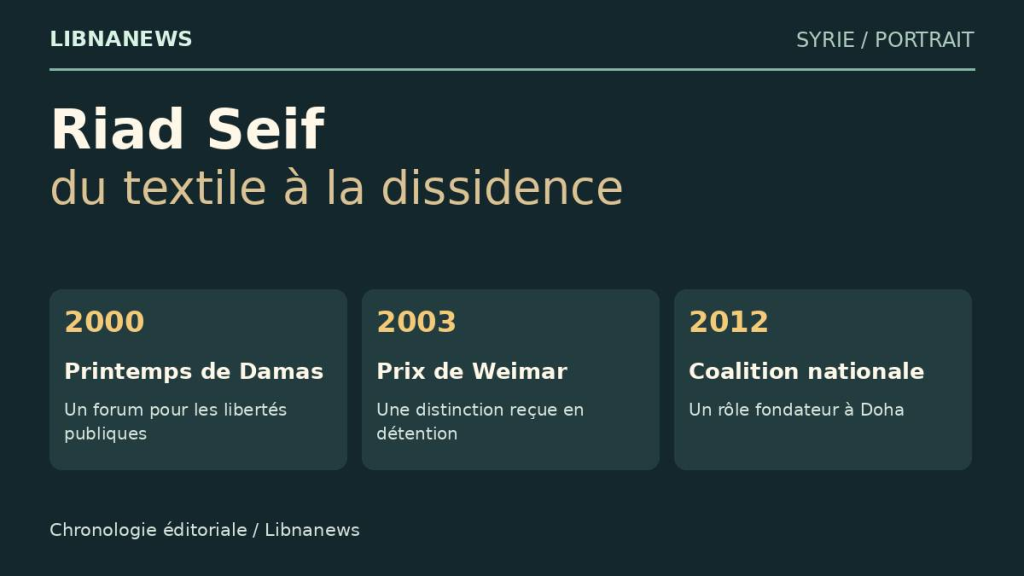
After the death of Hafez al-Assad in 2000, he hosted a forum on pluralism and public freedoms. These meetings took place in the spring of Damascus, a period of debate quickly interrupted by arrests. Amnesty International documented his referral to the courts in 2001. Seif was sentenced to five years in prison after challenging the Baas party’s political monopoly and announcing its intention to form another party. The city of Weimar awarded him his human rights prize in 2003 when he was imprisoned.
From public debate to opposition organisation
After his first release from prison, Seif continued his commitment to the Damascus Declaration, which brought together opposition movements in favour of democratic change. He was again incarcerated in the late 2000s. In May 2011, the German Commissioner for Human Rights confirmed his arrest in the context of the repression of demonstrations and presented him as one of the co-founders of the Damascus Declaration movement.
In Doha, in November 2012, several components of the opposition formed the National Coalition of Syrian Revolutionary and Opposition Forces. Seif contributed to its formation and was one of its Vice-Presidents, and then chaired it in 2017. The transition from forums held in Damascus to a coalition formed abroad reflects a major political change: while the former proposed opening a space for debate in Syria, the latter sought to represent forces opposed to the regime in the midst of war.
Returning to Damascus after the fall of Bashar al-Assad’s regime, he saw his memoirs published in November 2026. His trajectory is documented by the archives of his trials, contemporary statements about his arrests and the actions of the coalition. These pieces establish what he did and the consequences he suffered, beyond the tributes that followed the announcement of his death.





Comments