

Organize diaspora skills to support Lebanese diplomacy: this is the objective of a working paper published by the Civic Influence Hub and the Konrad Adenauer Foundation in Lebanon. Presented on November 4, 2026, this text by Joe Maalouf proposes to transform dispersed resources into coordinated instruments of external action.
The note is part of a programme on constitutional and multidisciplinary approaches to national security. It is available in Arabic and English. The measures outlined remain Joe Maalouf’s proposals: their presentation is not a government decision. The document also states that its positions do not necessarily involve the two bodies that publish it.
A strategy for Lebanese diplomacy and diaspora
The document defends a concept of security that goes beyond the military field alone. It combines diplomatic action with the economy, technology, communication and international partnerships. It establishes as a prerequisite the exclusive authority of the State and the unification of decisions of peace and war within the constitutional institutions.
Joe Maalouf believes that the problem is less about lack of resources than about their dispersion and weak institutional coordination. The diaspora is thus seen as a network of skills, relationships and influential capacities, the mobilization of which must be part of a coherent foreign policy.
The proposed strategy has five pillars: public diplomacy, diaspora diplomacy, international partnerships, economic diplomacy and national reputation management. The Department of Foreign Affairs and Migrants would ensure their strategic coordination.
Mapping skills and organizing dialogue
The note recommends a specialized mechanism for public diplomacy. It also offers a global mapping of skills and expat networks, as well as a secure digital strategic communication platform.
A global diaspora advisory board would complement this set, in coordination with the Lebanese World Cultural Union. The stated aim is to structure the relationship between institutions and Lebanese from abroad in a sustainable manner in order to involve them in the reflection on public policies and national interests.
An indicative roadmap without announced adoption
The complete note distinguishes three horizons. During the first 12 months, it offers an overview of diplomatic and expatriate networks and the creation of coordination tools. Between one and three years, the global advisory board and academic partnerships would take place in this organization. Between three and ten years, public diplomacy would be fully integrated into the national security strategy.
These periods are the author’s recommendations. They do not set a date for government launch or a legally enforceable deadline. The note makes this transformation conditional on State sovereignty and institutional reform. Its interest lies in the proposed organization; Its publication does not demonstrate that the structures described already have the means or are functioning.
Credit Line
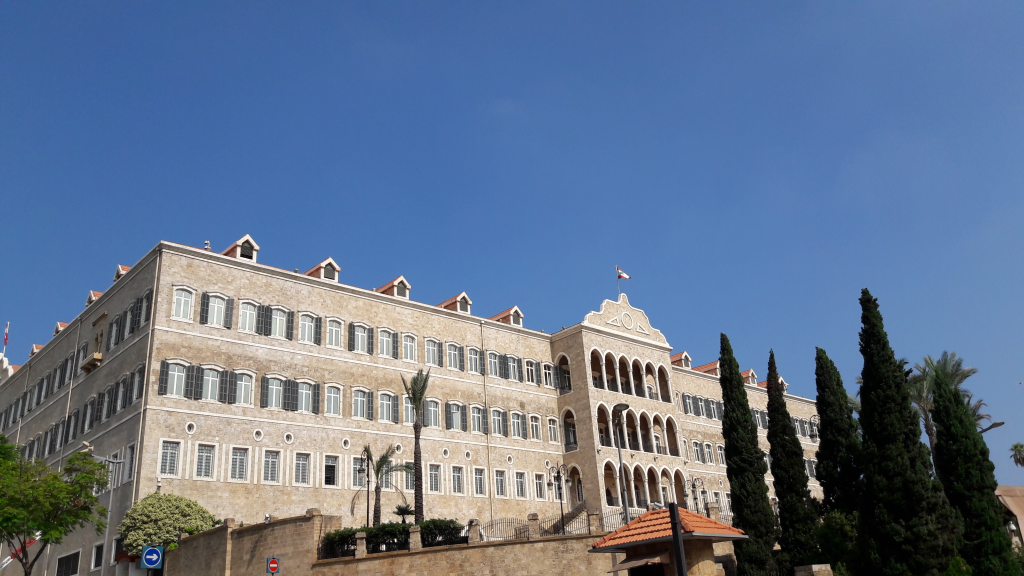
Le Grand Sérail in Beirut, photographed on August 12, 2017. Institutional illustration of archives, unrelated to a government adoption of the note. Photo: Pjposullivan1 / Wikimedia Commons, CC BY-SA 2.0. Photograph kept without modification. Original photograph. Photograph under CC BY-SA 2.0.






Comments