

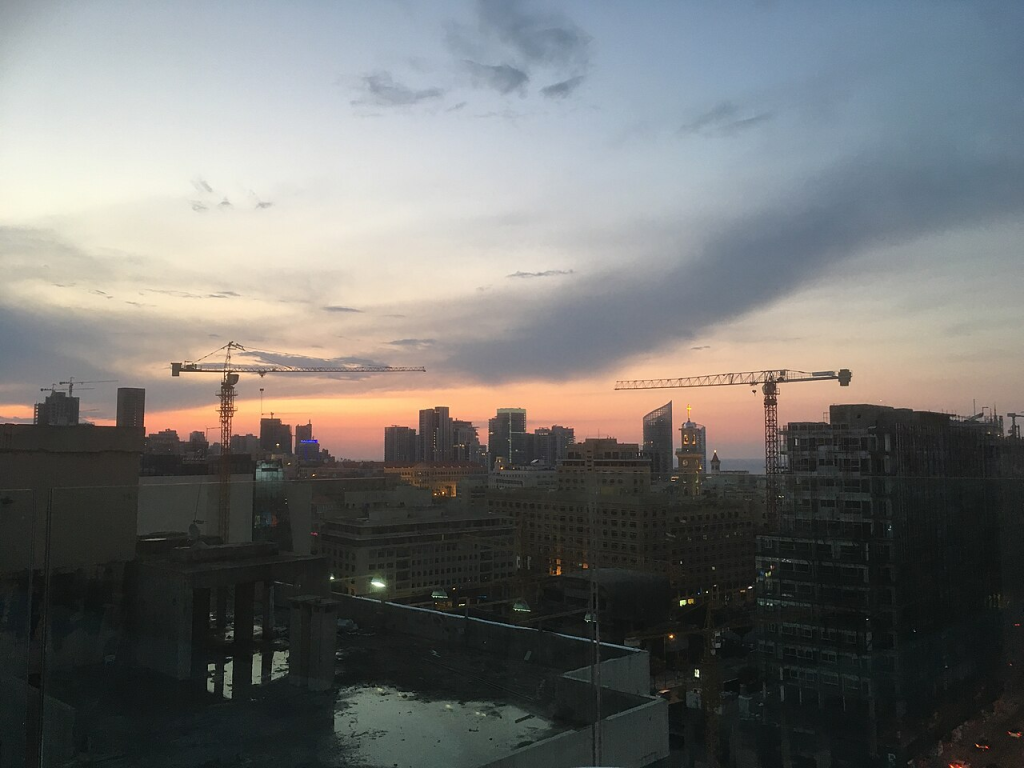
An equipped school, a hot water reception centre: solidarity between cities can be measured by very concrete services. A few days away from the national holiday, the International Association of Francophone Mayors (IAMF) is preparing « Solidarity Lebanon », a new mobilization for the benefit of Lebanese communities.
The launch was announced on 21 and 22 November 2026, for a campaign until 31 December. The proposed fund must support projects defined with the municipalities: schools, health, public services and reception of displaced persons. Municipal contributions, solidarity events and participation of companies or the diaspora are planned.
In particular, the preparation led to a mission to Beirut from 14 to 17 October, led by Fatimetou Abdel Malick, President of the Nouakchott region and Acting President of AIMF, with representatives from Paris and Liège.
A collective decision taken in Namur
This approach extends the declaration adopted on 8 June 2026 in Namur by the Association Bureau. The mayors affirmed their support for their Lebanese counterparts and proposed an exceptional operation, backed by the emergency fund, to contribute to urban, social and economic reconstruction.
The text did not separate this aid from the protection of the inhabitants. It called for the cessation of hostilities, respect for humanitarian law and international support for reconstruction. Signatory communities intended to play their part in the restoration of infrastructure and dialogue initiatives. It was a commitment to mobilize resources, not a record of achievements already completed.
In Jounieh, a precedent we can follow
The interest of this cooperation appears in an earlier programme. On 20 December 2024, AIMF presented work with the Federation of Municipalities of Kesrouan-Ftouh: equipping schools and places for displaced persons in the Jounieh region with solar equipment. In particular, electricity was to be used for heating and water supply.
Twenty-one institutions had been identified as priorities. Nine then had funding. This difference is important: an identified need does not mean that a facility has been paid, much less that it already works. Monitoring over time makes it possible not to confuse these steps.
Nine equipped sites, according to the March 2025 balance sheet
The report published by AIMF on 24 March 2025 brings the following stage: nine sites had received solar equipment, six schools and three religious establishments. The association indicated that they welcomed 500 displaced persons. This figure describes the situation reported on that date, not the number of occupants in November 2026.
The emergency fund had been mobilized as early as November 2024. Lausanne, Geneva, Nyon, Port-Louis, Woluwe-Saint-Lambert and Quartiers-sub-Poissy were among the contributors, alongside the National Federation of Urban Planning and Electricity Agencies of Metz.
The panels and water heaters met immediate needs. According to the association, they also had to make establishments less dependent on changes in the cost of electricity. No actual measured savings are reported here. The follow-up visit of Frédéric Vallier, General Delegate of AIMF, was part of the activities organized in Jounieh around 20 March 2025.
Transforming engagement into sustainable services
Jounieh’s precedent gives a useful point of comparison for the next campaign, but does not prejudge its result. In order to assess such an action, it is necessary to be able to distinguish the pledged contributions from the funds received, and then the selected projects from the equipment actually delivered.
It is on this scale that mutual aid becomes tangible for the inhabitants: not by the number of partners combined, but by the continuity of a service. The challenge of « Solidarity Lebanon » will be to transform an international mobilisation into local achievements whose effects the municipalities and their users can see.





Comments