

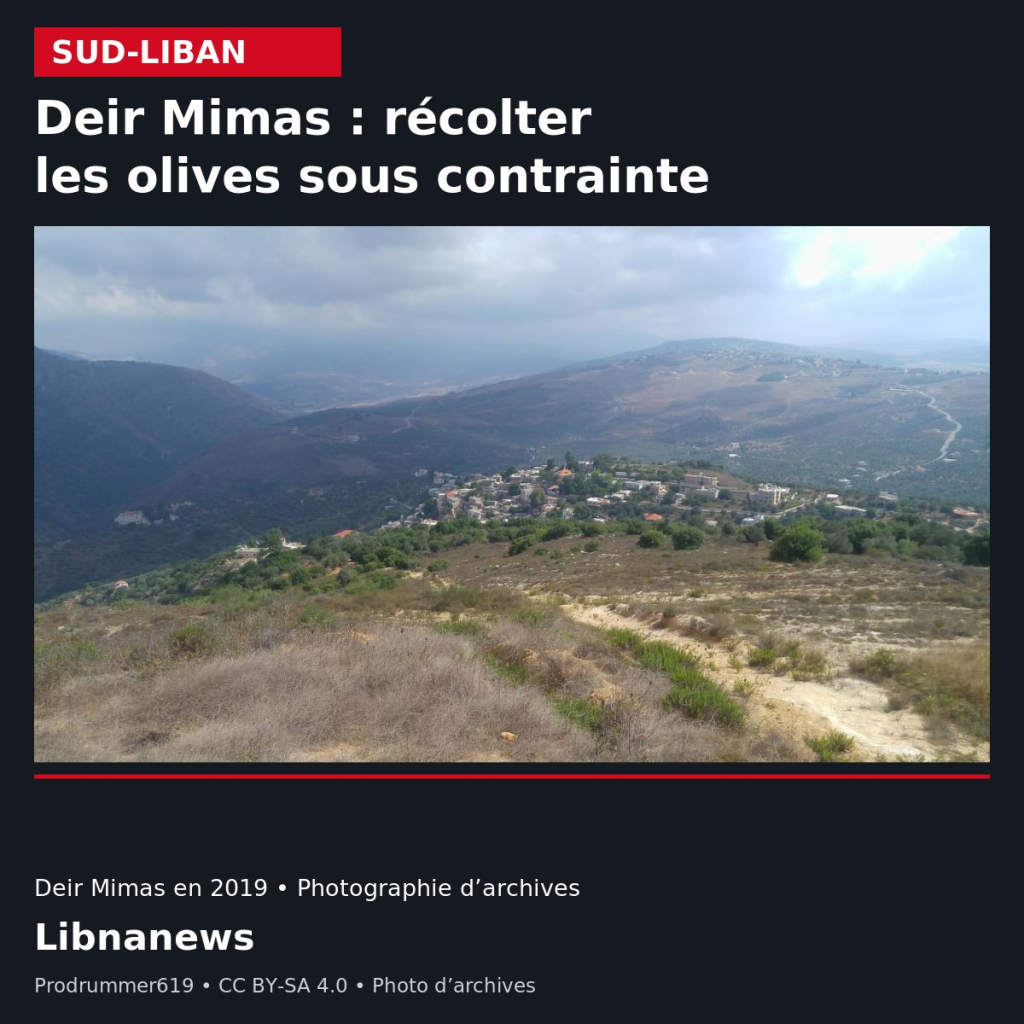
In Deir Mimas, the olive harvest hit another Israeli military intervention on Friday, 6 November. A patrol advanced from Kfar Kila to the outskirts of the town and opened fire in the area where the inhabitants were collecting, forcing them to leave the area, according to the consistent accounts of the incident.
A resident was also arrested and taken to an unspecified destination, according to the information reported that day. Its fate is not confirmed in the items consulted. No human balance can be added to this episode solely on the basis of the reported shootings around farmers.
In Deir Mimas, access to olive trees remains decisive
The facts described have an immediate consequence: people who came to harvest had to stop their work. The patrol then positioned itself near the locality. Security information also reports entry and exit restrictions.
The narrative does not determine the duration of the interruption or the number of parcels involved. Nor does it give the volume of olives that could not be collected. These limits prevent the incident from being converted into a loss estimate for Deir Mimas as a whole.
The difficulty, however, is concrete. Before transporting to a press or selling oil, you must be able to reach the trees and stay there long enough to work. The control of access to land thus acts directly on the course of the harvest, regardless of the state of the agricultural equipment.
Authorisations do not guarantee continuity
Farmers from several border localities have been describing for several weeks coordination approaches to join their olive groves. In Deir Mimas, a resident questioned about these procedures refers to information on participants, vehicles and parcels. His testimony describes the formalities encountered, without constituting a general rule applicable to the whole South.
The existence of an access approach is not a sustainable guarantee of harvesting. The incident of 6 November shows the possible gap between an agricultural work project and the conditions encountered on the spot. A distinction must be made between the preparation of an exit, the possible authorisation and the actual course of the day.
The information does not make it possible to determine whether the farmers concerned had completed any particular formalities before this episode. It would therefore be unjustified to grant them a prior agreement or a lack of authorisation. The reported fact remains their forced departure after shooting in their environment.
Return to land measures at work
The return to a locality and the resumption of agricultural activity are two different stages. A family can return to their home without having regular access to their plots. She may also be able to enter the village one day and then meet new restrictions the next day.
To assess the effects of the incident, it will be necessary to know the opportunities for access found, the fate of the resident arrested and the consequences described by the operators. Harvest and income figures are not available at this stage.
In Deir Mimas, the immediate question therefore remains that of the work actually possible. Commitments on safety and economic recovery only make sense for olive growers when they can reach their trees, finish harvesting and return safely.





Comments