






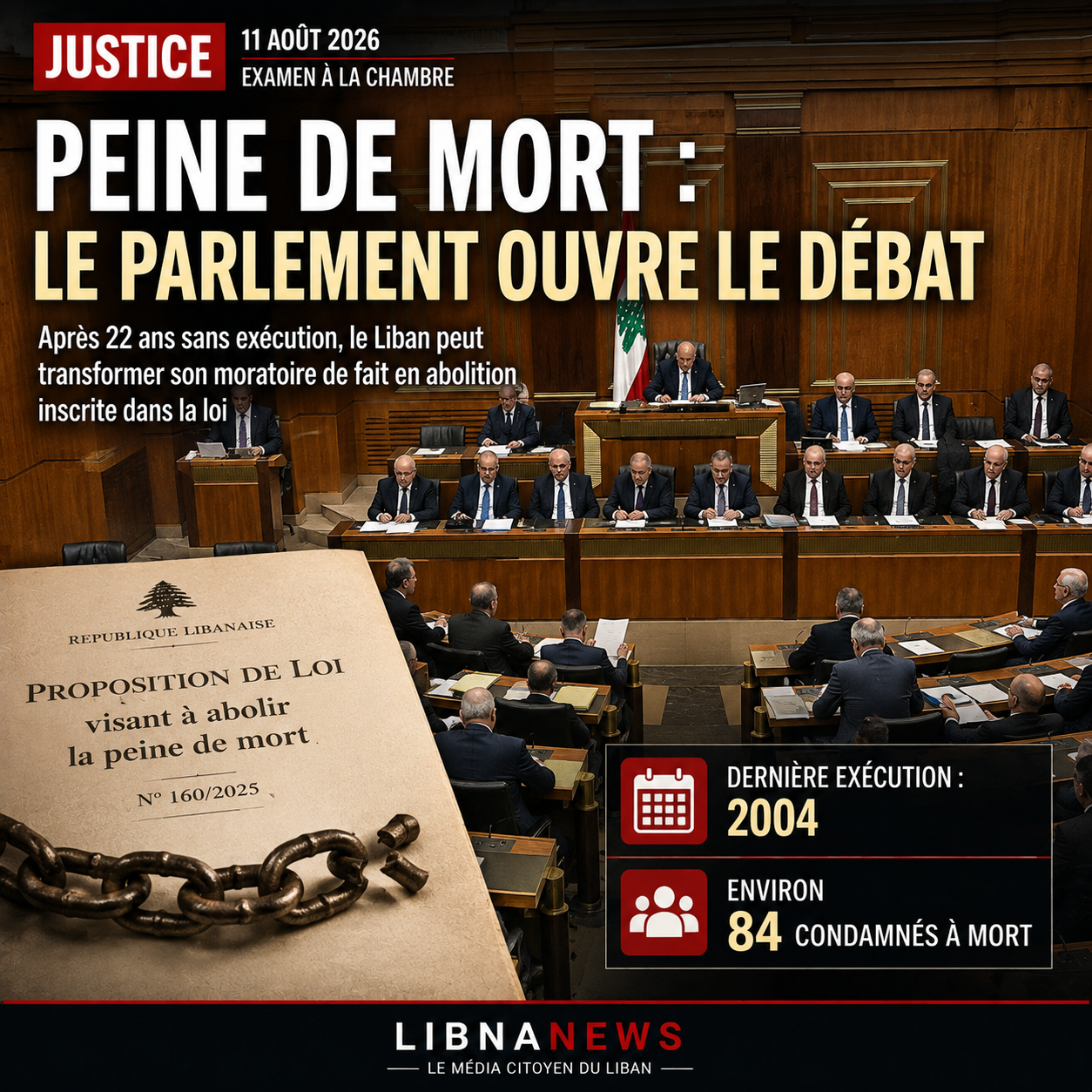
The House of Representatives began its consideration of the bill to abolish the death penalty in Lebanon on Tuesday, 11 August 2026 in Beirut. The text, which is at the top of the agenda of the legislative session convened by the Speaker of Parliament, Nabih Berri, aims to abolish capital punishment wherever it appears in Lebanese legislation and to organize the fate of convictions already handed down. Its examination comes after several months of committee work and after a first missed appointment in July, when the loss of quorum prevented the vote. The stakes are both legal and political: Lebanon has not carried out any executions since 2004, but its courts can still condemn to death. An adoption would therefore move the country from a de facto moratorium to an abolition enshrined in the law.
A reform at the top of the agenda
The choice to place the abolition of the death penalty among the first texts examined is not insignificant. The session on 11 and 12 August brought together several sensitive issues, including the Media Act and the general amnesty. In July, the chain of conflicting debates had contributed to the loss of quorum before Members could rule on the death penalty. This time, the Presidency of the Chamber seeks to prevent the text from once again being subject to a procedural blockage. The debate should therefore allow Members to decide on a matter which has already been largely prepared in committee.
The proposal does not come before the House without prior work. The Parliamentary Commission on Human Rights approved the principle of abolition in February 2026, and the Commission on Administration and Justice examined the mechanism and its consequences for criminal law. On 9 July, joint parliamentary committees approved a joint version and forwarded it to the General Assembly. This step has given the text a broader political basis, but it is not a final adoption. Only a vote of the House may amend the legislation in force.
What the abolition proposal provides for
The text under consideration was not limited to suspending executions, since that suspension had already existed in practice for more than two decades. It aims to abolish the death penalty wherever it is mentioned in Lebanese laws. The wording was important because capital punishment was not included in a single article. It appears in several provisions of the Criminal Code, the Code of Military Justice and other repressive legislation. The aim is therefore to withdraw the sanction from the entire legal arsenal, and not only to reduce the number of crimes to which it can apply.
The 2025 proposal provided for capital punishment to be replaced by the most severe sentence in the sanctions range. The work of the commissions then clarified the alternative penalty. In the version approved on 9 July, the death penalty must be replaced by life imprisonment with aggravated forced labour. This makes it possible to maintain an extremely heavy penalty for the most serious crimes while abolishing execution. It is also one of the main issues still under discussion, with some human rights institutions calling for forced labour to be removed from legislation.
Death row prisoners would remain detained
Abolition would not mean the release of those currently sentenced to death. On the contrary, the text provides that convictions already handed down shall benefit from the new legal regime and shall be transformed in accordance with the alternative penalty adopted. The subject is particularly sensitive in the public debate, as consideration of abolition takes place at the same time as discussions on general amnesty and the reduction of certain sentences. These files may concern inmates, but they meet different legal logics. Abolishing the death penalty does not mean removing a sentence or granting an amnesty.
According to data published by specialized organizations during the summer of 2026, approximately 84 people are sentenced to death in Lebanon. This figure can change with court decisions, appeals and sentencing changes. For these detainees, the immediate effect of the reform would be the disappearance of the legal threat of execution and the conversion of their sentences according to the new provisions. Their prison situation would, however, remain governed by the rules applicable to long sentences. The scope of the reform therefore lies in the nature of the sanction, not in automatic release.
Twenty-two years without execution in Lebanon
The last execution in Lebanon was in January 2004. Since then, no convicted persons have been executed, even though civilian and military courts have continued to impose death sentences. The country has thus lived for twenty-two years with a lasting contradiction between written law and State practice. The death penalty remains available to judges in some cases, but the executive has not implemented the necessary procedures to enforce these convictions. This is generally described as a de facto moratorium.
The reform discussed on 11 August is aimed precisely at closing this gap. As long as capital punishment remains in the codes, a change in policy could theoretically allow for a resumption of executions without prior reform of criminal law. Abolition would remove this possibility and oblige the State to punish the most serious crimes with other penalties. The parliamentary vote would therefore not create a break with the practice followed since 2004; It would provide a permanent legal basis for an approach already observed for more than two decades.
A parliamentary initiative launched in 2025
The proposal currently under consideration was tabled in Parliament on 7 October 2025 and registered as 160/2025. It was prepared by the Lebanese Organisation for Civil Rights and supported by seven deputies from several political sensitivities: Elias Hankach, Osama Saad, Paula Yacoubian, Georges Okais, Fayçal Sayegh, Halima Kaakour and Michel Doueihi. This diversity allowed the project not to be identified with a single parliamentary bloc. It has also facilitated its passage before several committees, where the principle of abolition has received sufficient support to continue its legislative process.
The 2025 text, however, is part of a longer history. Proposals to abolish the death penalty had already been put forward in Lebanon over the past two decades. In 2004, several MPs had pleaded for his replacement with life imprisonment. In 2008, the then Minister of Justice, Ibrahim Najjar, also carried out a draft abolition. These initiatives had not resulted in a definitive amendment of the law, despite the continuation of the moratorium on executions.
Why reform is coming back now
The context of 2026 differs from that of previous attempts. The moratorium is no longer a recent or fragile decision: it has lasted for more than 20 years and has gone through several governments, presidencies and political crises. At the same time, Lebanon has supported UN resolutions calling for a global moratorium on executions. The proposal also benefited from a more advanced technical review than several previous projects. The Department of Justice participated in the work, while the commissions sought to resolve in advance the consequences of abolition on existing legislation.
This accumulation does not guarantee the vote, but it changes the nature of the debate. Members no longer discuss only the theoretical opportunity to abolish capital punishment. They have a text detailing its replacement, the treatment of previous convictions and the articles to be deleted or amended. The question has thus become concrete: what punishment should replace death, how to treat the current convicts and how far should we go in reforming the penal system?
The debate on forced labour
One of the most difficult issues is the « aggravated forced labour » formula. It was retained in the Commission version to maintain a high level of sanction. For the promoters of this compromise, the aim is to prevent abolition from being interpreted as an excessive reduction in the criminal response to particularly serious crimes. Life must thus remain a reference penalty for the facts which today can lead to a death sentence.
The National Human Rights Commission, however, called for the reform not to stop the abolition of the death penalty. She believes that forced labour also poses difficulties with regard to contemporary human rights protection standards. This reservation does not necessarily call into question the principle of abolition, but it opens a second stage. Parliament may choose to adopt the text in its current form, amend the alternative sentence during the debate or refer certain issues to a subsequent reform of the Penal Code.
Families of victims at the heart of the discussions
The rights of victims and their relatives are central to the reservations expressed around the text. For some families facing a particularly violent murder, attack or crime, the removal of the maximum penalty can be seen as a reduction of the penalty. This concern is reinforced by the proximity of the debate on the general amnesty, which feeds the fear of a wider relaxation of the penal regime. Parliament must therefore clearly distinguish between the effects of each reform in order to avoid several cases being confused.
The abolition of the death penalty, however, does not eliminate either conviction or criminal responsibility. An author found guilty would continue to be liable to a very long sentence or even to life imprisonment according to the qualification. The debate concerns the right of the State to kill a convicted person, not the existence of a sanction. This distinction is essential to understand the logic of the text discussed in Beirut. It also explains why MEPs are at the same time discussing the conditions for reducing sentences and the guarantees given to victims’ families.
Judicial error, a central argument
Supporters of abolition also emphasize the irreversible nature of execution. A court decision may be challenged, revised or set aside when a new element appears. An unjustly imposed prison sentence may, at least in part, be corrected by release or reparation. An execution does not allow any correction. This argument is of particular importance in a judicial system where proceedings can be lengthy and where questions of judicial independence, conditions of interrogation and access to an effective defence remain regularly debated.
For the advocates of the text, the very existence of a risk of error is sufficient to justify the abandonment of an irreversible sanction. Supporters of the continued imposition of capital punishment generally respond that the most serious crimes warrant exceptional punishment and that the strengthening of judicial safeguards should help to limit errors. The debate thus contrasts two conceptions of punishment: one considers that the State must never permanently withdraw life; The other considers that certain infringements may justify the continuation of this possibility.
A religious and political dimension
In Lebanon, the issue also has a religious dimension. The political system is based on religious balances, and not all parties share the same reading of the foundations of punishment. Some reservations expressed during the parliamentary debates are linked to religious views of punishment and the right of victims. Others are purely political or legal. It would therefore be reducing to present the file as a simple opposition between denominational blocks.
The transparency of the proposal also shows that the fracture lines do not exactly follow those of the usual political alliances. Members of the House of Commons of very different backgrounds supported the tabling of the text, while reservations sometimes focused more on its modalities than on its principle. The vote in plenary will help to assess whether this ad hoc parliamentary coalition can withstand the tensions raised by the other dossiers of the session.
Previous postponement caused by loss of quorum
The memory of the July session remains crucial. The House was already to discuss abolition, but the loss of quorum prevented consideration of the text. The departure of Lebanese Forces deputies had taken place in a context of disagreement over the general amnesty. The episode illustrated the vulnerability of the parliamentary calendar: a text can be consensual or advanced in committee and remain blocked by a conflict on another issue.
The return of abolition to the top of the agenda aims to reduce this risk. Nabih Berri convened two days of discussions to give more time for consideration of proposals. Parliament must nevertheless retain the number of Members required to vote. As long as the latter has not intervened, it is therefore impossible to regard abolition as acquired. Opening the discussion is a major step, but it is not yet the final decision.
What adoption would change in the courts
If the proposal is adopted and enters into force, judges will no longer be able to impose the death penalty on the basis of the provisions deleted. The crimes concerned will continue to be prosecuted, but the maximum penalty will be that defined by the new law. The procedural rules governing the execution of a capital sentence will also have to disappear or become irrelevant. The reform would have an immediate effect on the entire criminal chain, from the delivery of the judgement to the execution of the sentence.
The change would also concern cases already tried. Persons sentenced to death before the entry into force of the law should be given the new penalty provided for by the law. This favourable retroactivity is consistent with the principle that softer criminal law can benefit already convicted persons. Parliament must, however, set out precisely how this conversion will be applied in order to avoid divergent interpretations between courts.
Development consistent with Lebanon’s international position
At the diplomatic level, Lebanon has already moved closer to the abolitionist camp. It voted in favour of UN General Assembly resolutions calling for a moratorium on executions in 2020, 2022 and 2024. This position does not mean abolition in domestic law, but it reflects a change in official policy. The parliamentary vote would bring domestic legislation closer to Beirut’s positions in international forums.
However, the country has not completed this route. It had not ratified the Second Optional Protocol to the International Covenant on Civil and Political Rights, an instrument devoted to the abolition of the death penalty. An adoption by the House would therefore not resolve all international issues related to the subject. However, it could open a further debate on Lebanon’s accession to more binding commitments.
Special scope in the Middle East
An abolition contained in the law would also be regional in scope. Capital punishment remains a feature of the legislation and practice of several States in the Middle East. Some countries still regularly carry out executions, while others have more or less lasting moratoriums. Lebanon would stand out by transforming an old moratorium into a complete abolition of capital punishment into domestic law.
However, this regional dimension should not mask the specific reasons of the Lebanese case. The process is the result of a debate that has taken place for several decades, a moratorium that has lasted since 2004 and a succession of parliamentary proposals. The 2026 vote would therefore be less a sudden break-up than a possible result of slow change. Parliament must now decide whether this development should be included in the codes or should remain a reversible practice.
The vote remains the decisive step
As of 11 August 2026, the death penalty remains legally in force in Lebanon. The opening of the parliamentary debate should therefore not be confused with its definitive abolition. MEPs still have to consider the text, its amendments and the alternative penalty, and then proceed to the vote. The constitutional procedure will then have to proceed before the reform comes into force. As long as these steps are not completed, the courts retain the possibility of imposing capital sentences in cases provided for by law.
The opening session in Beirut nevertheless places Parliament before a decision which it has repeatedly postponed over the last twenty years. After twenty-two years without execution, the debate no longer concerns the establishment of a moratorium, since it already exists in practice. It concerns its transformation into an irreversible rule for ordinary and military courts. The maintenance of a quorum, the fate of the amendments and the final choice of the alternative sentence will now determine whether the House is going through this stage during the session on 11 and 12 August.