





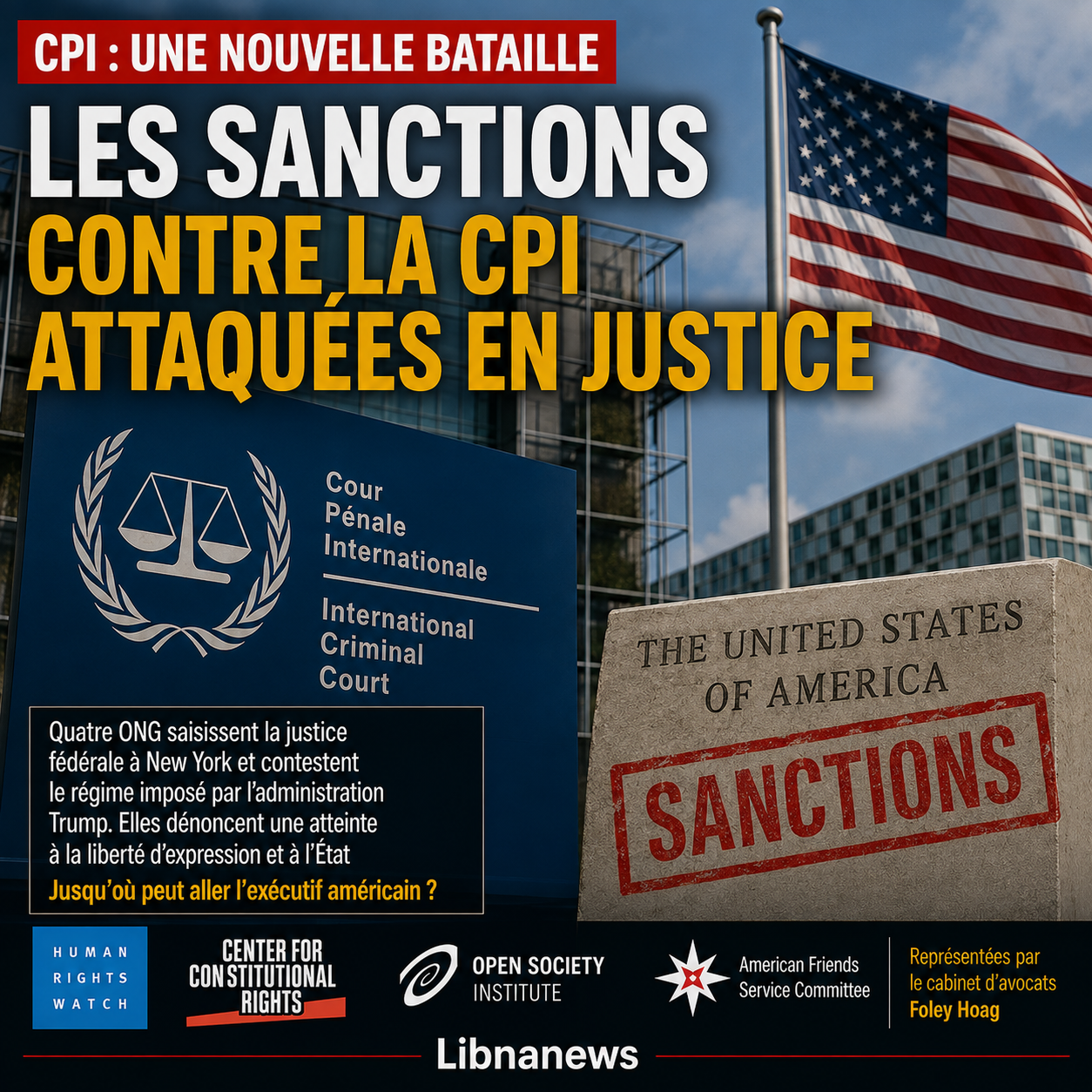
On Tuesday, August 11, 2026, four human rights organizations seized the US federal justice to challenge the sanctions regime imposed by Donald Trump’s administration against officials and partners of the International Criminal Court. Human Rights Watch, the Center for Constitutional Rights, the Open Society Institute and the American Friends Service Committee are asking a New York court to suspend and then invalidate a measure that they consider to be contrary to the American Constitution and superior to the powers granted to the president. Their complaint therefore not only concerns Washington’s foreign policy towards the ICC: it directly attacks the legality of the means used by the executive to prevent American actors from working with the Hague jurisdiction.
The appeal is aimed at Donald Trump, but also at several federal enforcement agencies. The departments of State, Treasury and Justice are concerned, as are their respective heads. The Office of Foreign Assets Control, OFAC, which administers US economic sanctions, is also among the respondents. The complainants claim that the current regime prevents them from normally pursuing legal representation, research, documentation of international crimes and cooperation with the ICC.
An appeal against the entire system
The complaint was filed with the Federal Court of the South District of New York. The four organizations do not simply request an exemption for their own activities. They seek to undermine the mechanism put in place by the presidential decree signed by Donald Trump on 6 February 2025.
This decree authorizes the United States administration to punish persons considered to have participated in certain investigations or proceedings of the International Criminal Court against United States nationals or officials of allied countries. It also makes it possible to punish those who provide material, financial or professional support to persons already affected.
The mechanism may result in the freezing of assets subject to US jurisdiction and the prohibition of certain transactions. It can also prevent sanctioned persons from entering the United States. In practice, its effects go far beyond those listed by OFAC.
The applicant organisations explain that an American actor may be exposed to legal risks if he or she provides certain services to a sanctioned person. This concept of « services » is one of the central points of the complaint, since it can cover advisory, legal representation, research, training or professional cooperation activities.
Up to 20 years in prison for certain violations
The particularly disincentive of the scheme comes from the sanctions provided for in US legislation. Certain voluntary violations of the restrictions imposed under the emergency economic powers can be punished with heavy fines and up to 20 years in prison.
This does not mean that any relationship with the International Criminal Court is automatically subject to twenty years ‘ imprisonment. The maximum penalty concerns voluntary criminal violations of the applicable prohibitions. The qualification therefore depends on the nature of the activity, the person with whom it is conducted and any rules or licences issued by the administration.
For the four organizations, however, this distinction is not enough to eliminate the problem. The potential legal risk is significant enough to induce lawyers, researchers and associations to interrupt certain collaborations. They argue that the threat of sanctions already has a concrete effect even before a prosecution is initiated.
It is precisely this deterrent effect that feeds their constitutional arguments. They believe that an organization should not have to choose between exercising an activity protected by the Constitution and running the risk of being pursued under a sanctions regime whose limits, in their view, remain insufficiently precise.
Trump accused of creating a « national pseudo-emergency »
The first major focus of the complaint concerns the legal basis chosen by Donald Trump. In particular, the Administration is guided by the International Emergency Economic Powers Act, which allows the President to use exceptional economic powers when an unusual and extraordinary threat from abroad affects the national security, foreign policy or economy of the United States.
Donald Trump considered that certain actions of the ICC met these criteria. Its decree presents proceedings initiated by the Court against US nationals or officials of allied countries as a threat to US sovereignty and Washington’s foreign policy.
The four organizations specifically challenge this qualification. They speak of a « national pseudo emergency », i.e. an artificial national emergency or without a sufficient factual basis. In their view, the activity of an international court established by treaty does not in itself constitute the type of threat that Congress had in mind when it granted the President emergency economic powers.
That is essential. If the court accepts their reasoning, it may consider Donald Trump to have used an exception law to deal with political and legal disagreement with an international institution. The problem would then far exceed the ICC alone.
The first amendment at the heart of the complaint
The organisations also invoke the First Amendment of the American Constitution, which protects freedom of expression and freedom of association. They believe that sanctions restrict their ability to communicate, advise, train or work with certain individuals related to the ICC.
The difficulty is that the activities concerned are not only financial. A lawyer who advises a victim or prepares a case for a court carries out a professional activity, but also a form of protected expression. The same applies to a researcher who submits a report, an academic who provides expertise or an organization that documents violations.
The complainants argue that the current regime turns this type of activity into potentially prohibited services when it benefits a sanctioned person. They consider that this restriction goes far too far and directly affects activities protected by the First Amendment.
The American Friends Service Committee adds a particular dimension. The Quaker organization believes that its commitment to peace, justice and the protection of victims is also religious. It considers that the sanctions affect the performance of this mission.
Fifth amendment raised against vague rules
The second major constitutional argument is based on the Fifth Amendment and respect for procedural guarantees. Organisations blame the system for being too vague about the activities actually prohibited.
The word « services » is again at the centre of the problem. A U.S. company cannot provide certain services to a sanctioned person, but the boundary between prohibited professional activity and protected expression can become difficult to identify.
For the complainants, this uncertainty is particularly serious given the level of penalties incurred. A rule that may lead to criminal proceedings must allow those subject to it to know clearly what they can or cannot do.
The four organizations claim that this clarity is lacking in the ICC mechanism. They argue that they are forced to abandon certain activities on a cautious basis, even though they consider them perfectly legal.
Activities to defend victims already interrupted
The complaint also seeks to demonstrate that injury is not theoretical. The four organizations describe activities that they should have modified, suspended or abandoned as a result of the sanctions.
These include representation of victims of war crimes and crimes against humanity, preparation of legal files, transmission of information to the ICC and cooperation with local organizations that document violations.
Research work is also concerned. Human Rights Watch and other human rights actors regularly produce reports that can be used by international courts or their prosecutors. When some persons within these institutions are sanctioned, the issue of transmission of documents or analyses becomes legally sensitive.
Public campaigns and advocacy can also be affected. An organization that organizes an event with a sanctioned magistrate, participates in training or prepares a joint activity may have to check whether such cooperation falls within the scope of prohibitions.
For the applicants, the result is clear: the U.S. regime not only punishes the individuals concerned. It gradually isolates the Court by deterring other actors from working with it.
The ICC officials directly involved
Since Donald Trump returned to the White House, several officials of the International Criminal Court have been struck by American sanctions. Judges and members of the prosecutor ‘ s office are among the persons concerned.
The conflict has gradually expanded to include external partners of the Court. Palestinian human rights organizations have also been targeted because of their cooperation with international judicial mechanisms.
This extension is important to understand the appeal filed in New York. American organizations are not necessarily themselves subject to sanctions. But they may find themselves prevented from working with people or associations that are.
The system therefore creates a chain effect. A penalty against a magistrate in The Hague may assign a lawyer in New York, a researcher in Washington or an American association working with victims in the Middle East.
Gaza at the centre of the conflict between Washington and the ICC
The escalation between Donald Trump and the International Criminal Court finds much of its origin in proceedings related to the war in Gaza. In November 2024, the ICC issued arrest warrants against Israeli Prime Minister Benjamin Netanyahu and former Defence Minister Yoav Gallant.
Washington strongly challenged these decisions. The Trump administration considers that the ICC has no legitimate jurisdiction to prosecute Israeli leaders, as Israel is not a party to the Rome Statute.
The Court considers a different analysis. It considers that jurisdiction may arise, inter alia, from the territory in which the alleged crimes were committed. As Palestine is a party to the Rome Statute, the ICC believes that it has a legal basis for certain proceedings relating to the Palestinian territories.
This legal disagreement became a major political conflict when the US administration chose economic sanctions to respond to the Court’s decisions.
However, the New York court seized on 11 August did not have to determine whether the ICC was right or wrong to issue arrest warrants against Israeli officials. Its task is different: it will have to consider whether the US President can use the economic emergency powers in this way and whether their application respects the constitutional rights of American organizations.
Washington has never ratified the Rome Statute
The American position is also part of an ancient and complex relationship with the International Criminal Court. The United States signed the Rome Statute at the end of the Clinton administration, but never ratified it. They are therefore not members of the ICC.
Washington has regularly expressed concern that US military or officials may be prosecuted by international jurisdiction without the consent of the United States. This mistrust has gone through several administrations, with varying degrees of hostility or cooperation.
The relationship has never been entirely negative. The United States has sometimes supported some ICC investigations when they were consistent with its foreign policy objectives. The situations in Darfur, Libya or Ukraine have shown that Washington may consider the Court useful in some cases while challenging its jurisdiction in others.
This contradiction today fuels the debate. US sanctions target people who can work simultaneously on several investigations, including some that Washington politically supports.
The precedent of Trump’s first term
Donald Trump had already faced the ICC during his first term. In 2020, her administration had imposed sanctions against prosecutor Fatou Bensouda and another senior official of her office.
At the time, the Court was investigating, inter alia, alleged crimes committed in Afghanistan. The sanctions had led to a strong controversy among American lawyers and human rights defenders.
At that time, academics and lawyers seized the courts, claiming that the measures prevented them from continuing to work with the prosecutor’s office. A federal judge had found that their arguments regarding the First Amendment were likely to prevail and had limited the application of certain measures.
The Biden administration then lifted the sanctions in 2021, which ended part of the litigation. Donald Trump’s return to power in 2025 reopened the case with an even broader regime.
This precedent today weighs on the new procedure. It shows that the US courts have already agreed to examine the effects of the ICC sanctions on the freedom of expression of United States actors.
Another setback after Trump’s return
The Trump administration also faced new legal difficulties after the adoption of the 2025 decree. American academics had challenged the restrictions that prevented them from working with Karim Khan and the ICC prosecutor’s office.
A federal court had granted them protection against certain applications of the regime, considering that their intellectual and professional activities could be subject to freedom of expression.
However, the new remedy is much more ambitious. The four organizations do not only wish to protect some specific activities. They ask the court to challenge the very architecture of the scheme.
The judicial battle should therefore focus as much on constitutional rights as on the limits of the delegation of authority granted to the President with regard to international sanctions.
IEEPA at the centre of a broader debate on presidential powers
The use of the International Emergency Economic Powers Act goes beyond the ICC’s sole file. For several decades, US presidents have been using this law to respond to international crises, punish foreign governments or block assets.
Power is extremely broad. Once a national emergency is declared, the President may intervene in economic transactions subject to US jurisdiction and target foreign persons or entities.
The complainants do not necessarily dispute the existence of this power in general. They argue that Donald Trump applied it to a situation that does not meet the requirements of Congress.
The court may therefore need to determine how far a judge can examine the reality of the urgency invoked by the president. This issue directly affects the balance between the executive, Congress and the judiciary.
A case likely to go far beyond the Hague Court
The scope of the case thus goes beyond the conflict between Washington and the ICC. A decision in favour of organisations could limit the executive’s ability to use economic sanctions against research, legal aid or human rights activities.
It could also reinforce the administrative obligation to define precisely the prohibited activities when they affect constitutional freedoms.
A White House victory would have the opposite effect. It would strengthen the President’s power to declare a national emergency in a foreign policy conflict and then use economic sanctions to isolate the individuals and institutions concerned, including American actors.
The issue therefore raises a fundamental question about the extraterritoriality of the US financial power. When a person is sanctioned by Washington, the consequences do not stop at the borders of the United States. Banks, companies, NGOs and international partners can change their behaviour to avoid any risk.
The special weight of OFAC
The Office of Foreign Assets Control plays an essential role here. This Treasury Department agency administers most of the major US economic sanctions regimes.
Its power comes in particular from the place of the dollar and the US financial system in the world economy. An organization that is at risk of being sanctioned by OFAC may lose access to banks, providers and services essential to its operations.
This explains why US sanctions often have wider effects than the legal prohibitions themselves. Private actors may choose to cut off any relationship with a sanctioned person, even when a specific activity could theoretically remain authorised.
The four organizations describe this environment of extreme caution. They believe that the ICC regime encourages a form of over-compliance, in which partners and providers avoid any relationship with targeted individuals in order to eliminate any risk.
The court must divide national security and constitutional freedoms
The Trump administration should defend a broad conception of presidential foreign policy powers. It may argue that the President has traditionally had a significant margin of appreciation when he considers that external action threatens US interests.
The complainants will reply that this latitude does not permit circumvention of the Constitution. They want to show that the executive cannot use a foreign sanctions regime to remove within the United States activities protected by the First Amendment.
The debate will therefore be less simple than a confrontation between supporters and opponents of the ICC. Even a skeptical court against the Court might consider that certain restrictions imposed on American citizens go too far.
Conversely, a judge could recognize strong constitutional protection for U.S. organizations while leaving some of the sanctions against foreign officials intact.
A new stage in the ICC offensive
The filing of the August 11 complaint therefore transforms the nature of the conflict. So far, Donald Trump used primarily the US diplomatic and financial power against the International Criminal Court. He will now have to defend this strategy before a court of his own country.
The four organizations want a decision that will allow them to resume their activities without fear that a collaboration with an ICC official or a sanctioned organization will trigger an American procedure.
They also seek to prevent new designations based on the same decree. The issue is therefore both retrospective and preventive.
The next phase will depend on the responses submitted by the administration and any requests for interim measures. The court could be called upon to decide quickly if the complainants requested a partial suspension of the sanctions during the examination of the merits.
After judicial precedents already unfavourable to certain applications of sanctions against the ICC, the Trump administration will now have to defend a broader issue: not only the sanction of a prosecutor or judge, but the President’s right to use economic urgency to cut off an international jurisdiction from those who work with it in the United States.