





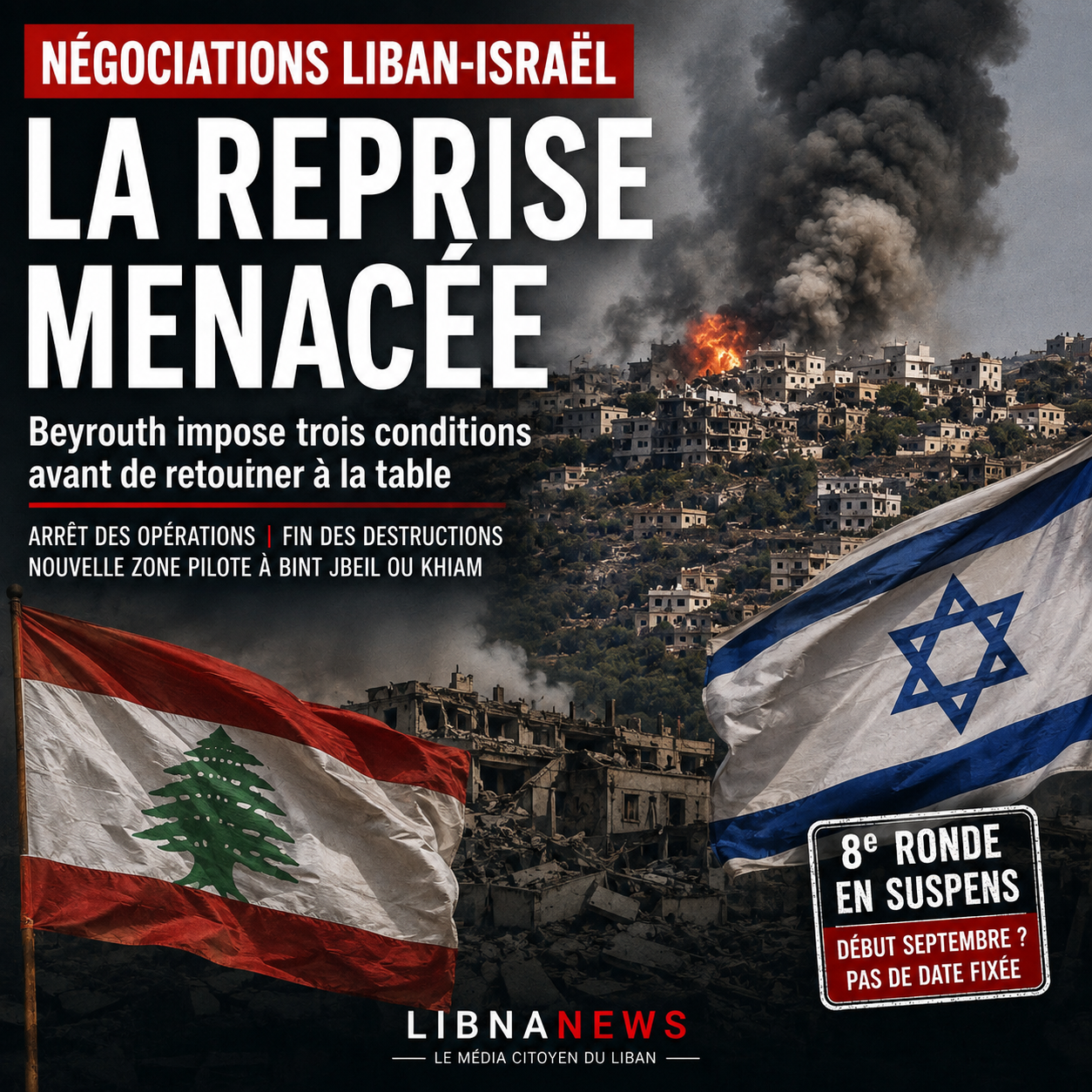
On 10 and 11 August 2026, Lebanon tightened the conditions for its participation in the next negotiating session with Israel, tentatively scheduled for early September under American mediation, following the failure of the seventh round held in Rome from 4 to 6 August. Beirut now calls for a complete halt to Israeli military operations, an end to the destruction of houses, neighbourhoods and agricultural land in the South, and the creation of a new « pilot zone » in Bint Jbeil or Khiam. This position comes as Israeli bombing continues and no further withdrawal has been obtained in Rome. The immediate consequence is uncertainty about the very holding of round eight: the discussions remain officially open, but Lebanon no longer wants to return to the table without prior concrete action on the ground.
Lebanon-Israel negotiations hit withdrawals
The next session was to extend a process started in the spring and then formalized by the Framework Agreement of 26 June 2026. This mechanism combines the gradual withdrawal of Israeli forces from parts of southern Lebanon, the deployment of the Lebanese army and an external verification to confirm the absence of Hezbollah military infrastructure in the sectors concerned. The scheme is based on « pilot zones »: Israel evacuates a perimeter, Lebanese forces take a position, and then a third verify the implementation of the commitments. The difficulty now lies in the order of the stages. Beirut believes that it has already accepted several guarantees requested by Israel. On the contrary, Israel considers that every withdrawal must depend on sufficiently robust security assurances.
In Rome, from 4 to 6 August, the Lebanese delegation wanted a new visible stage. She proposed Bint Jbeil or Khiam to become the next experimental zone. Israel has not retained either at this stage. However, the negotiators have made progress on another aspect: a limited list of countries that could contribute to the Hezbollah disarmament verification mechanism has been established. The United States still needs to choose which actors can participate in this arrangement. Lebanon has refused to entrust this mission to private security companies and favours States or an identified international structure.
This difference in results largely explains Lebanese hardening. The guarantees demanded by Israel are progressing in the discussions, but the withdrawal schedule remains uncertain. For Beirut, the risk is that the pilot zones will become a mechanism without a precise deadline rather than an instrument for gradually reducing the Israeli military presence. The government of Nawaf Salam and President Joseph Aoun must also politically defend the continuation of the process in Lebanon. Without further withdrawal and as the strikes continue, negotiation becomes more difficult to present as a way of producing concrete effects.
One last particularly tense day in Rome
The tension was particularly evident during the last day of the discussions in Rome. According to reports from the Lebanese press, the head of the Lebanese delegation, Simon Karam, had interrupted the discussions regarding what Beirut considered to be a blockade by the Israeli side. The meeting would have ended approximately two hours before the scheduled schedule. This episode did not end the negotiation channel, but it illustrated the growing gap between the expectations of both parties. Lebanon wanted a decision on a further withdrawal. Israel was first seeking to strengthen the verification mechanism and safeguards for Hezbollah weapons.
The bombardments have a direct impact on the recovery
The ground has aggravated this crisis of confidence. During the Rome round, two Israeli soldiers were killed in Majdal Zun in southern Lebanon during an explosion in an area where Israeli forces were operating. The exact circumstances were the subject of different versions and verifications. Israel then launched strikes in several sectors of the South, claiming to target Hezbollah infrastructure. The bombings accompanied the negotiations rather than diminished during the negotiations. For Beirut, this simultaneousity reduces the credibility of the diplomatic mechanism and feeds the demand for an end to operations before the next round.
The days following the meeting confirmed this tension. Strikes, explosions, ground operations, overflights and fires have been reported in several areas of southern Lebanon and western Bekaa. Operations have been reported in the Ali Al-Taher area. Benjamin Netanyahu said that Israel was conducting an important operation in Lebanon, while the Israeli army continued to assert that it was acting against Hezbollah’s positions or capabilities. However, not all information on the precise nature of the means used or the search for tunnels could be independently confirmed.
This military sequence is directly linked to the three requests now put forward by Beirut. The first concerns the complete cessation of military operations and firing. The second is aimed at ending the destruction of houses, neighbourhoods and agricultural land. The third concerns the actual creation of a new pilot area in Bint Jbeil or Khiam. These requests are not yet an official communiqué announcing the cessation of the talks. However, they reflect a desire not to dissociate the diplomatic calendar from security developments in the South.
A deferral that is not yet a breakdown
The grade is essential for the « postponement » of the next session. An eighth round remains to be seen in early September. A news agency had already indicated, after the Rome meeting, that negotiations would resume at that time. A file official also referred to the same schedule on 11 August. At the same time, press reports indicate a lack of a definitive date and Lebanese conditions to be met before any new participation. At this point, it is therefore more accurate to talk about a session that is put on hold or surrounded by uncertainty than by a formally announced cancellation.
The central disagreement exceeds the choice of a date. It concerns the sequence between Israeli withdrawal, deployment of the Lebanese army and treatment of Hezbollah weapons. Beirut wants the Israeli withdrawal to enable the State to effectively regain control of the evacuated areas. Israel wants to ensure in advance that Hezbollah will not be able to restore its military infrastructure in these areas. This divergence turns each new territorial step into a separate negotiation. It also gives the verification mechanism a decisive role, as confidence between the parties remains weak.
Hezbollah disarmament remains the main lock
Hezbollah is not party to the agreement between Lebanon, Israel and the United States and refuses to give up its arsenal under the current conditions. This is a structural difficulty. The Lebanese government is negotiating a mechanism that ultimately involves extending the authority of the State and the army in the areas concerned, while the Shiite movement challenges the political and security conditions for its disarmament. The persistence of Israeli strikes and Israeli positions on Lebanese territory reinforces Hezbollah’s argument that its weapons remain linked to the confrontation with Israel.
For the Lebanese authorities, this situation creates a double constraint. They are under international pressure to strengthen the state’s monopoly on arms and to extend military control. At the same time, they must obtain Israeli withdrawals and a lasting reduction in military operations to make this process politically and materially applicable. If Lebanese obligations become more precise while Israeli commitments remain conditional, the government may be accused within the country of accepting an unbalanced mechanism.
A technical agreement on verification, but not on the ground
The Rome meeting, however, produced technical progress that should not be confused with a territorial agreement. Lebanon and Israel agreed on a list of countries that could provide personnel to verify the implementation of the disarmament component. The United States must arbitrate between the options. Several formats remain possible, including an architecture linked to an existing international presence or a separate mechanism. A new international legal basis could be needed according to the formula finally chosen. None of these scenarios, however, made it possible to unlock the immediate issue of Bint Jbeil or Khiam.
The choice of these two localities is of operational and political importance. Beirut did not ask Rome for a full settlement of the entire border or of all disputes with Israel. It sought to demonstrate that the agreed methodology could be replicated in a new sector. The absence of agreement on one of these areas was therefore interpreted as a failed test of the device. If no further evacuation follows Lebanon’s technical commitments, the logic of reciprocity advocated by Lebanese negotiators becomes more difficult to sustain.
Why strikes weaken Beirut’s position
Bombing here plays a broader role than just a security element. They directly influence the margin of manoeuvre of the Lebanese delegation. Each ground strike, destruction or operation carried out during or after meetings feeds into the debate on the usefulness of dialogue. The government can hardly ask for further internal concessions on the arms issue while giving the impression that negotiations do not reduce Israeli strikes or military presence. Conversely, Israel believes that the continuation of its operations remains necessary as long as Hezbollah threats remain.
Majdal Zoun’s death reinforced this Israeli logic. After the death of two soldiers, the Israeli army intensified its attacks and claimed to target Hezbollah command centres and weapons depots. Strikes hit several sectors of the South. This episode showed how quickly a military incident can change the negotiating environment. Even when a diplomatic channel works, operational decisions on the ground can put both sides back in a confrontational dynamic within hours.
Washington called to unlock eighth round
The role of the United States thus becomes central before September. Washington is no longer simply gathering delegations. The US mediation must now try to produce a formula that allows each party to present the next step as a concrete gain. For Lebanon, this means at least a measurable reduction in military operations and a step forward on withdrawal. For Israel, this implies a verification mechanism capable of ensuring that the areas evacuated do not become areas of military activity in Hezbollah.
This mediation took place after several months of direct negotiations started in the spring of 2026. The process took on a new dimension with the framework agreement signed in Washington on 26 June. It has more clearly linked Israeli withdrawals, the deployment of the Lebanese army and the issue of arms. Since then, discussions have focused more on implementation than on general principles. The August round was to show that this framework could produce a new territorial stage. Above all, it revealed that disagreements over execution remain profound.
Israeli elections complicate schedule
The situation is also complicated by the Israeli political calendar. The elections in Israel are scheduled for 27 October 2026. In the run-up to the election, any decision on a withdrawal from Lebanon may become an issue of Israeli domestic politics. Several observers believe that this deadline reduces the scope for quick concessions. This does not mean that negotiations are frozen until the election, but the electoral factor weighs on the ability of mediators to obtain sensitive decisions in the coming weeks.
In Beirut, Joseph Aoun and Nawaf Salam must, for their part, maintain a balance between cooperation with Washington, the restoration of state authority and the constraints of the internal power ratio. The Government agreed that the issue of Hezbollah’s weapons should be integrated into the process. It also recognized the principle of external verification and progressive implementation. These choices represent important commitments. In return, the Lebanese authorities want to be able to show that the negotiations lead to Israeli withdrawals and an improvement in the security of the people of the South.
Destruction becomes a political condition
The question of destruction thus occupies a new place in Lebanese conditions. Beirut is not just asking for a reduction in the number of strikes. He also called for a halt to the destruction of homes, neighbourhoods and agricultural land. This formulation reflects the lasting impact of operations on border areas. Even when a strike does not bring about an immediate change in the front line, the destruction of a building or farm delays the return of the inhabitants and complicates the resumption of local economic life.
The next round will therefore depend less on a calendar announcement than on what will happen in southern Lebanon in the coming weeks. If the strikes decrease and an agreement appears on a new pilot area, the September meeting could again become a stage of execution. If military operations continue at the same pace and no withdrawal is accepted, Beirut could maintain its conditions or postpone its participation. The process would then remain formally open while being virtually blocked.
What is confirmed and what remains outstanding
We must also distinguish what is confirmed from what remains reported. It is confirmed that the seventh round ended on 6 August without agreement on Bint Jbeil or Khiam as a new area of withdrawal. It is also established that both parties worked on a list of countries that could participate in the verification and that Israeli strikes followed the Majdal Zun incident. On the other hand, the exact modalities of round eight, its final date and the imperative nature of the conditions imposed by Beirut remain dependent on ongoing diplomatic exchanges.
This uncertainty explains the contradictory formulations that have emerged in the latest information: some speak of a resumption in early September, others say that no date is finally fixed. These versions are not necessarily incompatible. The beginning of September may remain the working window provided by the mediators without constituting a formal convocation accepted by both parties. The real indicator will therefore be the evolution of contacts between Washington, Beirut and Israel, but above all the existence of concrete gestures before the meeting.
As of August 11, 2026, the bargaining channel was not broken, but its next stage was no longer automatic. Lebanon wants to make the cessation of operations, the cessation of destruction and a new pilot zone the basis for its return to the table. Israel continues to place security guarantees and control over the disarmament of Hezbollah at the heart of its position. In between, the United States must transform a partial technical agreement into an applicable compromise. The next days in the South, more than a provisional date on a diplomatic calendar, will determine whether the eighth round can actually be held in September.