

A remedy that goes beyond banking alone
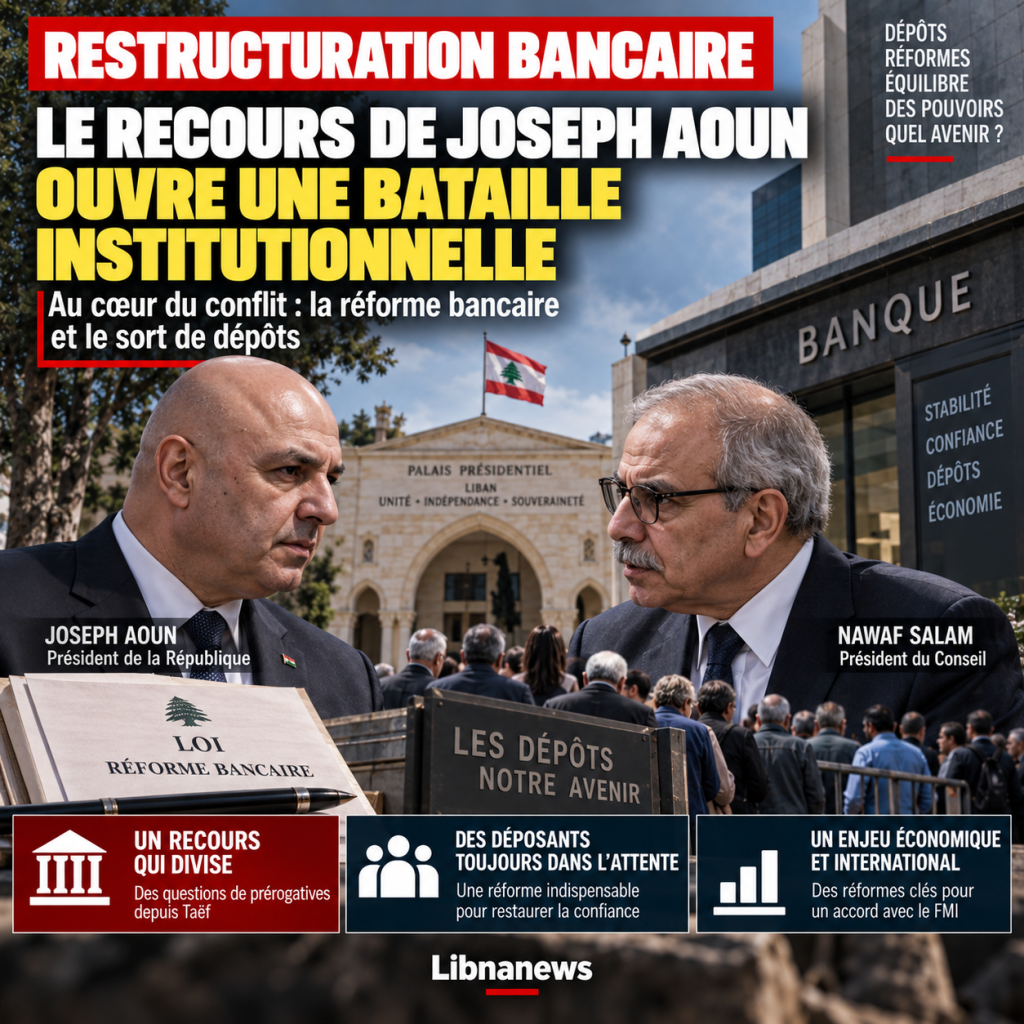
The appeal of President Joseph Aoun against a provision of a law on bank reform has opened a controversy that goes far beyond the drafting of an article of law. Deputy Jihad Al-Samad, Chairman of the Parliamentary Committee on Defence, Interior and Municipalities, sees this as an infringement of the prerogatives of the President of the Nawaf Salam Council and a first institutional since the Taif agreement. His criticism is based on a particularity which he puts at the centre of the case: the contested provision appeared in a draft submitted by the government, carried the signature of the President of the Republic and that of the Prime Minister, and then was forwarded to Parliament, which voted as it had been sent.
Al-Samad therefore considers that the Head of State is now contesting a provision of a text which he himself had signed and transmitted. He spoke of an infringement of his own signature, but above all of a challenge to the balance of powers to the detriment of the Council Presidency. It also accuses the use of curbing banking reform under the guise of protecting religious balance. This is a political position, not a judicial decision establishing a violation of the Constitution. This distinction is essential.
The available corpus does not fully reproduce the contested provision or the legal brief of the appeal. It would therefore be artificial to claim to decide its constitutionality here or to attribute to President Aoun reasons which are not documented. On the other hand, the evidence explains why this dispute becomes politically explosive: it comes at a time when Lebanon needs to reorganize its banks, deal with the financial crack accumulated since the crisis and finally define how the losses will be distributed without removing depositor rights.
The unusual path of a text signed, voted and then challenged
The heart of Jihad Al-Samad’s argument lies in the trajectory of the text. A government project is first prepared and adopted by the executive branch. It is then forwarded to Parliament, which may amend, reject or adopt it. In the case referred to, Al-Samad insists that the contested provision was maintained by the deputies as it appeared in the draft sent by the government.
This chronology feeds his criticism: how can a provision that has passed the government stage with the signature of the Head of State become the subject of a presidential appeal? Legally, the existence of an earlier signature does not necessarily exhaust the constitutional prerogatives available after the parliamentary vote. But politically, the gesture creates the image of an executive who no longer speaks with one voice on a reform that he himself had carried.
The conflict becomes even more sensitive because the text affects banks. A divergence on an ordinary law may remain confined to lawyers. A divergence on bank restructuring occurs in a case where hundreds of thousands of depositors are still waiting to know what share of their assets can be recovered, what timing and after what distribution of losses.
Why bank restructuring is inseparable from the financial crack
Bank reform cannot be understood in isolation. Since the crisis, the Lebanese financial system has been carrying a mass of losses that must be recognized, quantified and distributed. Until this stage is settled, bank balance sheets remain unable to return to normal functioning. Deposits exist legally as receivables, but their full and immediate repayment does not correspond to the resources actually available in the system.
That is what the debate on the « financial crack » covers. It’s not an abstract hole. It corresponds to the gap between the accumulated liabilities to depositors and the assets that can be actually mobilized after years of State financing, exposure to the Bank of Lebanon and the monetary crisis. Any serious reform must therefore answer a politically painful question: who absorbs the losses already produced?
Options have very different consequences. Making depositors bear an excessive share turns saving into an adjustment variable. To support the banks as a whole presupposes that their own funds and those of their shareholders can absorb considerable amounts. Deferring losses to the state ultimately means transferring them to taxpayers and future public resources. Nor does placing them on the Bank of Lebanon make them disappear, since the balance sheet of the central bank belongs to the same national financial architecture.
The problem is therefore not to choose an actor outside the system who would pay the bill. It is to define an order of responsibility and a sustainable distribution. That is precisely why every provision of banking restructuring becomes politically explosive: behind a technical rule is always the question of who loses how much.
Depositors in the centre, but without automatic guarantee of reimbursement
International partners stress that the adoption of financial reforms should enable depositors to recover at least part of their assets. This formulation is important. It recognizes the priority of the deposit file without promising full and immediate reimbursement that the available resources do not necessarily allow.
For depositors, the restructuring must respond to several unknowns. Will small deposits be protected more than larger ones? Will repayment be made in cash, in stages, through financial instruments or through several combined mechanisms? What will be the fate of accumulated interest? How to distinguish pre-crisis deposits from movements during the period of restrictions? The corpus of October 5 does not provide the complete answers to these questions and it would be misleading to invent them.
What he established, however, was that banking reform and the law to deal with the financial crack were now seen as essential for restoring confidence and moving forward in international negotiations. The applicant therefore finds himself at the crossroads of two imperatives: to obtain a credible restitution of his rights and to accept that an orderly resolution of the system requires rules which did not exist during the first years of the crisis.
The IMF in the background of every banking debate
The issue is not just between Baabda, Serail, Parliament and banks. Progress in reforms is also linked to discussions with the International Monetary Fund. Patrick Durel, Ambassador of France, stressed that the adoption of urgent reforms should enable Lebanon to move towards an agreement at the level of IMF services. Paris says to engage with both the Lebanese authorities and the Fund to help find solutions.
This sequence gives the legal battle an immediate economic dimension. A prolonged blocking of bank restructuring does not only delay a law. It delays the clarification of the balance sheets, the possibility of recapitalizing viable institutions, the treatment of institutions that are not, and, more broadly, the return to a system that can normally finance businesses and households.
International support also depends on the perception of reform. Patrick Durel insists that progress in this area would send a positive signal to the international community and facilitate greater financial support. In a country that must in parallel finance the reconstruction of the South and restore infrastructure, this credibility is not a theoretical question.
Restructuring a bank does not simply mean closing it
The term « restructuring » is often used as if it described a single transaction. In reality, it can cover several scenarios. A bank may be recapitalized by its shareholders, merged with another institution, see certain activities transferred, undergo a reorganization of its liabilities or, if deemed unsustainable, enter into a more cumbersome resolution procedure. The choice depends on the real state of its balance sheet.
In order to take these decisions, the authorities must have coherent criteria. A bank that has sufficient assets and can attract capital does not treat itself as an institution with long-term losses that exceed resources. The aim of reform is therefore not to save all banks in their present form. It is to rebuild a sector capable of fulfilling its essential functions: keeping deposits, making payments and financing the economy.
This clarification is also necessary for shareholders. In normal restructuring, capital is the first buffer to absorb losses. But the Lebanese crisis is of such magnitude that the debate quickly exceeds existing own funds. Hence the need to combine bank restructuring and the overall treatment of the financial crack.
The battle of prerogatives since Taif
Jihad Al-Samad’s criticism introduces another dimension: the constitutional balance resulting from the Taif agreement. He claims that the presidential appeal constitutes a further infringement of the prerogatives of the President of the Council and aims to marginalise his role. This charge must remain with the author. The corpus does not provide a decision of the Constitutional Council or the Council of State confirming this reading.
His argument, however, reveals an old political sensitivity. Since Taif, any disagreement over the respective powers of the President of the Republic, the Council of Ministers and the Prime Minister can quickly be interpreted through religious balance. Bank reform risks leaving the financial field to become a conflict over institutional competence.
This displacement is dangerous for reform. A bank provision should normally be assessed on the basis of its effect on financial stability, depositors and the viability of institutions. If the debate is mainly transformed into a confrontation over religious prerogatives, the economic content can go into the background. This is precisely what Al-Samad denounces when he speaks of a protection of « faithful privileges », even though this qualification is part of his political reading.
Joseph Aoun faced a political contradiction more than a demonstrated legal contradiction
The fact that Joseph Aoun signed the draft before then challenging a provision adopted by Parliament creates an apparent political contradiction. It alone does not make it possible to state that the appeal is legally inconsistent. A text may evolve during the legislative process and constitutional mechanisms may allow the Head of State to intervene at different stages.
The corpus does not reproduce the presidential motivation. It therefore does not allow us to state precisely what constitutional or institutional risk Joseph Aoun believes he wants to prevent. This absence is important. A serious article cannot turn a Member’s criticism into an explanation of the President’s intentions.
What can be established is that the remedy has created a controversy within the institutional camp that carries the reforms. But this image of division comes at the worst moment: Lebanon seeks to convince its partners that the authorities are able to complete the restructuring of the financial sector.
Time lost also costs the real economy
Bank blocking is not only about people waiting to recover their deposits. A modern economy needs banks that can provide credit, finance investment, support exporters and provide reliable payment instruments. As long as institutions remain trapped in unsanitized balance sheets and an uncertain legal framework, their capacity to play this role remains limited.
This weakness particularly affects companies that have to finance equipment or their working capital. It also affects reconstruction. Repairing infrastructure and reviving activity in destroyed areas requires financial channels capable of receiving international funds, financing businesses and monitoring payments.
Banking restructuring is therefore linked to cases which appear to be at first sight far from the banks. The reconstruction of the South, investment in the diaspora, industrial recovery and job creation all depend on a credible financial system. A country cannot ask expatriates and investors to mobilize their money while leaving the issue of already locked-in deposits indefinitely unresolved.
A reform that must answer three simple questions
Beyond conflicts of prerogatives and legal formulations, the reform will ultimately be judged on three issues. The first concerns applicants: how much can they recover, in what form and within what time frame? The second concerns banks: which are viable, how much capital must they bring and what happens when they cannot be saved? The third concerns the State and the Bank of Lebanon: what share of financial responsibility does it have in resolving the crisis?
Joseph Aoun’s appeal cannot be seriously assessed without knowing the precise text of the contested provision and the detailed legal grounds of the Presidency. The corpus does not provide them in its entirety. This limit prevents a constitutional verdict from being rendered, but it does not prevent the scope of the controversy from being measured.
Lebanon is at a time when every delay prolongs uncertainty about deposits and prevents normalization of the financial sector. The battle opened by the presidential remedy will therefore not only be observed as a new episode of the relations between Baabda and the Serail. It will be judged on the timing of reforms. If it clarifies a disputed provision without blocking the process, it will remain an institutional dispute under control. If it leads to further paralysis, it will add a conflict of competence to a financial crisis that has been awaiting resolution for years.





Comments