

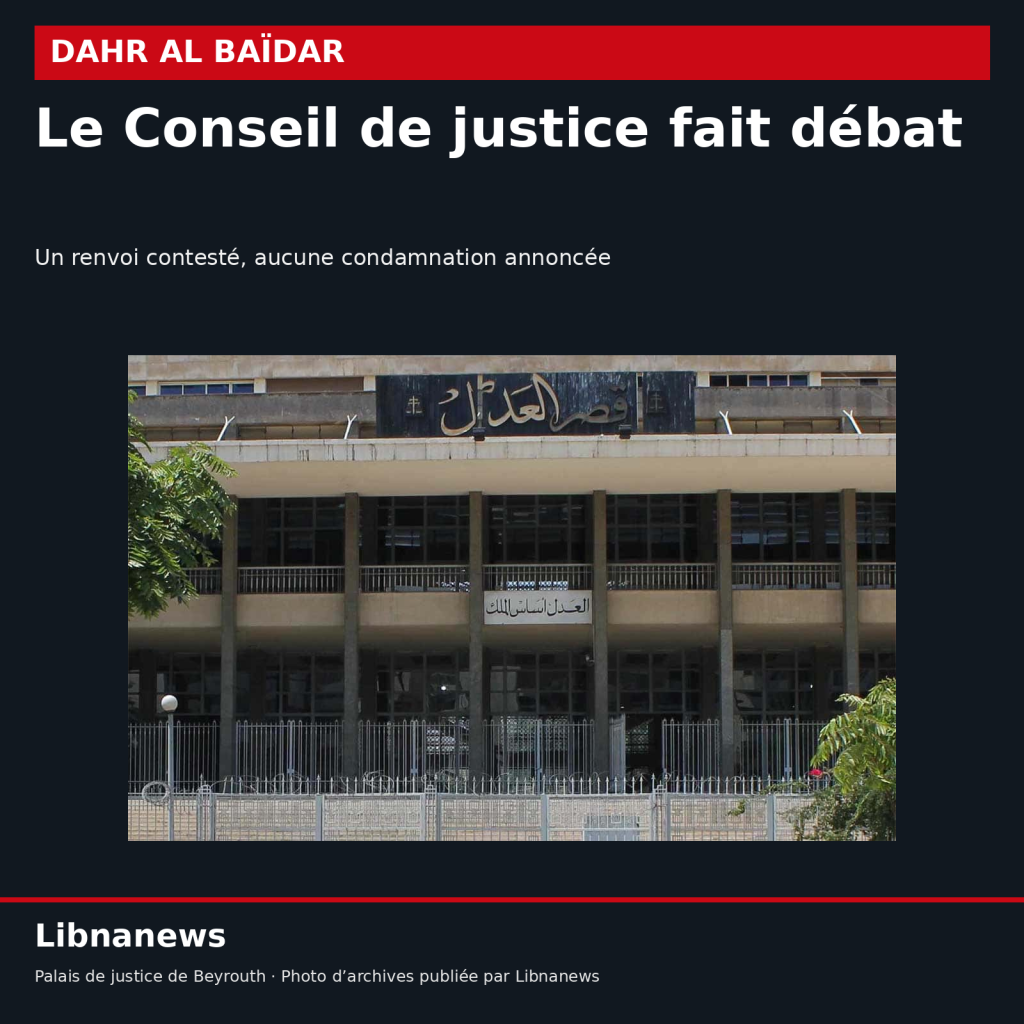
The case of the explosive truck intercepted in Dahr Al Baidar remains between two fronts: prosecution before the military justice system and a political confrontation over possible referral to the Council of Justice. In their 2 November 2026 editions, Al Jumhouria and Al Akhbar report charges against thirteen persons. The transfer of the case to the Council of Justice is not presented as accomplished.
The Minister of Justice, Adel Nassar, continues to defend the steps leading to this referral. Hezbollah challenges the scope of the case. Its officials claim the military destination of the shipment against Israel and denounce an instrumentalization of the prosecution. Between these two positions, political contacts seek to prevent a further break between the movement and the institutions.
Prosecutions, not convictions
According to Al Akhbar, the government commissioner to the military court, Claude Ghanem, has brought charges against two detainees, six fugitives and five persons known only by their nicknames. This count, which the daily presents as resumed media information, reaches thirteen people. The case was forwarded to the first military investigating judge with a request for arrest warrants.
The qualifications reported are based on several provisions of the Criminal Code and the arms legislation. These include armed formations, association to commit crimes and participation in the alleged acts. Prosecutions initiate proceedings; they do not constitute a conviction.
There is still a divergence in the press. Al Binaa mentions eight persons prosecuted, also under the authority of Claude Ghanem. The available evidence does not determine whether this difference is due to the scope of the persons counted or the state of the information used. It would therefore be misleading to draw a single total by deleting the powers.
The choice of jurisdiction becomes a political issue
Adel Nassar defends the continuation of procedures authorized by law to refer the matter to the Council of Justice. This position puts the case beyond the mere control of a transport of weapons. It raises the question of the State’s ability to deal with Hezbollah’s military activities and enforce its decisions.
Ad Diyar reports, however, that Joseph Aoun and Nawaf Salam do not wish, at this stage, to postpone the reference to the agenda of the Council of Ministers. According to daily news, they want to let the case follow its judicial path while limiting its political exploitation. This does not mean that a final decision was taken to abandon the dismissal.
Al Binaa also describes an effort to calm down. The newspaper interprets the postponement of the referral and the qualifications chosen as ways to contain the crisis. It relays information about foreign pressures and precautionary statements. These stories are based on unnamed political sources, not on a published judicial decision.
Hezbollah defends cargo and denounces prosecution
Hussein Hajj Hassan reiterated that explosives belong to « resistance ». In the words reproduced by Al Binaa, he states that the cargo was destined to face Israel. He opposed Lebanese prosecutions against the destruction in the South and accused some political forces of seeking to aggravate tensions.
At the same time, it calls for priority to be given to internal stability. But he refuses that this appeasement be made, according to his formulation, at the expense of the resistance, its fighters and their social environment. This position illustrates the limits of the search for a compromise: the movement wants to avoid internal confrontation without accepting the political reading of its opponents.
In Al Akhbar, Mojtaba Al Husseini’s legal column challenges the foundations of certain criminal qualifications. The author defends a reading that is more relevant to offences under the arms legislation. In particular, he stressed the absence, in his account of the act, of charges of terrorism.
This argument remains that of the columnist. It does not represent a decision of the judge or an independent validation of the legality of the cargo. The distinction is essential in a case where legal comments directly accompany political confrontation.
State authority at the centre of positions
Béchara Rai links the case with the need for a single national decision on war and peace. In his homily reported by Ad Diyar and Al Jumhouria, the patriarch demanded that the State and its legal institutions control weapons. It also calls for enhanced border surveillance.
The disagreement thus concerns two opposite readings. For defenders of a firm institutional response, the treatment of the truck tests the application of state rules. For Hezbollah and its supporting commentators, prosecution may be aimed at a military capability that they consider indispensable in the face of Israel.
The continuation of the procedure will have to establish individual responsibilities. Politically, the authorities are still seeking to preserve a margin between the continuation of the investigation and an internal escalation. None of the narratives published on 2 November allowed this tension to be presented as definitively settled.
Sources
Al Akhbar, 2 November 2026, page 2; Al Joumhouria, page 2; Ad Diyar, pages 2 and 4; Al Binaa, pages 3–4.





Comments