

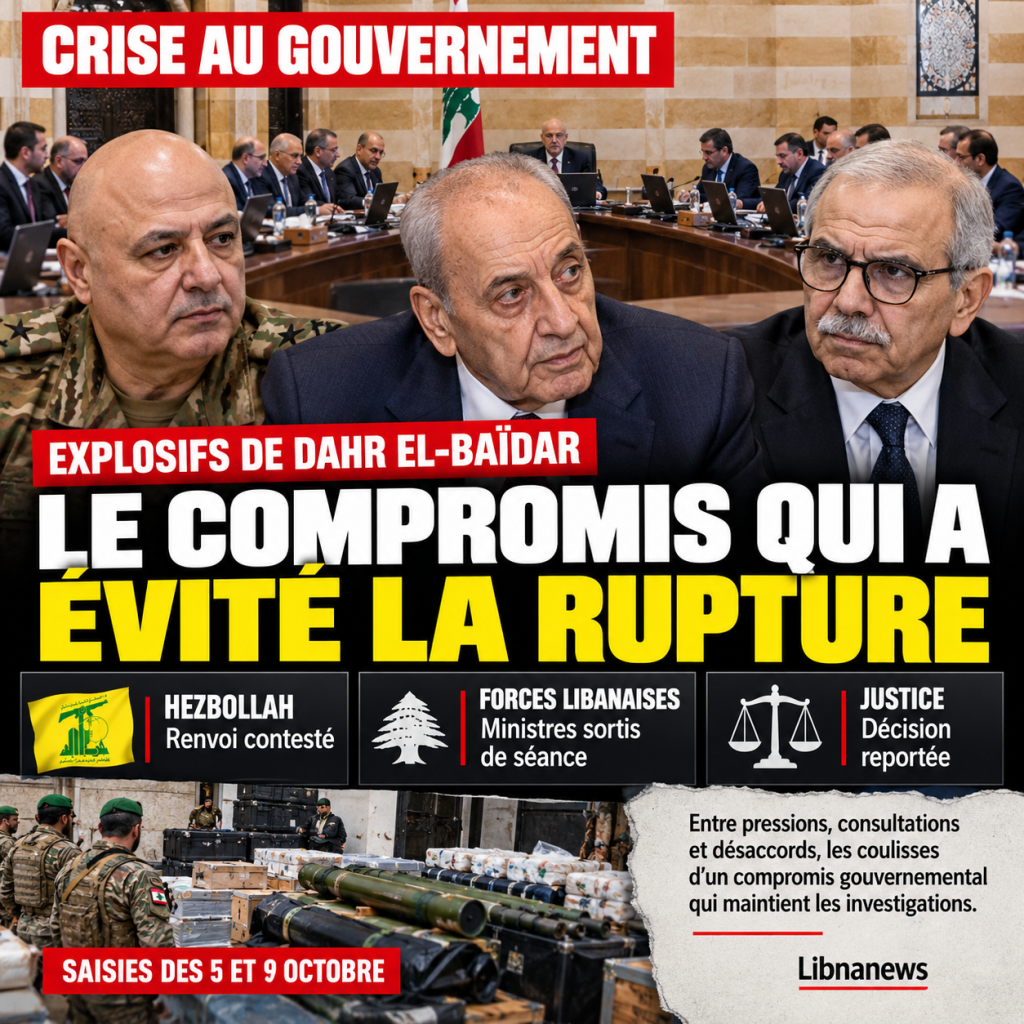
Two seizures of explosives causing a political crisis
The seizures of explosives carried out on 5 and 9 October 2026 in Dahr al-Baidar and in the al-Qasr region caused a crisis that quickly exceeded the judicial framework. The case put the government of Nawaf Salam before a sensitive question: should the case be entrusted to the Council of Justice, at the risk of provoking a political confrontation with Hezbollah? The Minister of Justice, Adel Nassar, defended this option because of the possible consequences of transporting explosive materials on national security. Hezbollah, for its part, challenged an approach that could turn a case of arms transport into direct confrontation with the state.
The situation was an important one. MP Hassan Fadllallah had acknowledged that the explosives belonged to Hezbollah, stating that they were intended for its resistance activities. This declaration gave an additional political dimension to the investigation. However, it did not address the question of the legality of transport, the question of individual responsibilities or the precise destination of seized materials. These issues were still subject to judicial investigation. For Hezbollah’s opponents, this recognition reinforced the need for a procedure before the Justice Council. For opponents of this referral, on the contrary, it risked turning a criminal procedure into an institutional confrontation.
The dossier was included in the seventh agenda item of the Council of Ministers on Thursday, 22 October. The Department of Justice’s request concerned explosives seized in both locations, but also any person whose investigations would establish a direct or indirect link to the subject matter. This formulation potentially expanded the scope of investigations. She explained part of the tensions that preceded the government meeting.
Nabih Berri at the centre of consultations
The hours leading up to the Council of Ministers were marked by a series of consultations between the main officials of the State. The President of Parliament, Nabih Berri, played a central role in seeking a compromise. His discussions with President Joseph Aoun and Prime Minister Nawaf Salam were aimed at preventing a vote on the dismissal from court from causing a breakdown in the government. The President of Parliament defended a solution allowing further investigations without immediately taking a decision on the competent court.
The position of Hezbollah was one of the main difficulties. According to the political information reported on these consultations, the party had indicated through intermediaries that an immediate referral to the Council of Justice would be considered a particularly hostile decision. He feared the political and security consequences of a procedure that could place his military activities at the centre of an investigation into state security. The messages also highlighted the risks of an internal confrontation in a context marked by military tensions with Israel.
The consultations were not limited to Hezbollah and institutional leaders. Joseph Aoun also received the president of Kataëb, Sami Gemayel, before the government meeting. This meeting was part of efforts to broaden support for a compromise solution. The information available indicates that the exchanges have helped prepare the political ground. However, they do not allow private discussions to be re-established word for word or give Sami Gemayel a specific commitment that would not have been made public.
The formula finally adopted was based on a principle: to review the Minister of Justice’s request, but to postpone the decision until the investigations were completed. This mechanism avoided an immediate vote while officially maintaining the possibility of a subsequent referral to the Justice Council. It thus offered a way out for those responsible who refused a government confrontation. On the other hand, it did not satisfy those who demanded a judicial decision without delay.
Joseph Aoun and Nawaf Salam facing the risk of rupture
President Joseph Aoun helped establish a climate conducive to compromise. At the beginning of the governmental meeting, he commended the efforts of the security services in combating terrorism, drug trafficking, arms smuggling and crime. He also stressed the importance of preserving military institutions despite economic difficulties. His intervention included a special tribute to Nabih Berri, particularly for his position as a red line not to be crossed.
This statement was politically relevant in the context of the meeting. It recognized the role of the President of Parliament in de-escalating efforts and recalled the need to preserve civil peace. Joseph Aoun also warned against the consequences of extending regional conflicts. He called on political leaders to exercise caution in order to prevent external tensions from causing a new crisis in Lebanon.
Nawaf Salam took a different approach in his intervention on the merits of the case. The Prime Minister reaffirmed that the arms monopoly belongs to the state and that decisions on war and peace are exclusively constitutional. He recalled the provisions of the Taif Agreement, Security Council resolution 1701 and the commitments contained in the declaration of cessation of hostilities of November 2024. He also stated that the bodies legally authorized to carry weapons included the army, the Internal Security Forces, General Security, State Security, customs and municipal police.
The Prime Minister stressed the consequences of transporting and storing weapons outside authorized structures. According to him, such activities violate applicable rules and may threaten the safety of citizens. He called on Hezbollah to respect the principles previously stated by Hezbollah. This intervention confirmed that the Government was not giving up its position on the arms monopoly, even if the decision on the Justice Council was postponed.
Lebanese Forces leave meeting
The government discussion finally led to a break with the Lebanese Forces ministers. They called for the immediate referral of the case to the Justice Council. They considered that the seriousness of the facts and the information already available warranted a speedy decision. In particular, Minister Joe Issa el-Khoury recalled that certain cases had been referred to that court shortly after they occurred. He considered that waiting for further investigations was not sufficient grounds to postpone the decision.
The Ministers of the Lebanese Forces presented judicial precedents to support their arguments. Their position was that the removal order did not necessarily require the completion of all investigations. They also believed that the recognition of Hizbullah as an explosive made the case sufficiently clear to warrant government intervention. This interpretation was challenged by those in favour of postponement, who invoked the need to clarify responsibilities before changing the legal framework of the case.
The withdrawal of ministers was the main political incident at the meeting. Nawaf Salam criticized this approach, which he presented as a political auction logic. The Prime Minister’s reaction illustrated the tension between the need to maintain government cohesion and the demands of some of his partners. The Lebanese Forces chose to publicly demonstrate their disagreement, without obtaining the vote they demanded.
However, a detail distinguishes this sequence from a complete break between the trainings concerned. Adel Nassar, Minister of Justice and author of the referral request, remained at the meeting. He therefore did not follow the withdrawal of Lebanese Forces ministers. This decision allowed further examination of the case within the government framework. It did not imply the abandonment of his application, as the minister maintained his intention to revert to the matter.
Why the Justice Council was crystallizing tensions
The disagreement concerned a decision with significant institutional consequences. The Council of Justice has jurisdiction over certain serious cases involving, inter alia, the security of the State. Its referral requires a decision by the Council of Ministers. The explosives case was already in judicial proceedings, but Adel Nassar wanted to give him another dimension by asking for his referral to that court.
The proponents of the referral considered that the nature of the materials transported, the circumstances of their movement and the possible risks to the population justified this procedure. They considered that the investigation should establish the origin of the explosives, the persons who organized their transport, their destination and the conditions under which they had been introduced or displaced into Lebanese territory. Recognition of their membership in Hezbollah was not enough, according to this approach, to answer all these questions.
Opponents of the immediate dismissal put forward another reading. They considered that a decision taken prior to the completion of investigations might have a disproportionate political impact. Some also questioned the existence, at this stage, of conditions justifying the transfer of the case to the Council of Justice. The question of whether the mere possession or transport of explosives was covered by the offences concerned was thus part of the debate.
This discrepancy explained why the choice of court had become as sensitive as the investigation itself. The referral would have been a major government decision in a context where the arms monopoly was already the subject of deep disagreement. The postponement avoided this immediate decision, but did not address any of the legal issues raised.
A decision to postpone, without abandoning the investigations
After about four hours of discussion, the Council of Ministers adopted a formula for further investigation before deciding on referral to the Council of Justice. The decision therefore did not constitute a definitive rejection of Adel Nassar’s request or a validation of Hezbollah’s position. It kept the case open and postponed the choice of jurisdiction.
This solution allowed ministers close to Hezbollah to remain in government and avoid direct confrontation during the meeting. It also allowed the Prime Minister to maintain his statements on the arms monopoly without immediately causing a major institutional crisis. On the other hand, the withdrawal of the Ministers of the Lebanese Forces showed that the compromise was not unanimous.
The consequences of the postponement will depend on the results of the investigations and how the government will deal with a possible new referral request. In particular, investigators will need to clarify the circumstances of the two seizures, the individual responsibilities and the offences that may be detained. The question of jurisdiction may then be referred to the Council of Ministers.
The crisis of 22 October thus reveals the limits of the compromise reached. Political leaders have avoided an immediate break, but their disagreements remain in Hezbollah’s place of arms, the powers of the State and the judicial means to enforce government decisions. The explosives case thus remains both an ongoing criminal case and a subject of political confrontation.





Comments