


The cost of an artificial intelligence response can decrease as the user’s bill increases. Between subscription, processed text volumes, searches and repeats, the price displayed is not enough to measure the budget. The official rates consulted on November 10, 2026 allow this expenditure to be broken down, without confusing a cheap response with a properly completed job.
After ram, the processors and electric billThe price series deals with a less visible expenditure: that of software which consumes calculation at each use. For an independent, a small business or an association, the practical question is what remains included in the package and what varies with the activity.
From 2022 to 2024, a decline at defined performance
LAI Stanford 2025 Index, published on April 7, 2025, provides a historical benchmark: the cost of questioning a model reaching GPT-3.5 on the MMLU test increased from $20 per million chips in November 2022 to $0.07 in October 2024. The threshold is 64.8% correct. The final point is Gemini-1.5-Flash-8B.
| Period | Dollars per million chips |
|---|---|
| November 2022 | 20.00 |
| October 2024 | 0.07 |
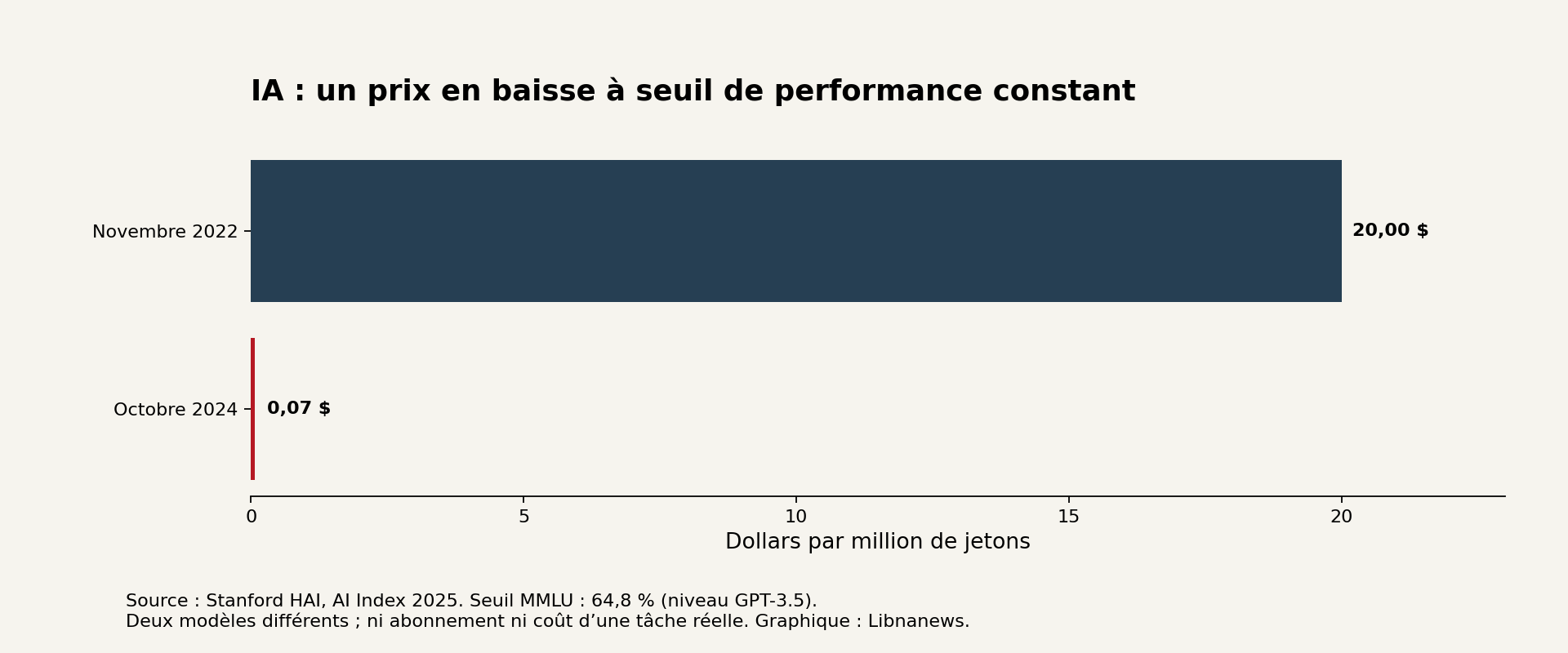
These are two observations at a specified performance threshold, not the price of the same product retained for two years. They do not measure the price of a subscription or the success of an agent in a company. The ratio exceeds 280, but it cannot be extended until 2026 without keeping the same method. The current rates below are therefore a second table, separate from this historical series.
Subscription and consumption do not pay the same
In an application, a subscription gives access to functions and capacity to use. An API is an interface that allows another software to query the model; its consumption is generally counted. A company that automates the processing of documents must therefore read the conditions of the API, even if its employees already have a subscription.
The claude grid illustrates this distinction: Pro is displayed at $20 per month in monthly payment, or $200 paid in advance for the year. Max costs $100 per month and Ultra $200, excluding applicable taxes. Use limits remain; The amount consumed depends in particular on the model, the length of conversations and the files.
However, it would be incorrect to state that both invoices are still completely separate. Anthropic now plans aPI credits for selected subscribers : 100 dollars monthly for Max and 200 for Ultra, under conditions of activation. They expire at the end of the cycle and do not refer. They do not cover Claude Code, exceedances in Claude applications, or partner platforms. Their amount does not therefore constitute a universal discount on all uses of the mark.
An identical basket of chips, not a promise of the same result
A token is a unit of text processed by the model, not necessarily a word. The entrance understands what is transmitted to it; the output corresponds to its invoiced production. To make tariffs readable, the following table applies the basic prices to a purely illustrative basket: one million uncashed input chips and 200,000 billable output chips, combined on several short queries. It excludes tools, taxes, promotional credits, accelerated modes and increased long-term treatments.
| Model | Entry per million | Output per million | Cost of basket |
|---|---|---|---|
| GPT-6 Luna | 0.10 | 0.50 | 0.20 |
| GPT-6.1 Soil | 2.00 | 10.00 | 4,00 |
| Claude Sonnet 5.5 | 2.00 | 10.00 | 4,00 |
| Claude Opus 5.5 | 4,00 | 20.00 | 8.00 |
| Claude Fable 5.2 | 8.00 | 40.00 | 16.00 |
Amounts from grids OpenAI, standard mode and short context, and Anthropic, basic rates. The calculation is input + 0.2 × output. Two identical prices do not mean two interchangeable models. The same document can also produce a different number of chips depending on the model. This simulation compares units charged; it does not classify the accuracy, speed or cost of a file actually completed.
Why long answers weigh more
In the $4 basket, entries cost $2 and exits $2. Yet, there are five times fewer chips out. At these rates, requiring longer production quickly changes the expense. If the output increases from 200,000 to 400,000 coins, with the same entry, the total reaches $6, an increase of 50%. This is a scenario calculation, not an observed invoice.
Searches can be added. In particular, the OpenAI grid displays $10 per 1,000 standard web search calls, plus billing for the search content transmitted to the model. A thousand searches are therefore not confused with a thousand simple textual answers. A tool that checks several pages, reformulates and repeats can multiply consumption stations before delivering a few paragraphs.
Reusing a document can reduce its rebilling
The cache instructions and documents avoid recalculating certain elements already dealt with. It concerns a common part located at the beginning of the request, which must remain identical. Maintaining a conversation alone does not guarantee that this reduction applies.
For GPT-6.1 Sol, the rate for reading the cache is $0.10 per million chips, compared to $2 for an ordinary entry. But the initial writing in the cache also has a price: $2.50 with the standard storage time of thirty minutes. Comparing only $0.10 to $2 would eliminate this first expense.
Simplified example: The same 100,000 token portion, fully reusable, costs $0.25 to write and $0.09 for nine readings. The total is $0.34, compared with $2 for 10 regular salaries. This calculation excludes outputs and new information added; it assumes nine successful reuses before expiry. He does not describe the price of an entire conversation.
Waiting can cost less
Speed is another economic choice. LBatch of OpenAI API offers a 50% reduction from synchronous calls, with a 24-hour processing window. The supplier is responsible in particular for the classification of large sets and evaluations.
For a company that files its documents at night, this period may be acceptable. For a service responding immediately to a customer, it changes the service rendered. The lower amount therefore pays another delivery constraint. All announced reductions should not be mechanically added up without verifying that the chosen model and mode allow them.
The right denominator: the task properly completed
In its optimization guideAnthropic recommends comparing the cost per completed task rather than the only token price. A more unit-priced model can reduce repeats; Conversely, using the most expensive for each elementary ranking can unnecessarily increase the budget. The results presented by the manufacturer remain unique to its tests and do not replace a test on the customer’s documents.
The concrete method consists of taking a stable sample, defining what an acceptable response is, and then identifying consumption, errors and corrections. Difficult files must remain in this sample. Removing them would artificially improve the average cost and mask precisely the cases that require the most work.
OpenAI identifies three levers in its cost reduction guide : limit the number of queries, reduce text volumes and choose a smaller template when accuracy is sufficient. For the reader, this translates into simple questions: do you have to return the complete file, get ten pages instead of a synthesis, or restart the whole task for a single correction?
The budget to follow includes several lines: possible lump sum, net consumption after actually usable credits, tools, and then human audit time. There is no public scale to allocate a universal price to this last line. That is precisely why a price per million tokens, even very low, does not allow itself to promise an economy on final work.





Comments