

Today’s world markets, Tuesday, November 10, 2026, advance with two signals that do not measure the same. Oil is falling, but US prices continue to rise. Europe and Asia are gaining ground, while Wall Street is yielding ground in the afternoon surveys. The results of SoftBank, Infineon and Vodafone add another distinction: sustained technological demand may coexist with heavy accounting or contractual losses. For both businesses and households, the relaxation of one cost does not eliminate all others.
File of Tuesday 10 November 2026. The hours below are expressed in UTC, with their equivalent in Beirut when necessary. European and American courses are statements in session, not closures. The company results relate to the periods indicated, not only the day of publication.
World Markets Today: Different Directions
The contrast first appears in the indices. Paris and Frankfurt are making progress in the comments. The three major U.S. indices fall from 0.64% to 1% in the selected surveys. These figures describe specific moments, with different broadcast times. They do not allow artificially to construct a world photograph taken at the same second.
| Index | Level in points | Daily change | Last trade displayed, UTC | Dissemination announced |
|---|---|---|---|---|
| ACC 40 | 8 310.49 | +0.94 % | 16 h 10 min 30 s | Real time |
| DAX | 26 423.57 | +0.60% | 15 h 55 min 30 s | Different |
| S&P 500 | 7 491.09 | -0,78 % | 15 h 55 min 16 s | Different |
| Nasdaq Composite | 25,000.88 | -1.00 per cent | 15 h 55 min 30 s | Different |
| Dow Jones | 52 052.98 | -0.64% | 15 h 55 min 34 s | Different |
November 10th. Changes are calculated from the previous closure. The listing pages indicate a delayed flow for Frankfurt and the US indices, without specifying its duration. In Beirut, add two hours to UTC hours. The time of a displayed course should not be confused with the time of page reference.
The Asian squares had already finished their session. The Japanese Nikkei won 2.87%, around 60,459 points. South Korean Kospi grew by 4.39%, around 5,239 points. Hong Kong’s Hang Seng took 0.4%, around 24,557 points, and Shanghai 0.08%, about 3,663 points. These rounded levels are reflected in a balance sheet published at 0910 UTC, or 1710 in Hong Kong. This schedule is that of the report, not that of each last exchange.
It would therefore be misleading to attribute all these performances to the American publication of the afternoon. Asian sessions were completed when price figures were published at 1.30 p.m. UTC. Europe and the United States were able to integrate this new information during their exchanges. The chronology limits possible explanations, even when several places evolve in the same direction.
Another precaution: an index measures a basket of actions, not the instantaneous health of an entire economy. The sectoral composition, the weight of the large capitalisations and the expected benefits differ. A performance comparison remains useful. It does not replace the examination of the undertakings making up it. Today’s industrial announcements clearly show why not all markets respond consistently.
Inflation is slowing down, without giving a signal of falling rates
The United States Bureau of Labour Statistics published the October prices at 8.30 a.m. in Washington, D.C., at 3.30 p.m. in Beirut. The CPI-U increased by 0.4% over one month, after 0.6% in September, in seasonally adjusted data. Without food and energy, the increase remains at 0.3%, as in the previous two months. Energy slowed sharply from +5.2 % to +0.7%. Housing is still increasing by 0.3% and represents more than 30% of the overall monthly increase.
A statistical limit distinguishes this publication. The absence of collection in October 2025 prevents the production of the official annual rate of the general index and underlying index. We must not put zero in their place, nor turn a private estimate into an official result. The graph therefore presents only the monthly variations available. The increase in October means that prices are rising slower than in September, not that the basket becomes cheaper.
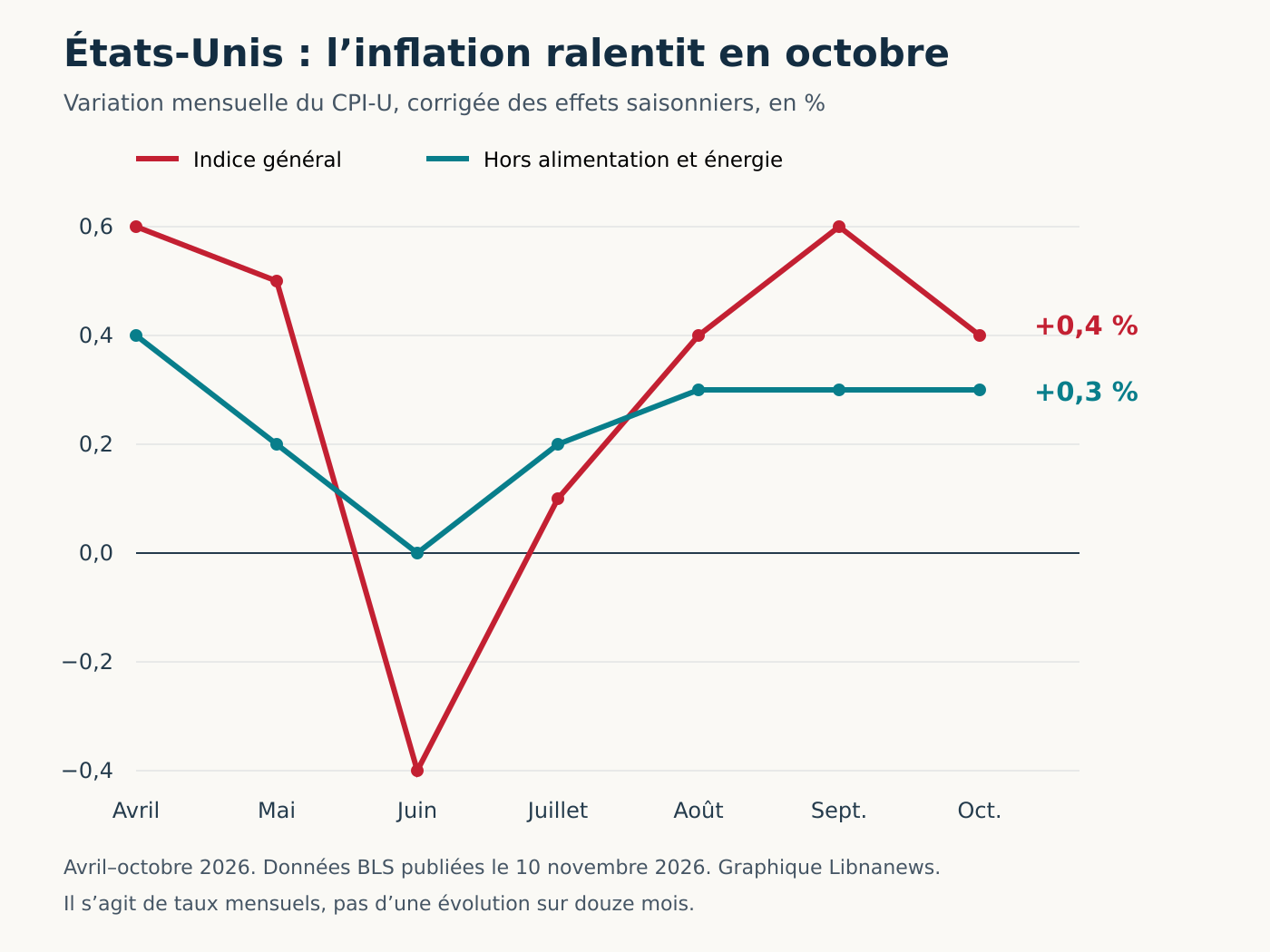
The period lag explains part of the contrast with oil. The ICC describes the purchases and prices recorded in October. The 10 November oil contract concerns a future delivery. A relaxation observed Tuesday cannot rewrite the expenses of the previous month. It could contribute to future surveys, depending on its duration and transmission. The graph helps to see this succession, without automatically projecting the last movement over the following months.
To understand the monetary scope of the statement, it is necessary to go back to the last decision, rather than announce a new decision. On 28 October, the Federal Reserve maintained its policy range between 3.75% and 4%. Two members, Lisa Cook and Beth Hammack, preferred a one-quarter point increase. The press release described still high inflation. It also highlighted the strength of activity, productivity and investment. This decision precedes the figures published on Tuesday.
Maintaining the underlying at 0.3% is therefore not sufficient to prove that a relaxation is approaching. On the other hand, only one month does not make it possible to say that a further rise in rates is being made. Monetary policy depends on a set of information. The ICC provides information on consumer prices, but a market anticipation and a formal decision remain two different objects.
This distinction directly concerns the valuation of shares. Long-term high rates increase the return on risky investment. They can reduce the present value of expected benefits far in the future. But an increase in income or a better margin can offset this effect. Observing the indices alone does not measure the exact proportion of each of these factors in the session.
Oil expands, contracts remain to be distinguished
At 1334 UTC, or 1534 hours in Beirut, Brent was worth $89.65 per barrel, down 3.15 per cent. The WTI was trading at $84.52, down 2.68 per cent. These intraday quotes were reported by a news agency. They accompanied Donald Trump’s statements on a break in new strikes against Iran. They do not constitute a closing settlement or evidence of a diplomatic agreement. The time limit for the distribution of these courses is not specified; they are not presented as prices in real time at the time of publication.
The reference dates are January 2027 for Brent and December 2026 for WTI. The gap between the two months is normal: their contractual schedules differ. The same deadline must be retained to calculate a daily change. Comparing the contract that expires with the one that takes its place can introduce a purely technical movement into a series of prices.
The fall in crude oil opens up the possibility of reducing costs. It does not directly fix the price of fuel delivered to a station. Oil must be transported, refined and distributed. Taxes, storage fees and margins are added. Purchases may also have been made earlier. The decline in a futures maturity is therefore not fully or at the same time passed on to all invoices.
For an airline or carrier, the coverage contract also counts. A company that has set part of its purchases in advance does not immediately benefit from any market decline. However, this protection may have been preserved in a previous increase. The cost actually paid should be examined, rather than deducting a company’s margin from the barrel movement alone.
Finally, the risk price can change faster than the physical situation. A change in anticipation is enough to move financial contracts. Delivery requires ships, insurance, ports and deadlines. The afternoon figure tells the market at this moment. He does not certify that all conditions of carriage have returned to normal.
Currency: ECB reference precedes US prices
The European Central Bank has a euro of $1,1214 for 10 November. Other references are 177.38 yen, 0.83545 pounds sterling, 0.9203 Swiss francs and 7.4801 yuan for one euro. These are information rates, not guaranteed prices for a commercial transaction. The ECB explicitly advises against using them as a transaction price.
| Currency received for 1 euro | Reference of 10 November 2026 |
|---|---|
| United States dollar | USD 1,1214 |
| Japanese yen | 177.38 JPY |
| Pound sterling | GBP 0.83545 |
| Swiss franc | CHF 0.9203 |
| Chinese Yuan | CNY 7,4801 |
The method is decisive for reading the day. Coordination between central banks normally takes place around 14.10 in Central Europe, i.e. 13.10 UTC. The broadcast usually takes place around 4 p.m., or 3 p.m. UTC. The timing of this reference therefore normally precedes the publication of the ICC by twenty minutes. Its later display does not transform it into a measure of currency response to inflation.
An example helps to understand the issue for an importer. A hypothetical invoice of €100,000 represents $112,140 at the daily reference rate. This calculation excludes commissions and the difference between purchase and sale. It does not describe any actual invoice. It only indicates that a dollar payment remains subject to exchange when a supplier sets its price in euros.
The billing currency can thus count as much as the country of origin. A European commodity invoiced in dollars does not have the same immediate exposure as an identical order invoiced in euros. The date of fixing of the price, the date of payment and possible cover further modify the result. No single public rate is sufficient to restore the full commercial cost of a business.
SoftBank makes the costs of a project change visible
The semi-annual accounts published by SoftBank on 10 November bring a concrete fact to the debate on AI. On April-September 2026, the group posted a net loss attributable to shareholders of 768 billion yen. In the July-September quarter alone, it reached about $1 115 billion. These two periods should not be added together.
The report also accounts for 597.2 billion yen in losses related to the reorganization of purchases of electrical equipment for US data centres. This total includes 457 billion non-reimbursable advances and 140.2 billion amendments or contractual settlements. Future discounts, capped at $2.1 billion over 10 years, are conditional. They do not appear as assets as at 30 September because their amount is not determinable. Therefore, removing them immediately from the loss would be wrong.
This case illustrates an industrial risk distinct from the simple price of chips. Reserve manufacturing capacity or secure equipment may require payment before any commercial revenue. If the project changes, the freedom to reorganize purchases depends on contracts. A non-refundable advance is not a cash reserve that is still available.
To assess this type of investment, three schedules need to be reconciled: payments to suppliers, commissioning, and customer receipts. Their lag creates a need for funding. An activity can meet a high demand and still suffer losses during construction. Conversely, an announcement of future capacity does not demonstrate that this demand will generate sufficient revenue.
The subject therefore does not allow a uniform verdict on all artificial intelligence. The risks of a software developer, a component manufacturer and a data centre owner differ. They do not commit the same amounts at the same time. The results published on Tuesday make it possible to better distinguish these positions in the industrial chain.
Infineon shows another side of technology investment
On the same day, Infineon presented a financial year 2026, which ended on 30 September, with a turnover of EUR 16.353 billion, up 12%. Its sectoral result reached 3.223 billion, a margin of 19.7 per cent. The fourth quarter represents 4.706 billion revenues. The German manufacturer anticipates about €20 billion in sales for 2027, with an exchange assumption of $1.15 per euro.
The group estimates that nearly EUR 4 billion of turnover will be generated in the power supply to data centres. It envisages between EUR 3 billion and EUR 3.5 billion in investments. These objectives concern the coming year. They are neither cash sales nor a guarantee of profitability. The cash flow of 2026 reached €993 million; The adjusted indicator is 1.925 billion. Both measurements are not interchangeable.
Reconciliation with SoftBank helps to understand the flow of expenses. The supplier can make sales while its customer builds an infrastructure. One person’s income becomes an investment or expense in the other. To judge the strength of the cycle, it is then necessary to check that the end user actually pays for the service provided.
The power supply is also a separate activity from the calculation itself. A data centre is not limited to installed processors. It must transform and distribute electricity, remove heat and ensure continuity of operation. This diversity opens up several industrial opportunities. It also creates several dependency points between suppliers.
Exchange rate assumptions should finally be kept in the reading of forecasts. A revenue target expressed in euros can evolve with the conversion of foreign sales. Comparing a forecast to a subsequent result requires checking volumes, prices, scope and currencies. A published growth alone does not explain the origin of the improvement.
Vodafone: a depreciation is not a cash out
Vodafone announced a turnover of 21.853 billion euros for the six months ended 30 September, compared with 19.609 billion a year earlier. The group’s forecast for 2027 of EBITDA adjusted after rents was between 13.2 billion and 13.4 billion. However, it recorded a depreciation of 4.85 billion in Germany. In particular, it links it with the rise in German bond yields and the effect of a European court decision.
This depreciation is without immediate disbursement. The half-yearly consolidated loss is €3.597 billion; The share attributable to the owners of the parent house is 4.789 billion. The account also includes a reduction of 2.2 billion UK tax deferred assets and a 3 billion accounting gain related to Safaricom. Holding only the German depreciation is therefore not sufficient to explain the net result.
The co-existence of a recorded operational forecast and a loss is not arithmetically impossible. Net income includes more elements than an adjusted operational indicator. Depreciation, financial charges, taxation and revaluation can significantly change the total. The definition of each measure should be retained, especially when a presentation is most favourable.
The term « without disbursement » also calls for a nuance. It means that this entry does not correspond to a payment made at the same time. It does not mean that it is economically indifferent. It may reflect a lower expected value of assets already funded. For a shareholder, the value of the assets and future profits count as much as the cash of the day.
For Lebanon, read together energy, exchange and financing
For a household or business in Lebanon, the most immediate link is through external purchases. A cheaper barrel can lighten a component of the energy bill. A euro that is more expensive in dollars can increase another order. These movements may be partially offset. Their effect depends on the basket actually purchased, not on a single global index.
Delays play an equally concrete role. Stock could have been paid before the oil fell. A supplier may revise its tariff after a specified period. A transport invoice may retain an overload for the duration of the contract. To assess an effective economy, it is necessary to compare identical products, quantities and delivery conditions.
The file therefore does not deduct any new Lebanese tariffs from international markets alone. Nor does it calculate an automatic improvement in purchasing power. The exchange rate used, commissions, taxes and local distribution costs remain necessary. Upstream relaxation becomes an economy for the consumer only when it reaches the price it pays.
The next stage of the evening is for AI companies. CoreWeave announced its third quarter results conference for November 10 at 5 p.m. on the East Coast of America. This corresponds to 2200 UTC, or midnight in Beirut on the night of 10-11 November. This appointment comes after the records of this file. The figures in this publication are therefore not anticipated here.
Cover: photo archive of the New York Stock Exchange, Vlada Karpovich / Pexels, used under license Pexels. Whole photo preserved without retouching in an editorial composition Libnanews. The date displayed is the folder, not the shooting.





Comments