

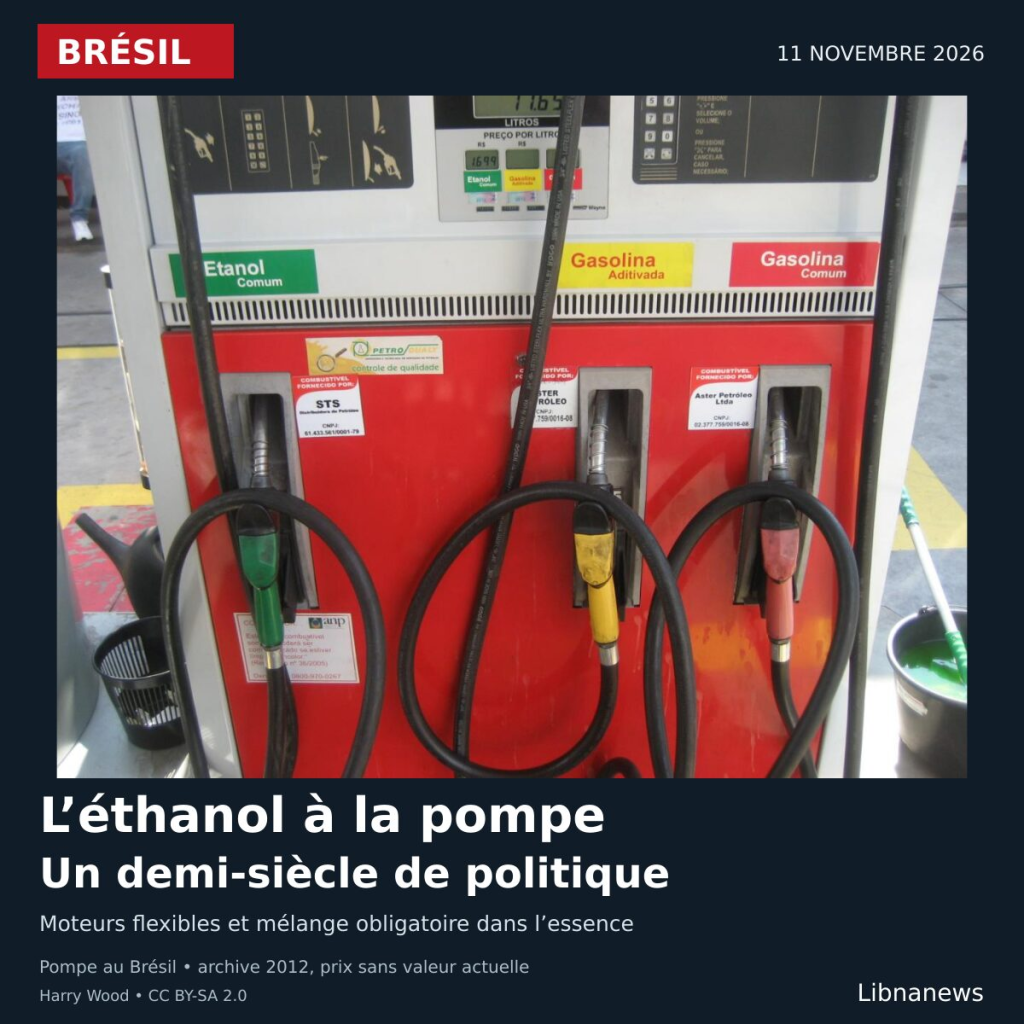
More than half a century after the launch of the Proálcool programme, Brazil continues to expand the role of ethanol in transport. Since 1 August 2026, ordinary gasoline must temporarily incorporate 32% of this biofuel. This decision adds to the choice already offered to motorists equipped with a flex engine, capable of driving with ethanol or gasoline.
The institutional starting point dates back to the decree of 14 November 1975 establishing the National Alcohol Programme. The aim was to develop a national fuel in a context marked by the oil shock. The fiftieth anniversary therefore belonged to 2025: in November 2026, this policy is approaching its 51th anniversary.
The continuity is remarkable, but the model has changed. Initial development was based on sugar cane and public support for production and technology. It now combines rules of incorporation, an adapted automotive industry and production in which maize is becoming increasingly important.
Brazilian ethanol also goes through gasoline
The National Petroleum, Natural Gas and Biofuels Agency states that the rate of 32% applies to ordinary C gasoline, with or without additives. Premium gasoline remains at 25%. The measure temporarily replaces the 30% rate previously applicable to ordinary gasoline.
The resolution of the National Energy Policy Council provides for 180 days from 1 August, with only one possible extension for the same period. It is therefore not yet a final change from all species to 32%.
The Ministry of Mines and Energy presents this increase as a means of reducing the need for gasoline imports. He states that the decision is based on technical tests, including the operation of vehicles and motorcycles. The final adoption of the new mixture, or a higher rate, remains linked to additional assessments.
The flexible engine leaves a choice to the pump
Another structuring step was the arrival of flexible cars in March 2003. These engines allow the proportion of ethanol and petrol to be changed in the tank, without requiring the driver to keep the same fuel at each fill.
This choice transforms the price displayed into a calculation of usage. Ethanol contains less energy per litre: a lower litre does not guarantee a lower cost to travel the same distance. The common rule in Brazil is to examine whether its price remains around 70% of that of gasoline.
This benchmark remains indicative. The relevant ratio depends on the actual consumption of the vehicle with each fuel. To compare, the price per litre must be divided by the distance travelled with that litre. The technical flexibility of the engine is therefore useful only if the motorist can also appreciate the cost of the journey.
Cane retains its place, corn grows
According to data from the Conab reported by the press on November 10, 2026, production estimates range from 2025-2026 to 37.5 billion litres. Cane is 27.33 billion and corn 10.17 billion. The forecast for 2026-2027 is 41.9 billion litres, of which 11.9 billion are maize.
This last value is a campaign projection, not a volume already produced. However, it illustrates the diversification of raw materials mobilized to meet the demand of motorists and the obligations of incorporation.
The energy issue does not exempt a precise environmental assessment. The renewable nature of the raw material does not mean no emissions. The effects depend in particular on agricultural practices, energy used to transform crops, transport and land use.
The Brazilian case shows above all that an alternative fuel is developing with the whole chain: agricultural production, factories, distribution, compatible engines and public rules. After half a century, ethanol remains both an agricultural product, a choice for the driver and an energy security instrument.





Comments