

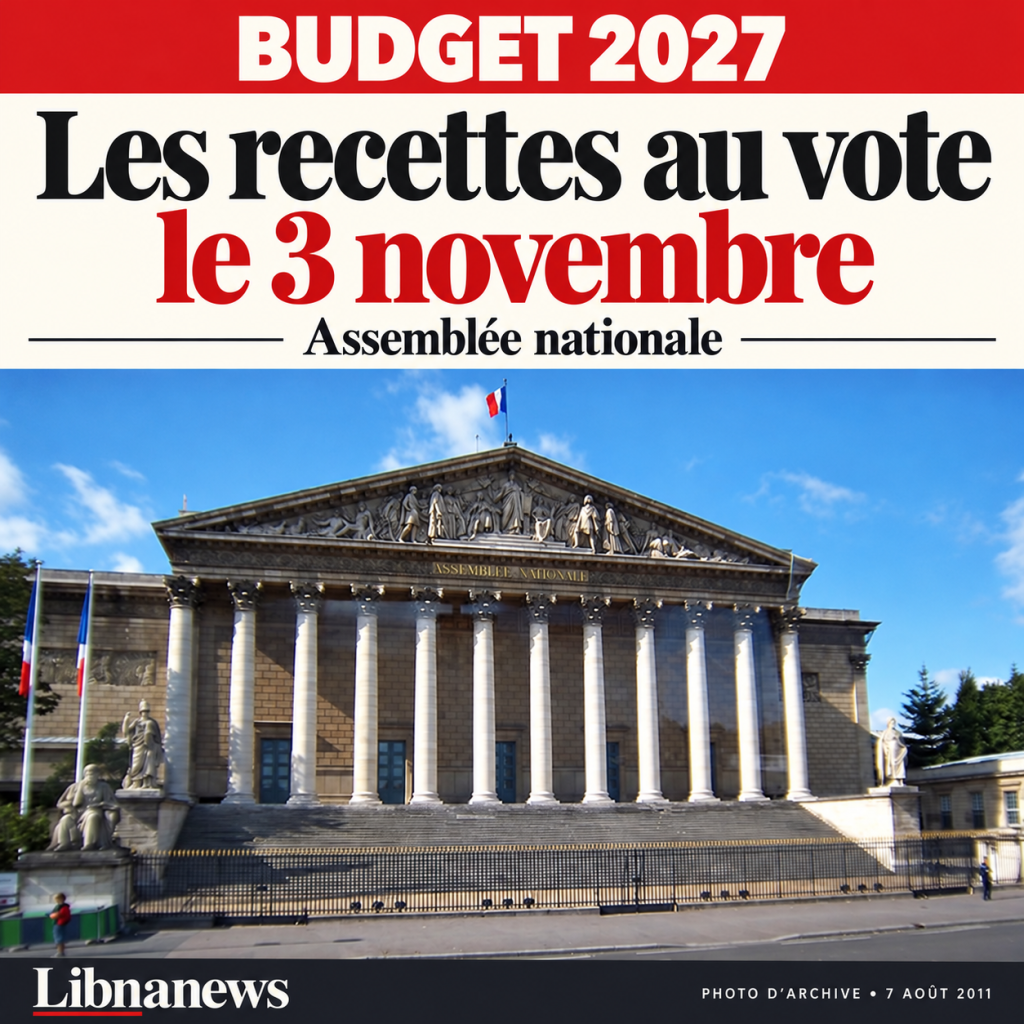
Budget 2027 took an important step on Tuesday 3 November at the National Assembly. Members must vote on its first part, on revenue. This election comes after a new weekend of mobilization against expensive life. It does not constitute the final adoption of the State budget.
On Monday, 2 November, MEPs continue to discuss the text in Paris. Three meetings are scheduled at 9 a.m., 3 p.m. and 9.30 p.m. The solemn vote on revenue is scheduled the following afternoon. This sequence must determine whether the Assembly can open the examination of expenditure at first reading.
Sébastien Lecornu’s government tabled the project on October 1. The discussion of its first part began in the Chamber on 13 October. Since then, MEPs have also discussed debt, the French contribution to the European budget and local finances.
Budget 2027: Why vote on revenue counts
A finance act is not just a succession of ministerial appropriations. Its first part sets out the resources and major conditions for financial balance. In particular, the latter allocates resources among public policies. This organization imposes an order of discussion.
Article 42 of the Organic Law on Finance Laws prohibits consideration of the second part before the adoption of the first. The vote on Tuesday is therefore a necessary passage. A favourable majority would allow further examination of expenditure. A rejection would prevent this continuation in this reading.
However, this vote must be distinguished from the outcome of the parliamentary procedure. The Senate is also involved in the budget review. The constitutional calendar provides Parliament with a maximum period of seventy days. A setback to the Assembly would therefore not alone mean the project disappearing at the end of the year.
A deficit target still to be translated into votes
The government project targets a government deficit of 5% of gross domestic product in 2027. The executive now forecasts 5.4% for 2026. These figures cover all public administrations, not just the state budget.
At the presentation on 1 October, the government announced €43 billion in recovery measures. This total covers the finance bill and the Social Security financing bill. It therefore does not correspond to the only area on which Members must vote on Tuesday.
The distinction is important in the political debate. A proposed measure, an amendment adopted and a provision definitively promulgated do not have the same status. The vote on 3 November concerns a parliamentary stage. It does not automatically transform all the proposals discussed into new tax rules for households or businesses.
A parliamentary meeting between two mobilizations
The vote takes place three days after the demonstrations on 31 October. Several hundred thousand people marched against expensive life. The reports of the authorities and organizers differ. The challenge thus forms the social background of the budget discussion, without deducing the behaviour of each parliamentary group.
A new day of strike and demonstrations is announced Thursday, November 5. The inter-union call concerns wages, public services, employment and industry. The timetable therefore approximates a decision on public resources and a mobilization on their use.
At this stage, neither the result of the vote nor the political continuation of the debate are acquired. The meeting remains the solemn vote on Tuesday, 3 November. Monday’s proceedings still need to clarify the text submitted to Members.





Comments