

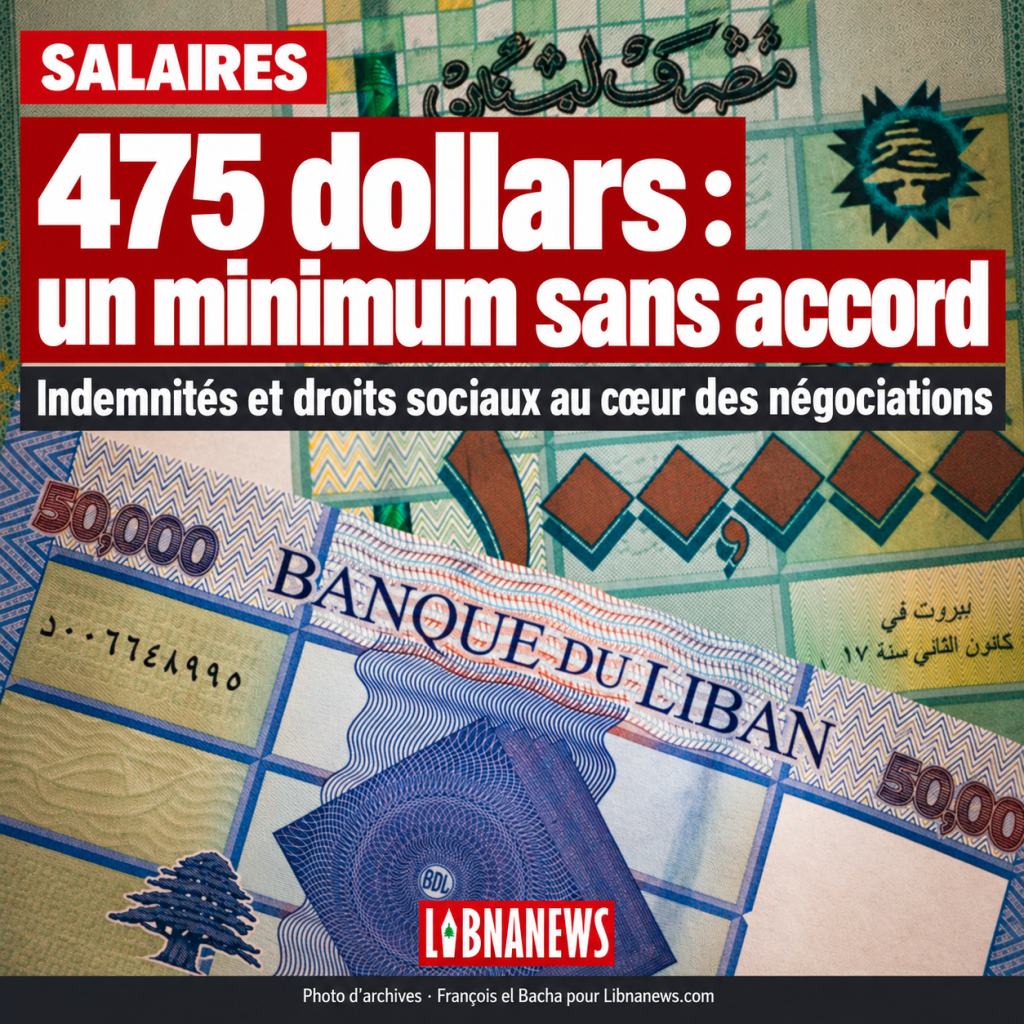
The negotiating deadline is over, but the increase in the minimum wage remains outstanding. According to Al Akhbar of 2 November 2026, the month granted by the Minister of Labour, Mohammad Haidar, to the index commission did not make it possible to conclude. The amount of $475 is now circulating between employers’ representatives and the General Confederation of Lebanese Workers. However, it does not constitute a signed agreement or a new legal threshold. The daily describes discussions slowed down by the demands of both sides. Everyone also has difficulties in getting their members to agree to compromise.
The meeting scheduled for the previous Friday was postponed to the middle of the week. It should enable a joint proposal to be discussed before it is examined by the index committee. The Commission could then forward the dossier to the Council of Ministers. This succession of steps remains to be accomplished. In the meantime, the gap between the amounts mentioned for living and the level around which negotiators appear ready to discuss remains significant.
Amount of $475 still subject to negotiation
Al Akhbar reports that employers have not formally approved any proposals. However, their representatives would suggest that a minimum wage of $475 could be accepted. For its part, the trade union centre would be willing to retain this amount. The newspaper points out, however, that this openness did not lead to a employers’ commitment. It is therefore necessary to distinguish the sum which serves as a point of discussion from a compromise actually adopted.
The current minimum quoted in the daily newspaper is £28 million, or about $313. An increase to $475 would represent an additional $162 and an increase of close to 52 per cent. Another amount had circulated at an earlier stage: $400. In this case, the increase would have been limited to $87 per month.
The absence of agreement does not relate solely to these amounts. The journal describes a negotiation in which raising the minimum is associated with other requests. The issue of payments to the National Social Security Fund, particularly for end-of-service allowances, is central. The level of wages and the conditions for settling these obligations are thus discussed in the same framework.
The cost of a family is not confused with an individual wage
Al Akhbar cites sources of the trade union centre. They refer to studies setting monthly family needs between $1,100 and $1,200. The daily accounts compare these estimates to the union availability to accept $475. The Committee notes that the latter amount represents approximately 43 per cent of a budget of $1,100. The comparison illustrates this distance, even if the needs of a family are not confused with an individual wage.
The criticism of Al Akhbar focuses on the method followed. The newspaper believes that discussions should be organised around prices, inflation and data from the Central Statistical Office. On the contrary, it describes a balance of forces dominated by political influences. In this reading, actors seek to avoid social mobilization while limiting the cost of compromise. This assessment belongs to the newspaper. It is not a finding shared by all negotiators.
Choucair invokes the ability of companies to pay
When asked by Al Akhbar, Mohammad Choucair does not set a minimum amount or ceiling for the proposed increase. He chairs the Union of Chambers of Commerce and Industry of Beirut and Mount Lebanon. According to him, the increase depends on what economic sectors can handle. It thus focuses on the constraints of enterprises, rather than on a common figure applicable immediately.
Choucair also distinguishes territories. For Beirut and Mount Lebanon, he claims that no one receives less than $400. He opposed this situation to the difficulties faced by the companies of Akkar and the South, which he considered less able to assume an increase. He also referred to the possibility of a new conflict and uncertainty over activity.
The daily challenges the use of these arguments to delay the increase. He noted that workers in the most vulnerable regions also had to pay for their housing, food and electricity. Economic risks therefore affect both companies and their employees. There is disagreement as to how these constraints should be distributed, but also on the place to be given to the needs of workers in calculating the minimum.
End-of-service benefits at the heart of disagreement
The social file exceeds the income paid each month. According to Al Akhbar, a large part of the employers refuse an adjustment without parallel resolution of the problem of end-of-service benefits. However, the versions differ on the exact scope of the concessions requested. This is one of the most obscure points in the negotiations.
Mohammad Choucair admits to the daily that the economic organizations want a staggering of the sums owed by the companies for these allowances. It denies, on the other hand, claiming other social security exemptions. Sources from the trade union centre present a different version. They refer to a broader set of concessions, exemptions and facilities, which would be sought in return for the wage agreement.
The employer’s representative thus spoke of an adjustment of payments, while union sources described more extensive requests. No cancellation of contributions or remission of debts is announced as acquired.
The declared wage also commits social rights
Finally, Al Akhbar points out the discrepancy between certain remuneration actually paid and the amounts declared to the National Social Security Fund. The daily reports that employees already earn more than the minimum envisaged. However, their full remuneration would not necessarily be declared. It presents this practice as a means of reducing contributions and end-of-service obligations. The declared remuneration therefore incurs social rights, including when the salary already paid exceeds the legal minimum.
As of the date of Al Akhbar’s publication, no increase was adopted. The deferred meeting was still to specify the amount proposed and the conditions attached to it. The next step was the possible transmission of a compromise to the index commission and then to the government.
Sources
Al Akhbar, November 2, 2026, page 5.





Comments