

Antony Blinken believes that Washington can push Tehran to negotiate, but doubts that it can get its surrender. In a TV interview on Monday, November 9, the former US Secretary of State pleaded for a diplomatic outcome. It highlights Iran’s size, its maritime façade and its remaining military capabilities. This assessment comes as Qatar continues to mediate between Washington and Tehran.
Blinken to Iran: Negotiating rather than capitulating
The report of this interview, published by an American financial media, reports its call to combine economic pressure and negotiation. Blinken believes that a new escalation would expose the United States to additional risks. It does not present any Iranian concession already obtained, nor does it present any agreement in preparation which it knows the terms.
He also criticises the US withdrawal from the 2015 nuclear agreement, decided by Donald Trump in 2018. According to him, the strikes damaged Iranian facilities without permanently eliminating the nuclear risk. His comments on possible buried stocks and surviving centrifuges constitute an analysis, not an on-site verified inventory.
A position already defended in Washington the day before
On Sunday, November 8, during a public meeting in Washington with Mike Pompeo, Blinken defended a similar line. The two former heads of American diplomacy spoke before the General Assembly of the Jewish Federations of North America.
Blinken then referred to the possibility of concessions, particularly on sanctions, to allow for negotiations. He proposed that sustained economic pressure should be maintained to this end. He invoked the 2015 nuclear agreement and the end of the Iran-Iraq war to distinguish a negotiated settlement from a capitulation.
Pompeo had, on the contrary, rejected the concessions and defended continued pressure on the Iranian regime. This disagreement relates to ways out of the conflict. Neither of them is currently conducting negotiations on behalf of Washington.
Geography illuminates the argument, not the outcome of the conflict
Iran’s dimensions provide a concrete basis for Blinken’s argument on the difficulties of prolonged war. United Nations data show an area of approximately 1.63 million square kilometres and an estimated population of 92.4 million by 2025. The figure often rounded to 90 million corresponds to an order of magnitude.
However, these data do not measure the current state of the Iranian arsenal or the ability of the power to withstand new operations. The political and military resilience mentioned by the former Secretary of State remains a strategic assessment. It does not mean that Iran would be immune from loss or pressure.
Qatari mediation continues in Paris
The debate took place after the November 9 meeting between Donald Trump and Qatari Prime Minister Mohammed bin Abdelrahmane Al-Thani. The US President then announced that he would not launch another offensive for the time being, citing progress towards a solution to the conflict. He maintained the possibility of acting if the situation changed.
On 10 November, the Qatari head of government was to present the results of his discussions to European and Saudi officials in Paris. The diplomatic sequence takes place on the margins of the G7 meeting of Foreign Ministers. These consultations are not yet worth announcing an agreement between the United States and Iran.
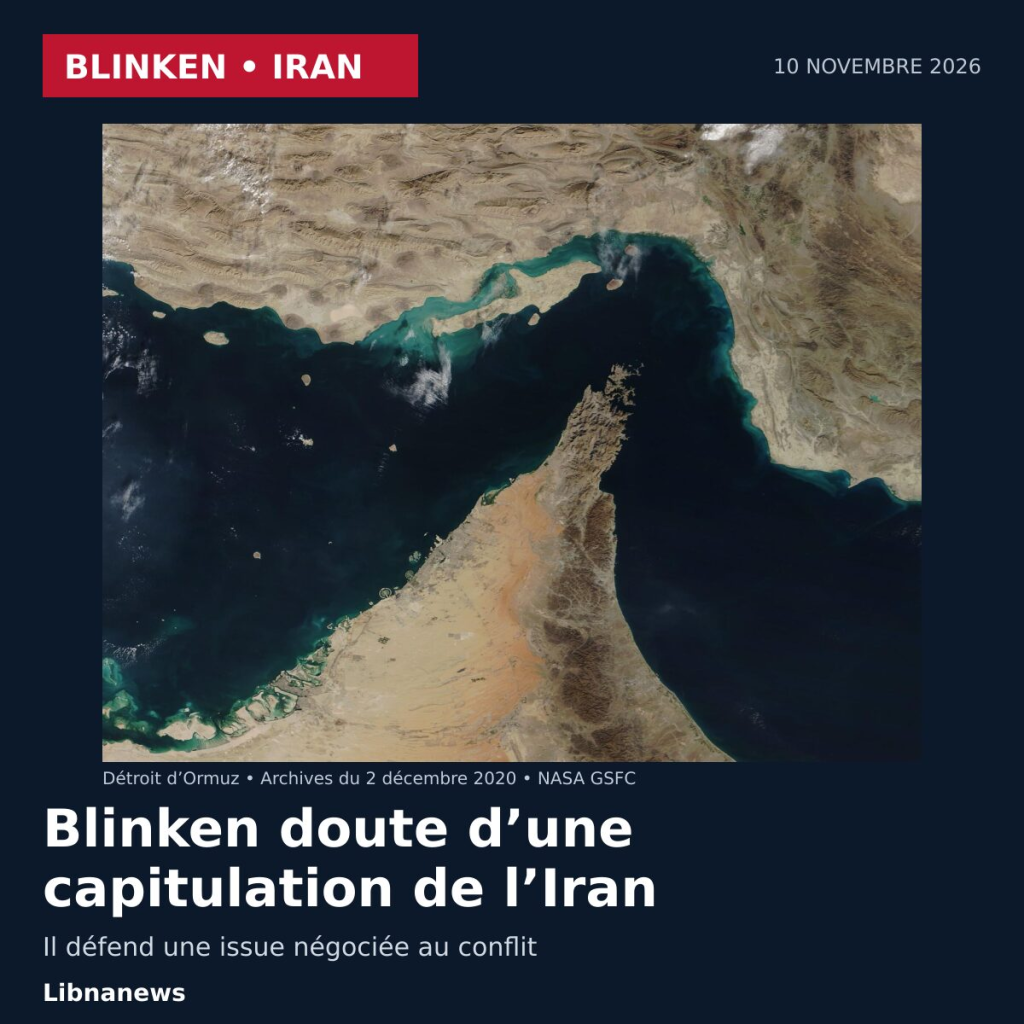
Archive photo: Ormuz Strait seen by Terra/MODIS, December 2, 2020. MODIS Land Rapid Response Team, NASA GSFC, public domain. Editorial dress; the view does not show the events of November 2026.





Comments