

The second episode of our series « LA transforms trades ». IA and school correction: behind the promise of annotated copies in seconds, studies draw several transformations. Tools facilitate the preparation of courses and provide useful feedback. Their ability to assign a stable score remains more uneven. For teachers, work is moving towards defining criteria, checking answers and accompanying students.
An assessment, rating and guidance decision do not entail the same responsibility. Bringing them together under the word « correction » blurs the debate. A commentary can help a student to repeat a reasoning. A note ranks its production according to a scale. A school decision can change its course. The results available in November 2026 suggest that these uses be examined separately.
IA and school correction: what experiences measure
In four American university courses in political science, researchers tested an organization involving teachers and GPT-4. Their study, published on 19 August 2025, covers 271 students and 3,080 short answers. The tool received the question, the correction criteria and examples already noted by the teachers. The scheme confided about 88% of the responses to AI.
The results support the possibility of assistance within this specific framework. Several notation features remain similar to those observed with human correctors. Students could request a new correction by a person. They felt, however, that human comments were slightly more useful.
Therefore, this protocol did not involve handing over a stack of copies to software without preparation. The teaching work preceded automation. Researchers have not established a universal percentage of time saved. Nor have they demonstrated a sustainable progress in learning. The small number of challenges alone does not measure the absence of errors.
In mathematics, notes that do not always coincide
A study published on October 28, 2026 has a less reassuring result. Hasan Fehmi Özdemir compared three teachers and four tools on answers from 196 college students from Şırnak, Turkey. The exercises required mathematical reasoning, beyond the choice of an answer. Copies were from the school year 2024-2025.
GPT-4o, Gemini 2.5 Flash, Microsoft Copilot and DeepSeek had the same scale, but without corrected examples. The tools found some general rankings among students. Their exact agreement with the human notes was only about three in ten cases. This does not mean that seven out of ten notes were objectively false: teachers could also diverge.
Variances reappeared when researchers submitted the same copies several times. Some tools also attributed reasoning absent from the answers. The study concerns a particular field, specific versions and protocol. It does not condemn any assisted correction. It shows why reading reasoning and applying a scale requires validation, especially when several approaches can lead to the right result.
A helpful comment is not necessarily a good rating
The educational interest also appears without automatic notation. An experiment published on 30 October 2026 divided 312 students into three groups. One received comments from an AI, another from a teacher, the last no substantial feedback. The final analysis selected 287 participants.
After revision of an argumentative text, the two accompanying groups achieved better results than the control group. The performance of human and automated feedback was within the margin of equivalence set by researchers. However, the stated motivation remained higher after the teacher returned.
Students knew the origin of the comment. The experiment involved a single institution and a rewriting cycle, with a local model. It therefore does not prove that AI is a sustainable improvement in school performance. It distinguishes two dimensions of the profession: helping to rework a text and making it want to continue this effort. A relevant assessment does not automatically replace the pedagogical relationship.
The most costed time saving concerns preparation
The British assessment of Aila, published on 6 October 2026, provides another benchmark. This assistant is used to prepare courses and their materials. The trial randomly distributed 464 primary teachers in 108 schools to two groups. The main analysis selected 416 teachers. Monitoring took place for 10 weeks in autumn 2025.
The Education Endowment Foundation’s synthesis estimates a 24% reduction in preparation time for the tasks studied. Participants were looking at working papers. Both groups could use other AI tools: the trial evaluated the intake of Aila, not all artificial intelligence against its absence.
This result does not mean 24% less teaching work or 24% time saved on copies. Use remained limited and opinions were divided. The quality of the resources assessed was not deteriorating, but experience did not demonstrate an improvement in learning. She measured a task of preparation, not the whole job.
Work changes before employment can be quantified
These experiments do not allow the calculation of a number of positions which the AI would replace. They describe tasks under specific conditions. Moving from this to a workforce forecast would require further data: classroom organization, audit time, cost of tools and institution selection.
Assisted correction nevertheless moves the steps to be examined. Before use, the teacher must specify what he wants to evaluate. After the generation, he must check that the comment is about copying. A fluid formulation can mask a bad reading. A correct suggestion may also refer to a notion that the class has not yet addressed.
The net gain therefore depends on the work kept around the tool. Producing more annotations is not enough if each requires a long recovery. Conversely, a relevant first return may leave more room for a targeted explanation. Total time must be measured, from the preparation of the criteria to restitution, rather than the only speed of generation.
Separate rules for aid and evaluation
In France, the framework published in June 2025 allows assistance in preparation and correction, under teacher responsibility. He asked to check the productions. Uses having a significant effect on the assessment or course of students require human supervision and prior validation by the competent authority.
The same framework excludes the sending of personal or confidential data to a general public AI. A copy does not necessarily become anonymous because its name has disappeared. Its content can still identify the student. The choice of service, the data transmitted and their retention are part of the arrangements to be checked.
In England, Ofqual maintains a more specific limit in its doctrine updated on July 16, 2026. The AI cannot be the sole corrector of an assessment falling within a regulated qualification. This rule does not constitute a general prohibition on classroom assistants. These French and English frameworks are not by themselves rules applicable to Lebanon.
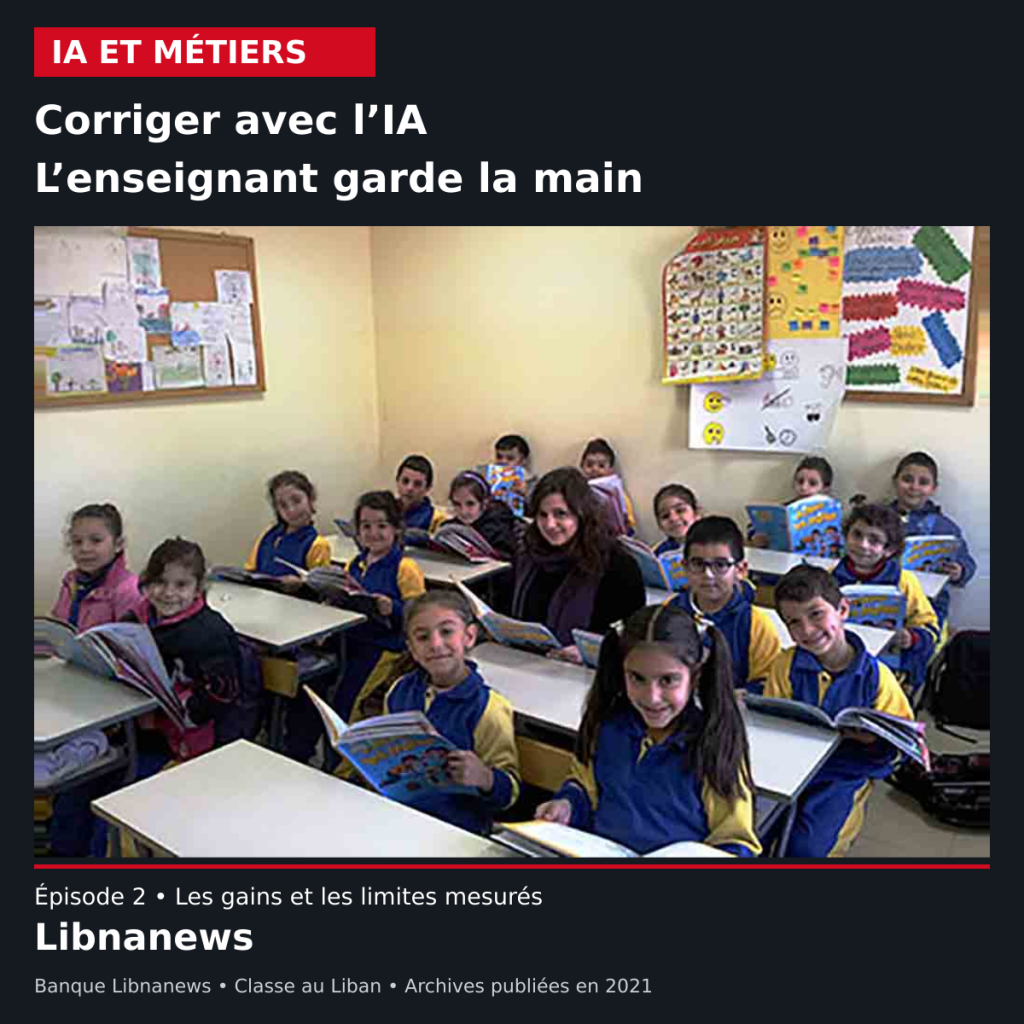
For a Lebanese institution considering these tools, foreign studies offer points of comparison, not ready-to-use validation. The language, the level of the pupils and the scale must correspond to the test carried out. Before extending usage, there is still a need to document the differences in ratings, the necessary corrections and the possibility of a human review. These local results will make it possible to distinguish a real relief from an additional control load.





Comments