

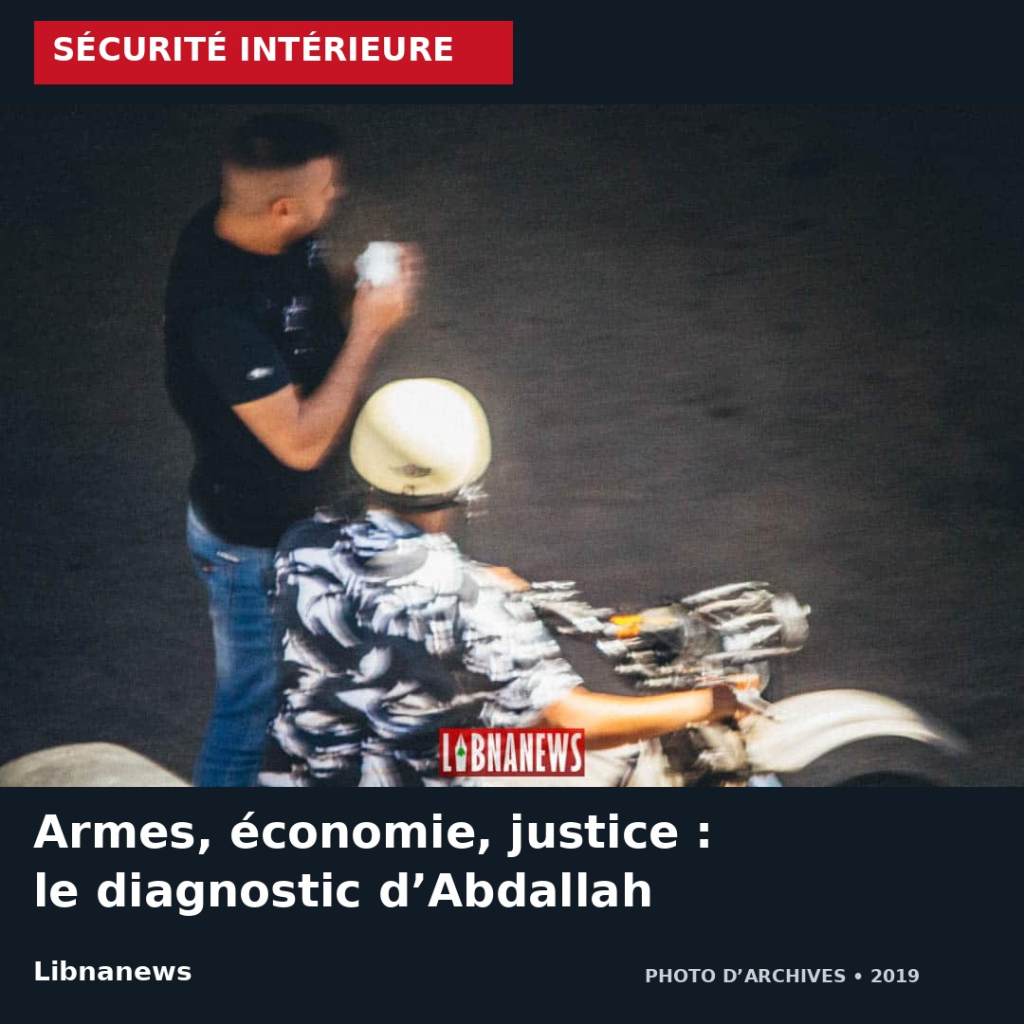
Internal security in Lebanon is not limited to the arrests announced in recent days. In an interview on November 10, 2026, Bilal Abdallah linked instability to out-of-control weapons, economic conditions and judicial weaknesses. The deputy for the Democratic Rally defends Minister Ahmad Hajjar. His intervention accompanied a revival of coordination between the Interior and Defence, announced the previous day in Baabda.
The speech of the parliamentarian moves the debate. He does not dispute the usefulness of police operations. On the contrary, it supports the services under the Ministry of the Interior and considers their action useful for national security. But the causes he’s advancing are beyond their ability to question suspects.
Internal security in Lebanon, beyond operations
Bilal Abdallah distinguishes between three factors: the uncontrolled flow of weapons, economic difficulties and weak judicial procedures. This reading is that of the Member. The interview does not include a statistical set of offences or measures to determine the respective weight of these factors.
Hajjar announces coordination with Defence
On 9 November, Ahmad Hajjar briefed President Joseph Aoun on the measures taken against theft and aggression. At the end of their meeting, the minister reported about twenty arrests. He also announced a forthcoming meeting with the Minister of Defence at the Ministry of the Interior to coordinate security action.
Hajjar stated that recent measures had reassured the population. This assessment remains with the Minister. He indicated that operations would continue with the Internal Security Forces, the army and other services. The presidential communiqué does not set the date of the announced meeting with the Defence.
The Minister cited Sabra’s intervention and his three arrests. Investigations still need to clarify the circumstances of the incidents, he stressed. The number of arrests is therefore not a record of convictions.
Political defence of the Ministry of the Interior
Bilal Abdallah, for his part, denounces a campaign against Ahmad Hajjar and his services. He accuses some circles of exploiting the incidents to attack their action. It does not provide, in this interview, the basis for establishing independently the existence or organisation of this campaign.
His intervention also carries a demand for internal unity. It considers that regional tensions and the risk of a new war make this cohesion a priority. He opposed this requirement to the settlement of political accounts. This is a political position, not the announcement of an agreement between the parties.
Judicial follow-up remains a decisive point
Abdallah’s emphasis on judicial proceedings points to an essential difference: arrest, investigation and trial are distinct steps. Individual responsibilities must be established in each file. Statements about confessions or past records do not replace a court decision.
The available announcements therefore describe a mobilization of services and a willingness to coordinate. They do not yet provide a complete picture of their effects. The next meeting announced between the Interior and Defence, and the subsequent investigations, will clarify the scope of this mobilisation.





Comments