

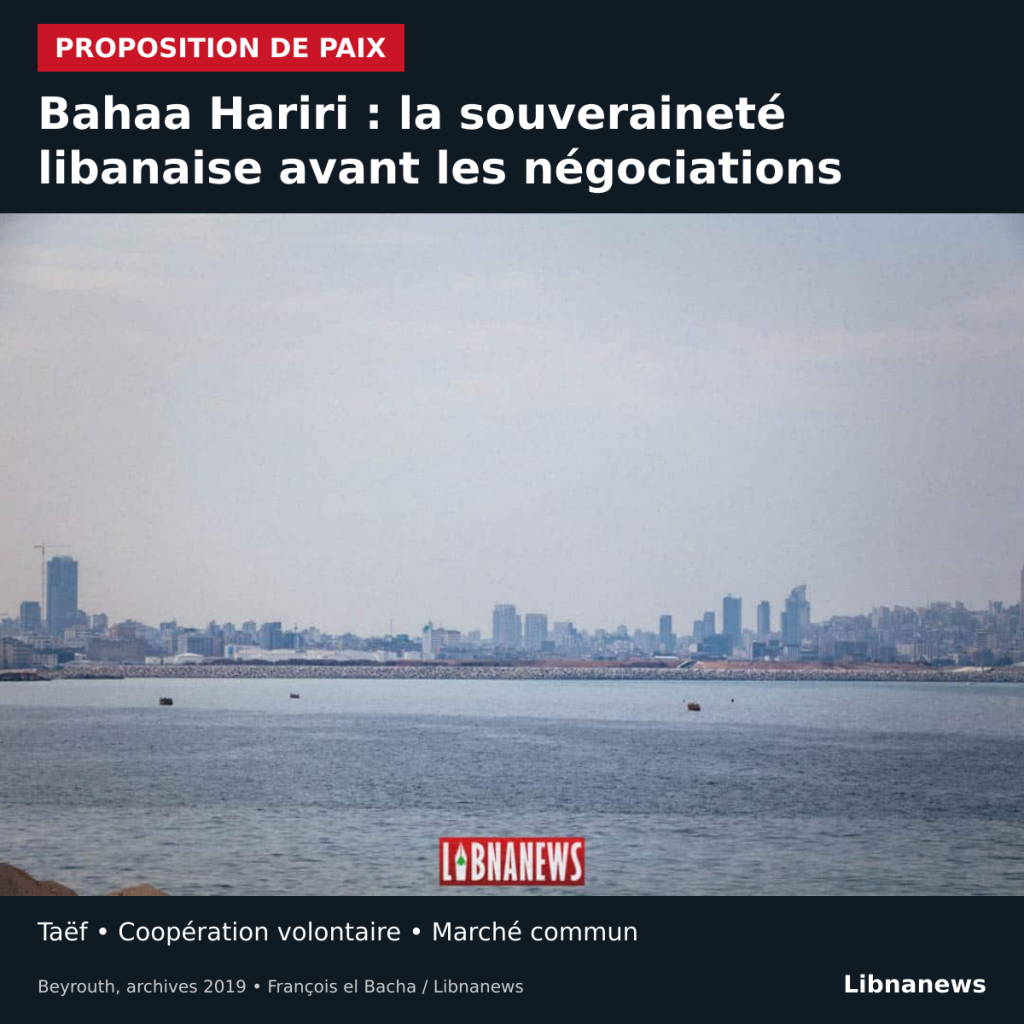
Bahaa Hariri defends a « warm peace » based on the restoration of Lebanese sovereignty and voluntary regional cooperation. In a speech delivered in Oxford, published on 9 November, it places the application of the Taif agreement and the state monopoly on arms before the opening of lasting negotiations. His speech set out a political proposal, without announcing an agreement between governments.
Baha’a Hariri’s starting point is Lebanese. It considers that a country deprived of control of its territory cannot negotiate under satisfactory conditions. In his view, the reconstruction of the institutions should enable Lebanon to adopt a common position. It thus links its regional project to a prior transformation of the functioning of the State.
His speech links three objectives: to restore effective public authority, to build peace beyond diplomatic arrangements and to develop common economic interests.
He said that « warm peace » began in Lebanon
Bahaa Hariri calls for the full application of the 1989 Taif Agreement. It also invokes Security Council resolutions 1559 and 1701. In its reasoning, these references must support the exclusive sovereignty of the State over the whole territory. They constitute the political conditions for credible negotiations.
It involves parallel armed structures linked to external agendas. It assigns them responsibility for weakening institutions, fragmentation of power and economic collapse.
The message addressed to Lebanese actors concerns the representation of the country. For him, the unity of public decision precedes a serious discussion on a lasting peace. It therefore defends a political order in which the institutions have the authority to negotiate and fulfil their commitments.
A common market rather than a single bilateral agreement
However, the proposal goes beyond the Lebanese framework. Bahaa Hariri considers that the conflicts in the Middle East are interrelated. It wishes to include them in a cooperation involving movement of persons, trade in goods, capital and knowledge. The announced objective is a gradual integration of economies.
It cites infrastructure, energy and digital as areas of common work. Food security, water and environmental policies are also included in this vision.
Bahaa Hariri proposes to divide future institutions between several capitals and major cities. He wants to give a geographical reality to the interdependence sought. European experience serves as a reference to explain this link between national identities and cooperation across borders.
He said that this construction should remain voluntary. It excludes a confederation imposed on the states of the region. It describes a network of common interests, based on shared institutions and law.
The Palestinian question integrated into its proposal
The scope referred to includes the Levant and Mesopotamia, Israel and Palestine as part of a two-State solution. Bahaa Hariri also wishes to see a transformed Iran participate.
It links this perspective to the right of Palestinians to self-determination. In his view, the peace he is defending presupposes recognition of the rights of the various components of the region. He refuses to reduce it to a commercial transaction or a territorial arrangement without reconciliation.
This dimension explains his choice of the expression « warm peace ». He wanted cooperation in travel, studies, work and exchanges.
Beirut in a financial and cultural role
Bahaa Hariri envisages a financial, cultural and economic hub for Beirut. He believes that Lebanon’s pluralism, openness and diaspora networks can support this ambition. However, this role is conditional upon the prior restoration of sovereignty.
It also calls on the United Kingdom to contribute to this reflection, in particular through its administrative experience. It expects this cooperation to have a positive effect on the Eastern Mediterranean, the Gulf and Europe.
At the institutional level, it insists on representative powers subject to accountability mechanisms. It considers that international commitments lose credibility when institutions are captured by narrow interests. This requirement of governance complements economic proposals in his speech.
Bahaa Hariri states that the Rafic Hariri Centre and its partners are working on the intellectual foundations of this approach. The concrete extension announced therefore remains that of reflection and dialogue. No treaties, timetable for implementation or common financing mechanism shall accompany this presentation.





Comments