

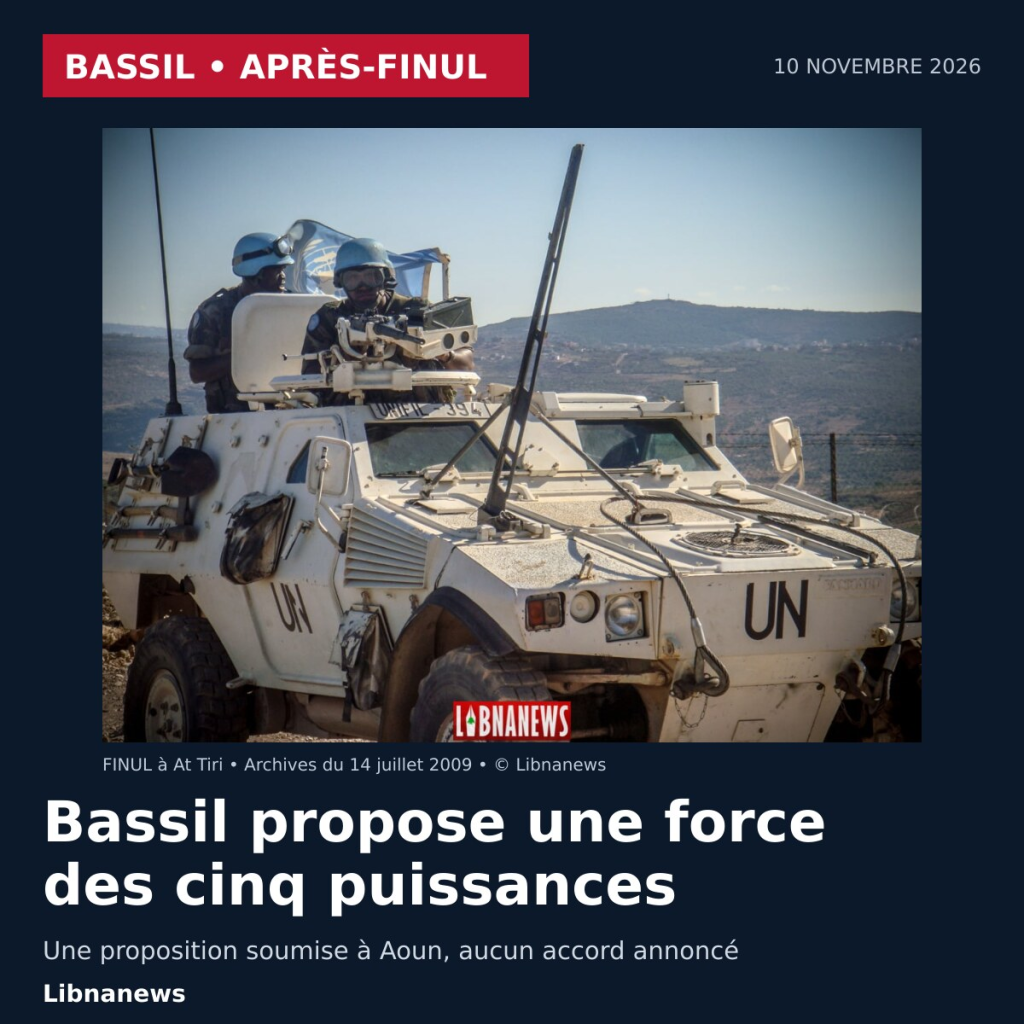
Gebran Bassil proposed, on Tuesday, 10 November, in Baabda, to establish an international force with the permanent members of the Security Council. The leader of the Free Patriotic Current presented this idea to President Joseph Aoun. It associates it with Israeli withdrawal, the Lebanese State’s arms monopoly and international safeguards. This initiative remains a proposal in a post-FINUL debate which has not yet resulted in an agreed arrangement.
Bassil proposes a force based on the five powers
At the end of his meeting with Joseph Aoun, whom he met at the head of a delegation, Bassil said that he had handed his project over to the president. He called for consultations with the countries concerned to get Lebanon out of the queue.
The composition it is advancing refers to the five permanent members of the Security Council: China, the United States, France, the United Kingdom and Russia. Bassil sees it as a way to balance the treatment of Lebanon and Israel. He believes that such an arrangement would withdraw Israel’s argument for the protection of its territory.
This assessment is that of the CPL leader. His statement does not mention any commitment from the five capitals. It does not specify the number of personnel, the chain of command or the funding. Nor does it define the rules for the intervention of the envisaged force.
Israeli withdrawal and State weapons
Basil links Lebanese sovereignty to two requirements: Israel’s withdrawal and the State’s commitment to arms exclusivity. It distinguishes these objectives from the adoption of a national security strategy, which it presents as an internal process.
It also calls for Lebanon to stay away from wars and confrontations between regional axes. The proposed international safeguards could be accompanied by defence agreements with States capable of protecting the country.
On relations with Israel, Basil defends a truce establishing lasting calm. It then evokes a comprehensive and just peace when its conditions are met. He refused, however, that the Israeli occupation should be used to impose normalization. These positions are not worth the announced negotiation of a treaty or government agreement on its draft.
A separate debate from the civil trail mentioned by Rubio
The day before, in Paris, US Secretary of State Marco Rubio had mentioned another possibility: a civilian verification mission. He indicated that he had approached this lead with Emmanuel Macron, on the margins of the G7 ministerial meeting.
Washington is looking for credible observers to monitor security commitments. Rubio stressed the need for a Lebanese and Israeli agreement. He did not announce any final format or deployment schedule.
The two interventions thus concern the international presence, but propose different criteria. Bassil emphasizes the participation of the five permanent powers. Rubio describes a verification function that could be civilian. There is no public element at this stage to present them as the two parts of a common plan.
The mandate of UNIFIL ends on 31 December
Resolution 2790, adopted on 28 August 2025, extended the mandate of UNIFIL for a final period until 31 December 2026. Operations must cease on that date and staff must withdraw in an orderly and secure manner within one year. The termination of the mandate therefore did not mean a simultaneous departure of all peacekeepers.
The text also calls for the withdrawal of Israeli forces from the occupied positions north of the Blue Line. It calls on the Lebanese authorities to deploy their forces there and to extend their territorial control. It provides for the consideration of options for the further implementation of resolution 1701 after the withdrawal of UNIFIL, without adopting the force proposed today by Basil.
The Baabda presentation now leaves two stages open: the response of the Lebanese authorities and the international consultations sought by the CPL. Basil was then received by the Speaker of Parliament, Nabih Berri, in Ain al-Tinah. The announcement of this meeting does not yet detail the results of their discussions.
Photo archive: UNIFIL French contingent at At Tiri, 14 July 2009. © Libnanews. Editorial dress; This image does not show the strength proposed in 2026.





Comments