

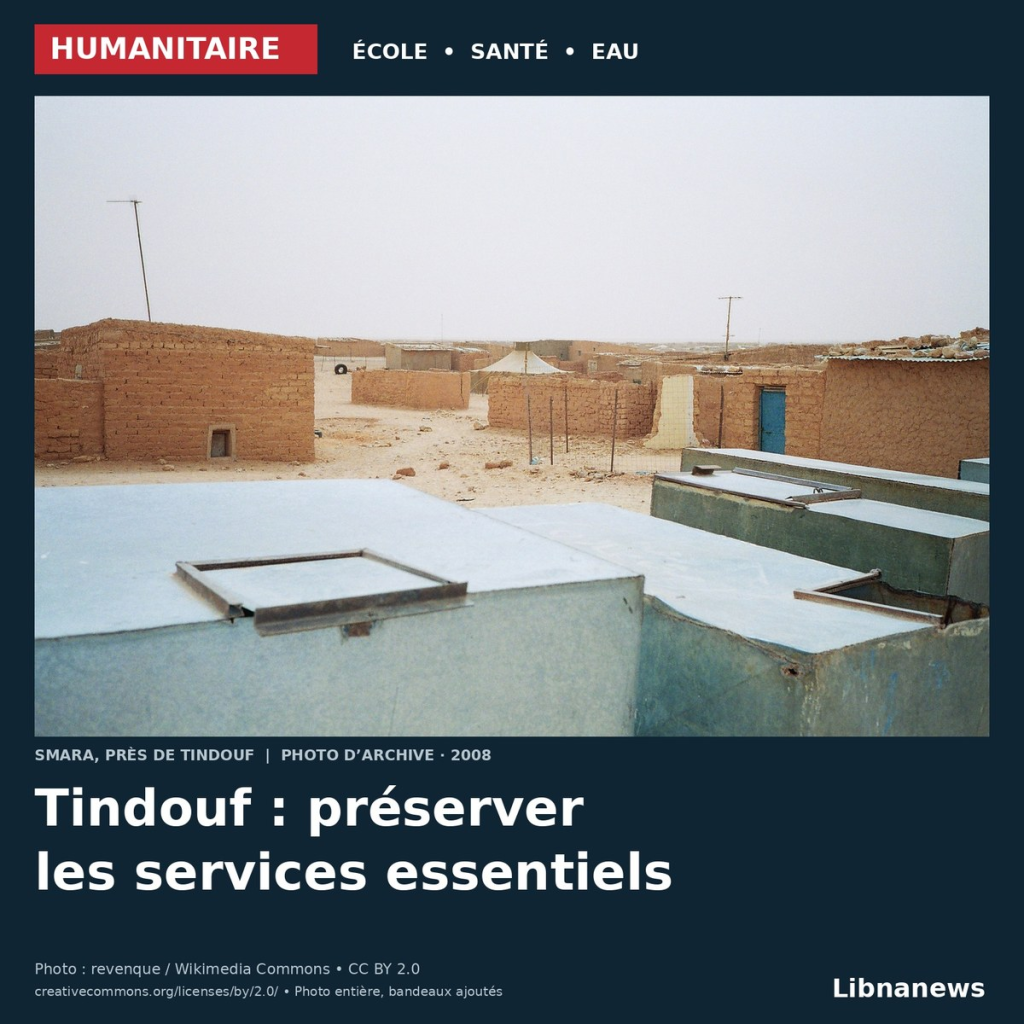
In the Saharawi refugee camps near Tindouf, Algeria, schools, care and access to water depend on sustainable financing. A UNICEF note issued in September 2026 highlights the fragility of the education system. The humanitarian plan for 2026–27 combines these needs with other essential services.
The five camps have hosted families from Western Sahara since 1975. In its communiqué of 16 February 2026, the World Food Programme recalls that their isolation in the desert has a strong dependence on food aid. The maintenance of services is also based on the refugee teams themselves, as highlighted in the UN response plan.
A school run by volunteers
The UNICEF educational note of September 2026 reported 41,700 children enrolled from pre-school to lower secondary school for the year 2026–27. It has about 1,800 voluntary educational staff, more than 80 per cent of whom are women. Delays in compensation can last up to six months and weaken the retention of teams.
The Agency advocates multi-year commitments aligned with the school schedule. It distinguishes an annual envelope of $3.7 million to $4.1 million for allowances, materials and teaching support from the cost of the comprehensive educational strategy, close to $12 million for 2026. These are indicative needs, not financing already obtained.
The note also recommends better monitoring of learning. In particular, it is based on an assessment of mathematics conducted in April 2024 with a targeted, non-random sample. The difficulties identified warrant educational support, but the results are not a representative measure of all students in the camps.
A two-year plan, distinct populations
Published in November 2025, the Response Plan for Saharawi Refugees 2026–27 brings together 27 partners and estimates its needs to over $177 million. This envelope covers two years of intervention in food, health, education, water and shelter in particular. It does not provide information on the amounts actually received as at 3 November 2026.
The plan selects 173,600 people as the basis for calculating assistance. His methodological note states that this figure comes from a 2018 interagency study that cross-references identification, health and education data. It therefore does not correspond to a census conducted in 2026. Recipients of each program must be distinguished from this planning population.
Health needs documented in 2025
In its 2025 review published on 28 April 2026, UNICEF reported that nearly half of community health centres needed urgent rehabilitation. The Agency notes shortages of trained volunteers, irregular medical supplies and difficulties in maternal and neonatal services. An outbreak of diphtheria, which occurred in October 2025, also required a vaccine response.
Preliminary results of the 2025 nutrition survey, announced by UN agencies on 25 June of this year, reported 13.6 per cent of the total acute malnutrition among young children and a stunted growth rate in about one in three children. The study, conducted by University College London with humanitarian partners, also reported a high incidence of anaemia. These data describe the 2025 survey, not a new November 2026 evaluation.
WFP reported in its communiqué of 16 February 2026 that it distributed more than 22,000 tons of food to 133,000 beneficiaries in 2025. Special nutritional foods had also been provided to 15,000 children under the age of five. These numbers describe the assistance provided, without constituting a count of all the inhabitants of the camps.
Water, from drilling to distribution
Plan 2026–27 describes a supply based on deep water and water treatment, in particular to reduce salinity. Some of the inhabitants remain dependent on tanker trucks. Priorities include network expansion and maintenance. In addition to new installations, the availability of parts and technical teams determines the continuity of service.





Comments