

Germany, France, the United Kingdom and Ukraine call on Russia to accept an energy truce during the winter. Their joint statement, published on Thursday 19 November after the Berlin meeting, also called for a ceasefire allowing food exports to the Black Sea. It specifies the guarantees envisaged for Kyiv after a halt to the fighting, without announcing Russian acceptance or peace agreement.
An energy truce proposed to Russia
The German document presents the energy truce as a first step towards the cessation of hostilities. Its proposed duration covers winter. However, it does not lay down a date of commencement, a detailed list of the installations concerned, or a specific procedure for monitoring the suspension. It is a call to Moscow, not an announcement of an effective interruption of strikes.
The four leaders associate this proposal with a second objective: to allow food exports from the Black Sea region. They invoke the security of passage of ships and the freedom of navigation necessary for global supply. Again, the text calls for an agreement. It does not announce the reopening of a corridor, departure schedule or a maritime arrangement already accepted by the parties.
The declaration condemns the Russian attacks on Ukrainian civilians and civilian infrastructure. It also provides for additional efforts, with third countries, to strengthen Ukraine’s missile defence before winter. This aid and the proposal for a truce are two distinct aspects: the strengthening of support is not presented as suspended from a favourable Russian response.
Four leaders carry the Berlin text
The title of the document designates the leaders of Germany, France, the United Kingdom and Ukraine. His introduction states that the members of the Coalition of Volunteers, Ukraine and the United States met in Berlin. US participation should therefore not be confused with the identity of the four authors of the declaration.
The text then presents a broad consensus between the members of the Coalition and Ukraine. It supports a direct dialogue between Kyiv and Moscow, with American and European participation. It reaffirms that international borders must not be changed by force and that Ukraine must be able to choose its alliances and security arrangements.
This declaration is a different step from the Shenzhen Summit held on the same day between Donald Trump, Xi Jinping and Vladimir Putin. The document published in China did not announce a ceasefire in Ukraine. The detailed proposals in Berlin therefore do not constitute the modalities for implementing a three-party pact in China.
Guarantees provided after a ceasefire
The leaders resumed the commitments discussed in Berlin in December 2025 and in Paris in January 2026. They call for strong and legally binding security assurances for Ukraine as soon as a ceasefire enters into force. Their character must be defensive, with close coordination with Washington.
The document lists several possible components: sustainable military, financial and technical assistance; participation in a proposed US-led ceasefire monitoring mechanism; and a European-led multinational force with US support. It does not declare these devices deployed in Ukraine.
It also envisages a legally binding commitment to take steps to restore peace and security in the event of another Russian attack. This formula remains subject to national procedures. It does not activate Article 5 of NATO and does not transform Ukraine into a member of the Alliance. The communiqué also states that any negotiations concerning the European Union or NATO would require the agreement of their respective members.
Financial commitments are not a new envelope
The declaration reaffirms the NATO allies’ commitment to provide EUR 70 billion in military equipment, assistance and training to Ukraine in 2026 and at least an equivalent level in 2027. It also recalls the EUR 90 billion foreseen under the European Union support loan by the end of 2027.
These amounts refer to commitments and instruments already established. They should not be presented as two new cheques released on Thursday, nor should they be added to announce a new aid of EUR 160 billion. The document does not provide a breakdown for such a calculation. It provides for the continuation of joint work on Ukraine’s financial needs in connection with agreed reforms, including anti-corruption.
At the same time, leaders want to increase pressure on Russian oil and gas revenues, illegal financial channels and circumvention of sanctions. This policy does not amount to the publication of new lists of applicable sanctions. The next step for both the energy truce and food exports is to secure an agreement with Russia, which is not mentioned in this declaration.
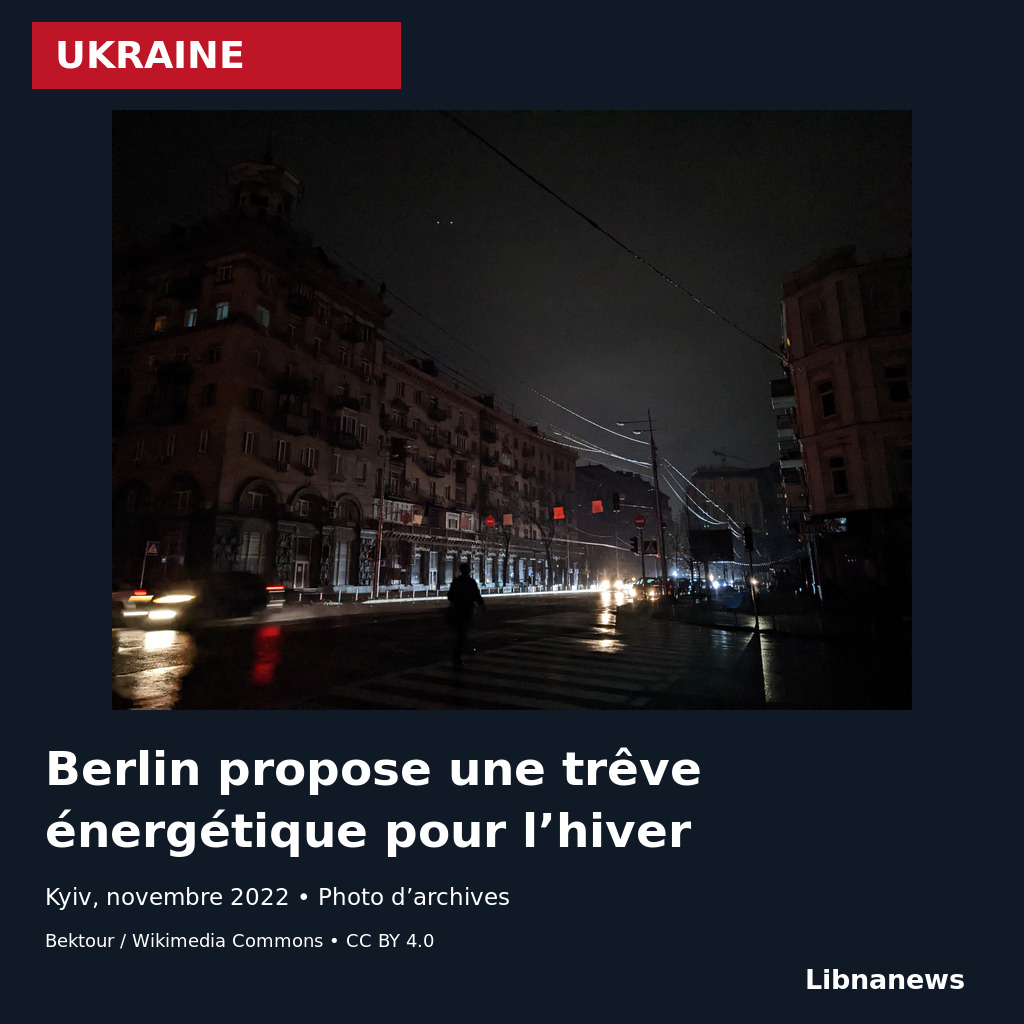
Photo archive: Kyiv during a power cut, November 25, 2022. Bektour / Wikimedia Commons,CC BY 4.0. whole photograph preserved, resized and dressed Libnanews; it does not represent the Berlin meeting.





Comments