

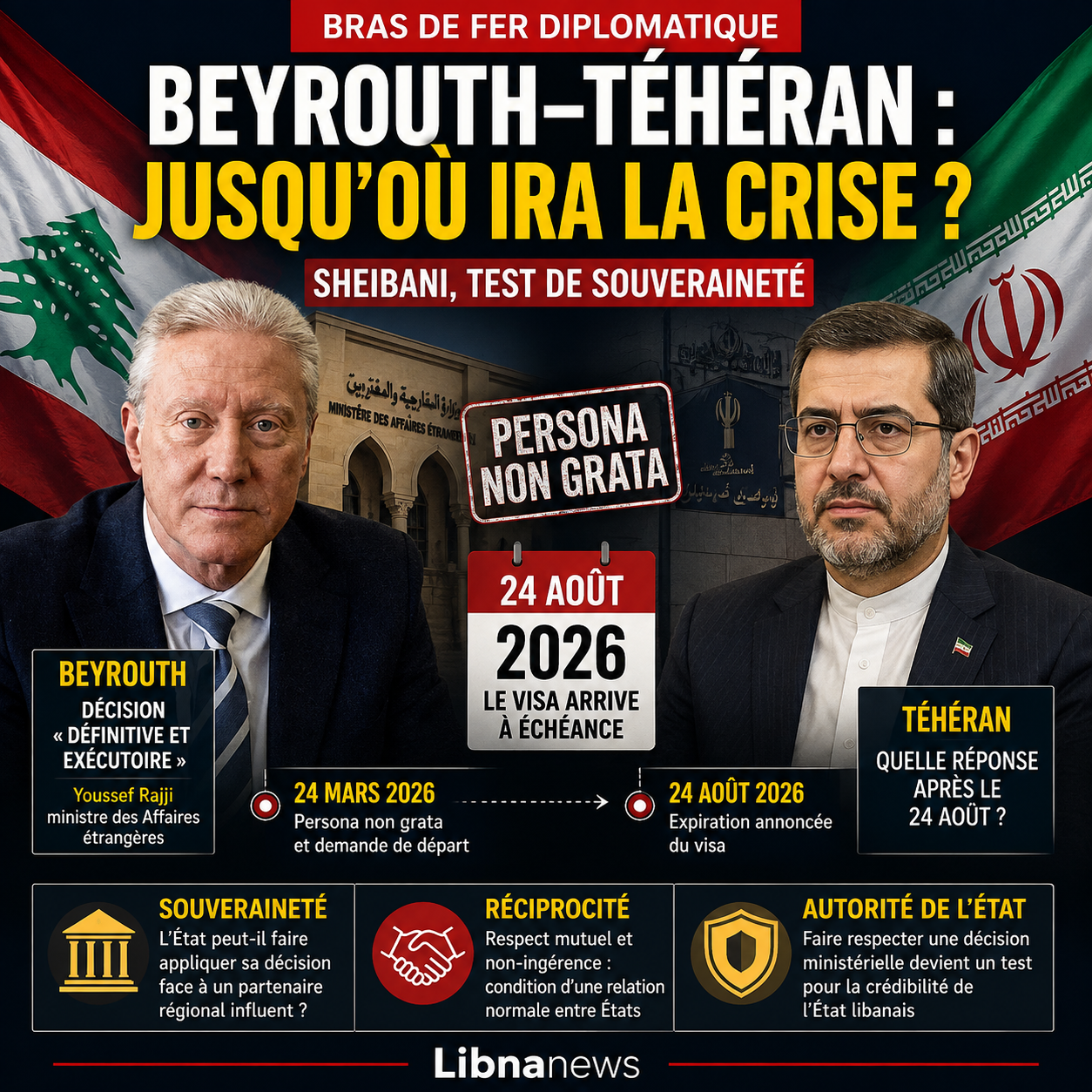
The presence in Lebanon of Mohammad Reza Rauf Sheibani, a diplomat appointed by Tehran as ambassador but whose approval Beirut has withdrawn, has become a test of sovereignty for the Lebanese State. A few days after the announced expiry of his visa, on 24 August 2026, Foreign Minister Youssef Rajji tightened the tone: the retention of Sheibani on Lebanese territory would, in his view, be incompatible with a sovereign, final and enforceable decision. Behind this apparently technical issue is now a broader question: how far can Lebanon enforce its diplomatic decisions against Iran, an influential regional partner and historical support for Hezbollah?
Sheibani, a dossier that has become a test of sovereignty
The current sequence does not start in August. On 24 March 2026, the Lebanese Ministry of Foreign Affairs withdrew its agreement to the accreditation of Mohammad Reza Rauf Sheibani and declared persona non grata. Beirut then asked him to leave the territory by 29 March. The Ministry had invoked statements considered to be interference in Lebanese domestic policy as well as meetings with unofficial actors who allegedly did not respect the diplomatic practices expected.
This distinction is important. Sheibani is presented by Iran as his Ambassador-designate, but he has not been accepted as Ambassador by the Lebanese State. The dispute therefore does not concern the recall of a regularly accredited ambassador. It concerns the prolonged presence in Lebanon of a diplomat whose approval was withdrawn and whom the host country has formally declared undesirable.
On 20 August, in statements taken from the Lebanese and regional press, Youssef Rajji sought to close the door to any alternative interpretation. For the Minister, the existence of a visa still valid until 24 August cannot neutralise the previous decision of Lebanese diplomacy. From the moment a diplomat was declared persona non grata, he argued, a residence permit or prior entry permit is no longer a sufficient basis to justify his continued presence in the country.
Rajji thus presents the case as a matter of state authority, not as a mere administrative problem. In its argument, allowing Sheibani to remain or regularize her situation would mean admitting that a sovereign decision of the Lebanese executive can be suspended, circumvented or renegotiated under political pressure. It is this point that gives the case a greater scope than the individual status of the Iranian diplomat.
The Beirut-Tehran crisis now depends on execution
The minister also placed a political condition on the return to normal relations with the Iranian mission. According to what was reported this week, the normalization of diplomatic operations depends first and foremost on respect for Lebanese decision-making and, more broadly, on the sovereignty of the country and the rules governing relations between States.
This formulation moves the folder. Beirut no longer only asks what Sheibani will do after the expiry of his visa. The ministry now links the quality of the relationship with Iranian representation to Tehran’s ability to recognize a Lebanese decision that it effectively challenges by maintaining its diplomat in the country.
Rajji also denounced the actions of Iranian officials in Lebanese internal affairs. Criticisms include statements from Tehran on government choices and Hezbollah-related issues. In the reading advocated by the Minister, the relationship with Iran can only function normally on a basis of institutional equality: Iran can defend its interests and positions, but it cannot replace the Lebanese authorities when they decide on issues of domestic policy or diplomatic representation.
Hezbollah places Iran at the heart of the internal debate
The diplomatic incident cannot be separated from the debate on Hezbollah weapons, but it does not diminish. The Lebanese Government has initiated a process aimed at strengthening the authority of the army and limiting armed structures beyond direct State control. Rajji himself has repeatedly expressed his support for the disarmament of Hezbollah and has publicly described the Iranian influence on the movement as a determining factor.
It is in this space that the Sheibani case takes on a symbolic dimension. The dispute does not concern a shipment of weapons or a military operation. It concerns the ability of a Lebanese ministry to impose a decision within its competence on a representative of a State which maintains close links with one of the country’s main political and military actors.
The regional context further enhances the sensitivity of the case. Washington continues its campaign of pressure against networks linked to Iran and Hezbollah. On 20 August, the United States announced new sanctions against persons accused of participating in financial channels supporting the Lebanese movement and again stressed its links with Iranian structures. This US pressure is part of the regional landscape, but it does not reduce the Lebanese decision on Sheibani to a Washington request. The Lebanese official documents describe the withdrawal of approval as a State decision based on diplomatic rules and on complaints of interference.
Lebanese decision partially without effect
The heart of the problem is precisely here. The March decision was clear: withdrawal of the accreditation agreement, declaration of persona non grata and request for departure. Yet Sheibani was still in Lebanon several months later. This persistence turns a diplomatic incident into questioning the State’s ability to execute.
Under diplomatic law, the receiving State has wide discretion to refuse or withdraw acceptance from a foreign representative. The Vienna Convention on Diplomatic Relations provides that a State may declare a member of a personala non-grata mission without being obliged to give reasons for its decision. The sending State shall then recall the person concerned or terminate his or her duties. The principle therefore leaves little doubt about Lebanon ‘ s right to refuse Sheibani as a diplomatic representative.
The difficulty moves towards practical application. How can this decision be enforced if the person concerned does not leave? How far can the Lebanese administration go without causing an escalation with Tehran? And what institution must intervene after the visa expires if the diplomat remains in the territory?
Tehran can respond without breaking with Beirut
Diplomatic escalation is possible, but its forms remain open. Iran could formally protest, reduce the level of its contacts with the ministry, convene the Lebanese representative in Tehran or adopt a measure of reciprocity towards a Lebanese diplomat. He could also choose to let the case fall by changing his representation in Beirut. As of 21 August, there is no indication of which of these scenarios will be used.
Above all, the crisis around Sheibani must be distinguished from a breakdown in diplomatic relations. As early as 24 March, the Lebanese Ministry of Foreign Affairs had explicitly stated that the withdrawal of the Iranian diplomat’s permission did not constitute a break with Iran. On the contrary, Beirut claimed to want to maintain good relations, provided that they were based on reciprocity, mutual respect and non-interference.
The crisis can therefore worsen sharply without reaching this threshold. Between a normal relationship and a formal breakdown exists a range of measures: reduction of contacts, repeated summonses, recall of ambassadors for consultations, administrative restrictions, refusal of diplomatic appointments or freezing of certain cooperation mechanisms.
The previous one counts as much as the diplomat
This dimension explains the firmness of Rajji’s vocabulary. If the ministry accepts that a diplomat declared undesirable remains in the country for a long time, the precedent would immediately exceed the Iranian case. It would mean that a foreign policy decision can be contested in its application according to the political weight of the State concerned or its local relays.
Sovereignty is not limited to border control or the monopoly of force. In this case, it measures itself to something much more administrative: the ability of an institution to enforce a decision taken in its area of competence when it upsets a powerful regional partner.
This is also what distinguishes the Sheibani dossier from the general debate on relations between Lebanon and Iran. The Ministry of Foreign Affairs does not formally seek to redefine the entire bilateral relationship in this matter. He asked for a specific measure to be applied to a specific diplomat. If this measure cannot be implemented, then the institutional difficulty becomes more important than its original purpose.
24 August becomes a political deadline
The announced expiry of the visa on 24 August does not, in Rajji’s argument, constitute the origin of the obligation to leave. In his view, this was the result of the March decision. But the date now provides a clear administrative deadline around which the crisis can crystallize.
If Sheibani leaves the territory, Beirut may consider that its decision has finally been implemented and pave the way for a new Iranian appointment in accordance with Lebanese procedures. The relationship with Tehran would remain tense, but litigation could then return to the traditional diplomatic framework.
If it remains, the question will change in nature. It will no longer deal with a divergence of interpretation concerning its status, but with the means available to the Lebanese State to enforce a decision which it presents as final. The government will then have to determine how far it intends to go and with which administrative, diplomatic or political instruments.
This makes the Sheibani case more than an episode between two ministries. It puts to the test a central promise of the Lebanese official discourse: restoring the state’s ability to decide without the weight of an internal actor or regional power being able to suspend the effect of its decisions. The next concrete development is now close: the visa that Youssef Rajji says will expire on 24 August places the Iranian response, and especially the action capacity of Beirut, at the center of the next few days.




