

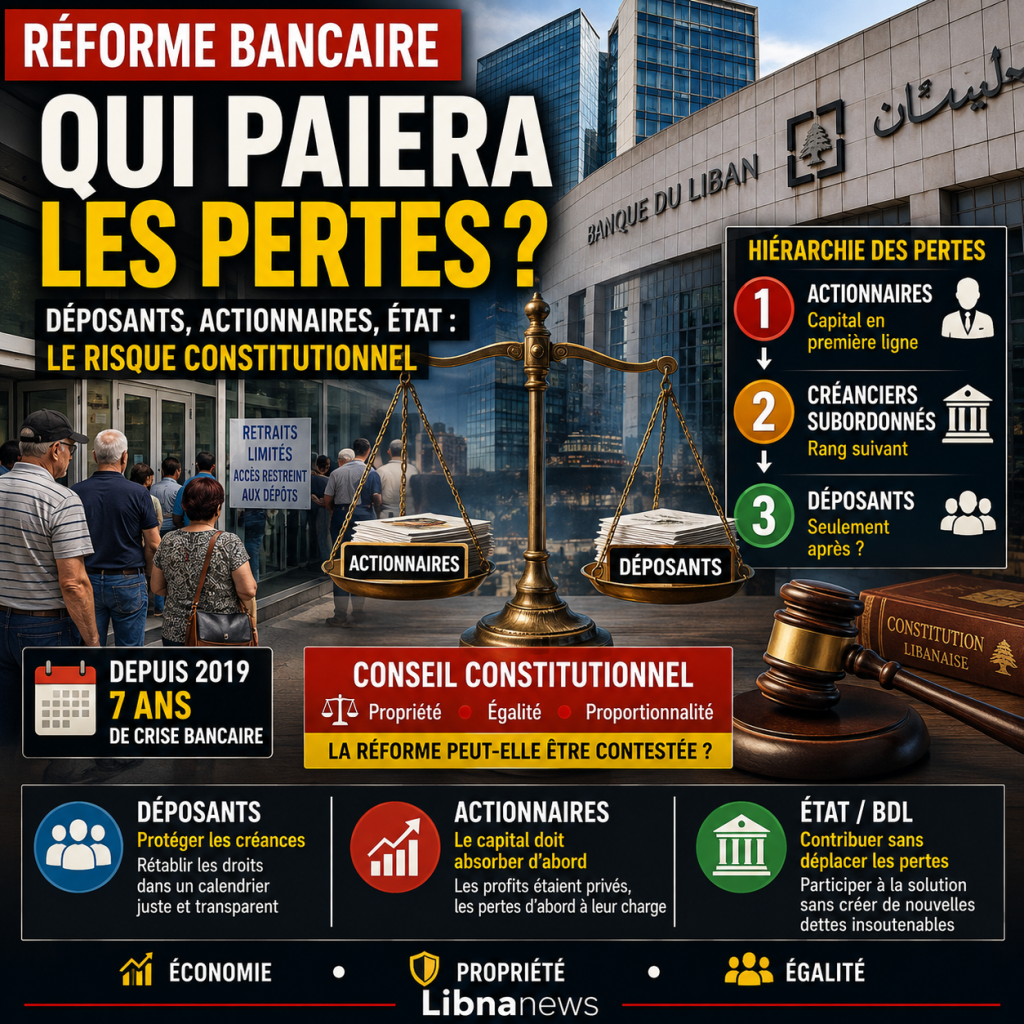
Lebanese banking reform is entering its most difficult phase. The debates reported on 21 August on the new restructuring framework show that the problem is no longer just how to end a crisis started in 2019. It is now necessary to determine who will absorb the accumulated losses, in what order and with what legal guarantees. Behind the financial mechanisms is a constitutional battle. If the scheme infringes the rights of depositors or overly protects bank shareholders, its provisions could be challenged before the Constitutional Council.
The economic stake is considerable. Lebanon cannot rebuild a viable banking system without recognizing the losses that have destroyed the balance sheets of banks and the Bank of Lebanon. But recognizing these losses is not enough. We have to divide them. It is precisely here that the economy meets the law: restructuring can be financially coherent while becoming legally vulnerable if it changes the rights of creditors without sufficiently solid criteria.
Banking reform leads to loss-sharing
Since 2019, the Lebanese system has been operating in an exceptional situation that has become almost permanent. Depositors have lost free access to a large part of their assets, banks have imposed restrictions without a comprehensive resolution framework being established for several years, credit to the economy has contracted and a large part of the transactions have moved to cash.
The result goes well beyond the issue of blocked deposits. A bank normally performs an intermediation function: it collects savings, assesses risk and converts part of these resources into loans for businesses and households. When confidence disappears, this mechanics block. The economy can continue to operate, but it does so with less credit, more cash and a reduced capacity to finance investment.
Restructuring is therefore essential. It must determine which banks remain viable, which must be recapitalised, merged or liquidated, how to deal with their impaired assets and how to progressively restore access to deposits.
But this operation involves an issue that the various Lebanese authorities have long postponed:who has to pay the losses already incurred?
This choice cannot be offset by an accounting formula. A bank loss exists even when it is not officially recorded. Leaving it for years in the balance sheets does not make it disappear; It simply postpones its recognition while keeping applicants in uncertainty.
Shareholders cannot stay safe
This is where the responsibility of bank shareholders becomes central. In normal banking restructuring, capital is the first line of loss absorption. A shareholder owns a bank because he owns its capital and benefits from its profits when the establishment thrives. This property also implies a risk: when the value of the assets becomes insufficient, the capital must absorb losses before the creditors of higher rank.
This principle is essential in the Lebanese case.
In the years leading up to the collapse, banks benefited from an extremely profitable model based, inter alia, on exposure to the State and the Bank of Lebanon. High rates were used to attract deposits, while investments in the central bank and public debt generated significant income. The shareholders therefore benefited from the returns generated by this model when it was operating.
They cannot economically demand that the consequences of its collapse be borne first and foremost by those who had entrusted their money to the institutions.
The argument that banks were themselves victims of the State and the Bank of Lebanon is not sufficient to absolve their responsibility. Banking institutions were not merely passive depositaries. Their boards of directors chose their risk policies, validated their exposures and paid their shareholders.
This does not mean that bank capital will be sufficient to cover all losses. It is clearly insufficient in view of the magnitude of the financial imbalance. But insufficient capital is not a reason to artificially preserve the former owners.
The relevant question is different:did the shareholders actually absorb all the losses corresponding to their rank before part of the cost was transferred to the depositors?
If the answer remains ambiguous, the reform will retain an economic, political and potentially legal weakness.
IMF insists on loss hierarchy
The International Monetary Fund intervenes precisely on this point, but its role must be properly defined. The IMF does not write the details of each article instead of the Lebanese Parliament. It assesses whether the overall strategy is conducive to rebuilding a viable banking sector, restoring financial sustainability and respecting recognized principles of banking resolution.
In February 2026, his services explicitly insisted on the hierarchy of claims. Their position is particularly important: no loss should be attributed to depositors until it has been borne by shareholders and lower-ranking creditors.
This principle obviously does not guarantee that all deposits can be repaid immediately and in full. Rather, it establishes the order in which losses are to be absorbed.
The difference is fundamental.
The Lebanese public debate sometimes mixes two distinct issues: the recognition of a depositor’s right to his bank and the economic capacity of the system to immediately return the entire claim. A right may be recognised even though its repayment is spread or subject to restructuring. It is precisely this transformation of economic law that must be legally regulated.
The IMF also calls for credible banking restructuring and an independent and transparent resolution process. The aim is to emerge from a situation where institutions can continue to exist without their true solvency being definitively established.
Why the Constitutional Council Could Come On
The constitutional risk arises when the legislator transforms the claims of depositors or allocates losses in a manner likely to affect the guarantees attached to property.
The Lebanese Constitution protects private property. Bank deposits should not, however, be understood as banknotes physically stored in a safe in the client’s name. Legally, the deposit essentially creates a depositor’s claim on the bank. The constitutional question therefore concerns how the law can change the value, the conditions for repayment or the availability of this claim.
Any restriction is not automatically unconstitutional. A State facing a systemic crisis may adopt exceptional measures to protect the economic order and public interest. But these measures must be based on a sufficiently strong justification and respect the applicable principles, including equality and proportionality.
The problem would become particularly sensitive if a law significantly reduced the rights of depositors while preserving a significant value for the benefit of existing shareholders.
Such an architecture would reverse the normal economic logic of investment. The depositor would become the one absorbing the loss while the bank owner would retain part of the residual value of the establishment.
It is precisely this type of imbalance that could fuel a remedy.
A question of ownership, but also equality
The potential litigation would not be limited to property rights. Differences in treatment between categories of applicants could also be examined.
Restructuring must necessarily establish categories. Small deposits may benefit from higher protection. Large deposits can be repaid longer or partially converted into financial instruments. Specific treatment may also be provided depending on the nature of the accounts.
These distinctions may have economic and social justification. But they must be based on objective criteria.
The more the reform increases the categories, exemptions and special treatment, the more the legislator must be able to explain why two creditors in comparable situations do not enjoy the same rights.
The constitutionality of the scheme will therefore depend not only on the amount of money returned, but on the logic used to distribute the sacrifice.
The real subject is the residual value of banks
A often neglected economic issue lies behind the loss debate:who will own the banks after their restructuring?
Suppose an establishment is technically insolvent. If the State or Bank of Lebanon absorbs part of its losses, if the depositors see their claims reduced or transformed, and then if the bank becomes viable again, a new economic value appears.
To whom should this value belong?
If the former shareholders retain their securities after other players have borne the bulk of the consolidation, they benefit indirectly from the restructuring financed by the losses of the others.
This is why erasing or diluting former shareholders is not an ideological sanction against banks. It is an economic mechanism of resolution.
Owners may retain their position if they provide sufficient new capital to recapitalize their establishment after recognition of losses. If they cannot, their participation must logically be diluted or even cancelled according to the bank’s net position.
Artificially protecting historical ownership would also create an incentive problem. This would mean that profits remain private during expansion periods while systemic losses are transferred to depositors or taxpayers when the model fails.
Making the State pay does not erase losses
The other often advanced solution is to transfer a large part of the bill to the state. It seems to protect applicants, but it also poses an economic problem.
The Lebanese State does not have a mass of money independent of society. Its resources come from taxes, assets, future income or debt. To fully assume bank losses to the Consolidated Revenue Fund is therefore to transfer them to present and future taxpayers.
This option may be necessary for part of the restructuring, particularly where the State’s liability for the accumulation of losses is established. However, it cannot be considered an unlimited source of funding.
An unsustainable public debt would eventually recreate the problem that the reform is seeking to solve. The banking system could be recapitalised at the price of a State that is again unable to meet its commitments.
The same reasoning applies to the Bank of Lebanon. Using its assets or future income can help resolve the crisis. But imposing impossible commitments to finance would simply migrate losses from one balance sheet to another.
Doing nothing is also a transfer of losses
Criticism of reform therefore raises real questions. But the status quo is not a protective solution for depositors.
Since 2019, the lack of comprehensive settlement itself has resulted in a breakdown of losses. Depositors in need of liquidity sometimes had to accept unfavourable conditions to access their funds. Those with fresh income in foreign currency or assets abroad were much less exposed. Companies had to operate in a largely dollarized economy dominated by cash.
In other words, not voting for reform does not mean refusing « haircut ». This may mean allowing an implicit, uneven and untransparent adjustment to continue.
The absence of restructuring also prevents us from knowing which banks are truly viable. A banking system cannot start financing the economy as long as the value of its assets, liabilities and capital remains contested.
Lebanon thus faces two opposing risks. Misconceived reform could legalize an unfair distribution of losses. The lack of reform would prolong an informal distribution that already takes place at the expense of some applicants and the real economy.
Reform must also produce new banks
Success cannot therefore be measured solely by the amount promised to depositors. Real restructuring must produce a banking sector capable of functioning after the crisis.
This requires serious valuations of asset quality, recognition of bank losses per bank and credible recapitalisation needs. Sustainable institutions must be able to attract new capital. Those who are not must be merged, restructured or liquidated according to predictable procedures.
The new shareholding is a decisive factor here. Bringing in new investors after absorption of losses can restore capital and improve governance. Maintaining the previous ownership structures without sufficient recapitalisation risks, on the contrary, reproducing the conflicts of interest that accompanied the old model.
Thus, banking reform is not just about settling the past. It must determine which institutions will have the right to collect savings from Lebanese tomorrow.
Economic speed versus legal strength
Parliament is thus faced with difficult arbitration. Lebanon needs to move forward quickly. The financial system cannot remain indefinitely in an exception regime, and banking restructuring is a central element in restoring relations with international financial institutions.
But speed cannot replace legal solidity.
A law quickly adopted and subsequently amputated with key provisions by the Constitutional Council could create more uncertainty. Banks would again ignore the applicable rules, depositors would no longer know what timetable to expect and international partners should reassess the coherence of the entire programme.
The best way to reduce this risk is to make explicit the hierarchy of losses: shareholders’ capital first, subordinated creditors then, and then only the categories of claims that can be affected according to the rules adopted. The Bank of Lebanon’s and the State’s contribution must also be clearly determined without making impossible promises.
It is ultimately this hierarchy that will judge the reform. After almost seven years of crisis, asking depositors to bear most of the cost while protecting the residual value of bank owners would not constitute a credible restructuring. But promising the immediate repayment of all debts without identifying the corresponding resources would not be so.
Parliament must now turn a deficit accumulated for years into legally defensible and economically financial rules. It is at this stage that the next confrontation takes place: no longer on the existence of losses, which have become difficult to contest, but on the order in which the State will finally agree to make them appear in the balance sheets of those who must bear them.




