

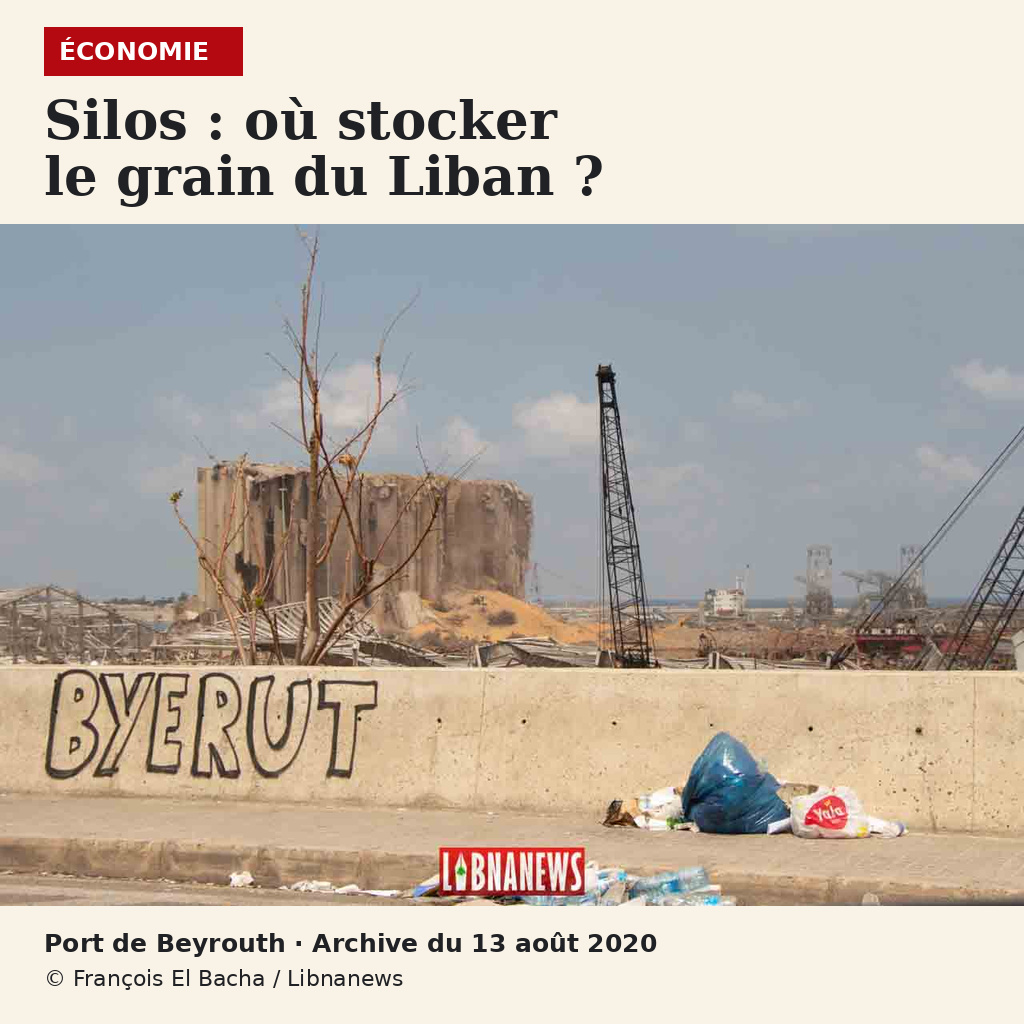
The Council for Development and Reconstruction launched an international call for proposals on 20 November to study the future of grain elevators. Proposals are expected on December 17 at noon, Beirut time. A share of $1.5 million of a Kuwaiti donation was earmarked for preliminary studies. The consultation does not cover the construction of silos and does not designate their operator.
The procedure opens up a question that the announcements about the reconstruction of the port often leave aside: what part of the grain reserves should be kept in Beirut, and what part can be distributed elsewhere? The documents of the Council for Development and Reconstruction, the CDR, plan to consider several solutions. This is distinct from the extension of the container terminal and a service market that the Harbour Authority has already signed for its own operations.
Grain elevators: sites and capacity to be determined
The consultant will first have to study storage requirements and the grain market. The specifications also require him to examine the status of the remains and the compatibility of the various options with the port plan. A reconstruction in Beirut, one or more regional sites or a combination of them remain to be compared. Tripoli, Tal Amara and Saida are among the avenues to be studied, without constituting a list of sites already selected.
Choice changes how reserves can be used. A port site facilitates access to landed cargo but concentrates part of the storage in the same enclosure. Regional sites could reduce this dependency. This should take into account the distance to the docks, inland transport, the cost of land and the operation of the facilities. The specifications require comparing these constraints before stopping a solution.
The grant agreement was signed in September 2025 with the Kuwait Fund for Arab Economic Development. The terms of reference indicated that $1.5 million of its resources had been allocated to preliminary studies. This amount is neither the price of the future contract, which is not publicly estimated, nor the amount already paid to the consultant. Nor does it constitute a construction budget.
The CDR conducts the procedure for the government, in coordination with the Ministry of Economy and Trade and the Kuwait Fund. After validation of a solution, the consultant will have to prepare the future tender files for the works companies and the mandate of the site control. The procedure opened in November buys this preparation. It does not attribute work, monitoring of its execution or future operation of silos.
Container terminal: a project carried by its operator
The extension of the terminal follows another calendar. CMA Terminals, a subsidiary of CMA CGM, obtained in 2022 a ten-year contract, starting in March, to manage, operate and maintain the container terminal. This perimeter does not correspond to the entire port management. It does not include, in the public announcements consulted, the choice of an operator for cereal reserves.
In September 2026, the port administration and CMA CGM launched an expansion project. Both partners announce a $100 million investment by CMA CGM. The group aims to have an annual capacity of 2.8 million equivalents twenty feet, while the harbour management evokes a rounded target of three million. These values describe an envisaged capacity, not the number of containers actually processed. Nor does the advertisement give the amount already disbursed.
Port maintenance: a service contract already signed
The third issue is the Harbour Authority’s procurement. On 8 October, it signed a contract with Dar Al-Handasah, Shair & Partners, for studies and supervision of rehabilitation, restoration and maintenance. The market includes preventive, corrective and urgent maintenance. It does not designate the company that will perform each repair.
The Autorité des pôts publics sheet shows $764,000 for this service. It does not provide the specific source of funding. This amount describes a signed consultancy contract, while the $100 million announced for containers is an expansion investment and the 1.5 million arrows of the Kuwait Fund are for studies. Adding them would not cost any of the three projects.
The European Bank for Reconstruction and Development also met with the port management on 20 November. The administration reported discussions on priorities and opportunities for cooperation, not an approved loan. For elevators, the next date announced remains the date of the submission of offers of advice. The country will only have a choice of capacity and sites after consideration of options and decision by the authorities.





Comments