

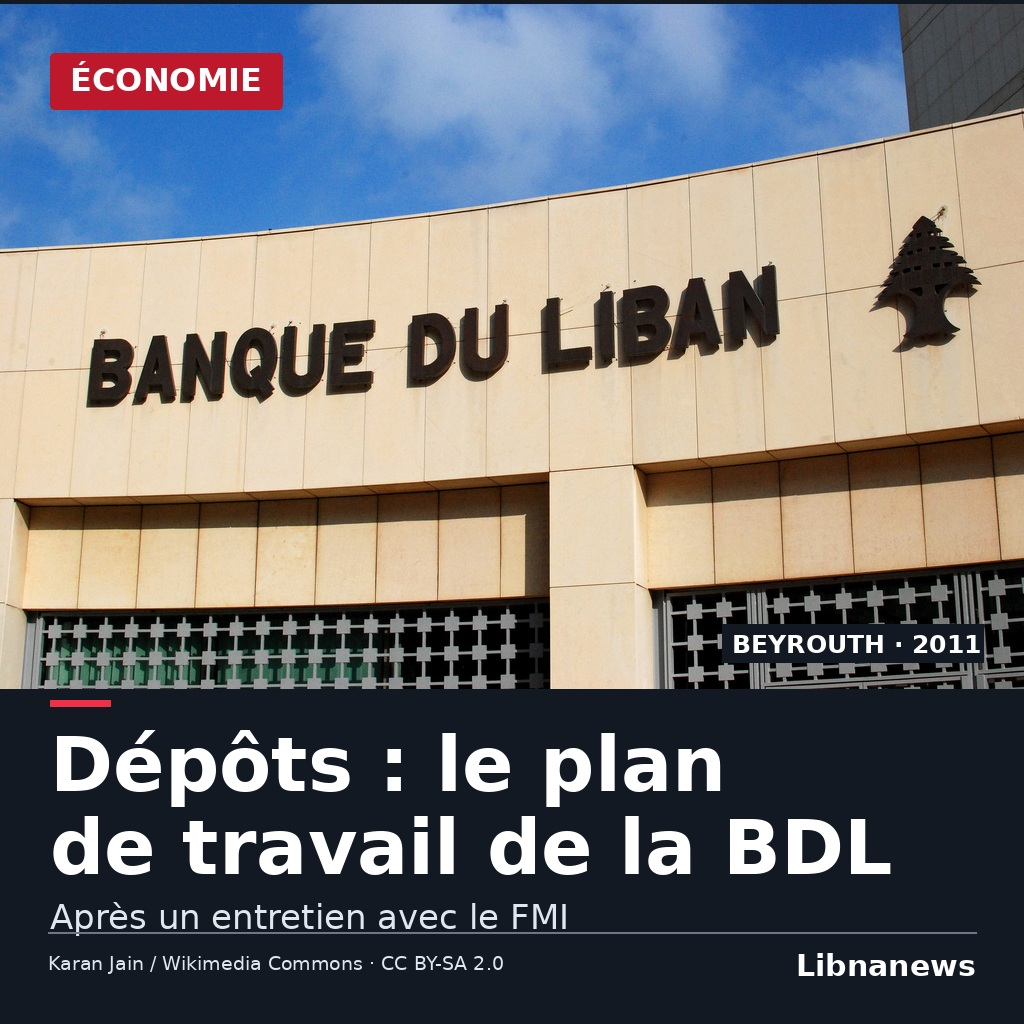
The Bank of Lebanon announces a work plan until the end of the year after the meeting of its governor, Karim Suaid, with Jihad Azour in Washington. Trade concerns the draft law on financial stabilization and return of deposits. The central bank does not mention a financing agreement with the IMF or the adoption of the text.
Karim Suaid met with the Director of the Middle East and Central Asia Department of the International Monetary Fund in the presence of the Lebanon team. The Bank of Lebanon’s communications cell, whose report was released on Saturday, 21 November, reported that participants had reviewed the progress of the project’s principles with a view to presenting it to Parliament. The report does not specify the day of the meeting.
What the BDL says it wants to settle by the end of the year
The Bank of Lebanon describes the plan as a way of setting the convergence points and continuing work on those that remain to be clarified, including how they are implemented. She said that the work must take into account the requirements of the IMF and its own position, in coordination with the Lebanese Government. It does not publish a list of issues or disagreements, nor does it provide a date for the project to be submitted to Parliament.
The plan is reported by the central bank. It does not constitute confirmation by the Fund of an agreement on the content of the project or on a financing programme for Lebanon. The record shall not set any amount or timetable for the return to depositors. Its year-end horizon concerns the work to be continued, not its entry into force.
The distribution of losses remains at the heart of the case
After a mission to Lebanon in September, IMF services had distinguished two texts. They welcomed the amendments already approved to the Banking Resolution Act, which governs the processing and, where appropriate, liquidation of banks. On the proposal for financial stabilization and return of deposits, however, they called for priority of claims: depositors should not bear losses before shareholders and lower-ranking creditors. IMF also called for repayment arrangements to be compatible with the viability of the banking sector and the sustainability of public debt.
The meeting in Washington concerns this second text. The report of the Bank of Lebanon does not indicate how these requirements will be translated into the project. The next step announced is to continue discussions before presenting it to Parliament.





Comments