

The port of Beirut handled 699,465 20-foot equivalents (TEUs) between January and September 2026, an increase of 5.42% over the previous year. This increase is entirely due to the transfer of 31.49%. At the same time, non-transshipment container volumes decreased by 2.05%, freight tonnage decreased by 10.7% and ports of call decreased by 9.3%.
Transshipment accounts for almost 28% of the volume
In nine months, containers transferred from one ship to another in Beirut represented 194,474 TEUs, compared with 147,905 in the same period of 2025. These transactions do not imply that the goods are imported into or exported from Lebanon. Their share increased from 22.3% to 27.8% of containerized traffic. The TEU measures the volume of handling in 20-foot container equivalents, not the weight or value of the goods.
The increase of 46,569 TEUs in trans-shipment more than offset the decrease of 10,581 TEUs outside trans-shipment, from 515,572 to 504,991. The net gain of the terminal is therefore 35,988 TEUs. Without the increase in ship-to-ship connections, total containerized traffic would have declined rather than increased.
Containers destined for the Lebanese market decline
The details of the port statistics presented on 25 November by Elie Zakhour, former President of the International Chamber of Navigation of Beirut, confirm that the withdrawal affects both sides of trade with the Lebanese market. Containers imported for local consumption totaled 229,298 TEUs, compared to 244,774 a year earlier, a decrease of 6.3%. Full containers exported with Lebanese products increased from 54,496 to 47,199 TEUs, down 13.4%. These two series alone do not cover all non-transshipment traffic and do not measure the value of imports or exports.
All modes of loading combined, 4.259 million tonnes of goods were handled, compared with 4.772 million a year earlier. The port received 952 vessels compared to 1,050. Conversely, the number of vehicles imported or re-exported by sea increased slightly, from 51 215 to 51 729, according to the same survey. There is therefore no uniform movement between freight categories.
A strengthened but concentrated regional role
According to the count presented by Élie Zakhour, the CMA CGM group represented 159,028 TEUs for transshipment, or about 82% of this activity in Beirut over the period. Its subsidiary CMA Terminals operates the container terminal as part of a ten-year concession that began in March 2022. The increase shows that Beirut has taken on more space as a connecting port of call; The concentration of flows also means that the evolution of volumes depends largely on the rotations of a single group.
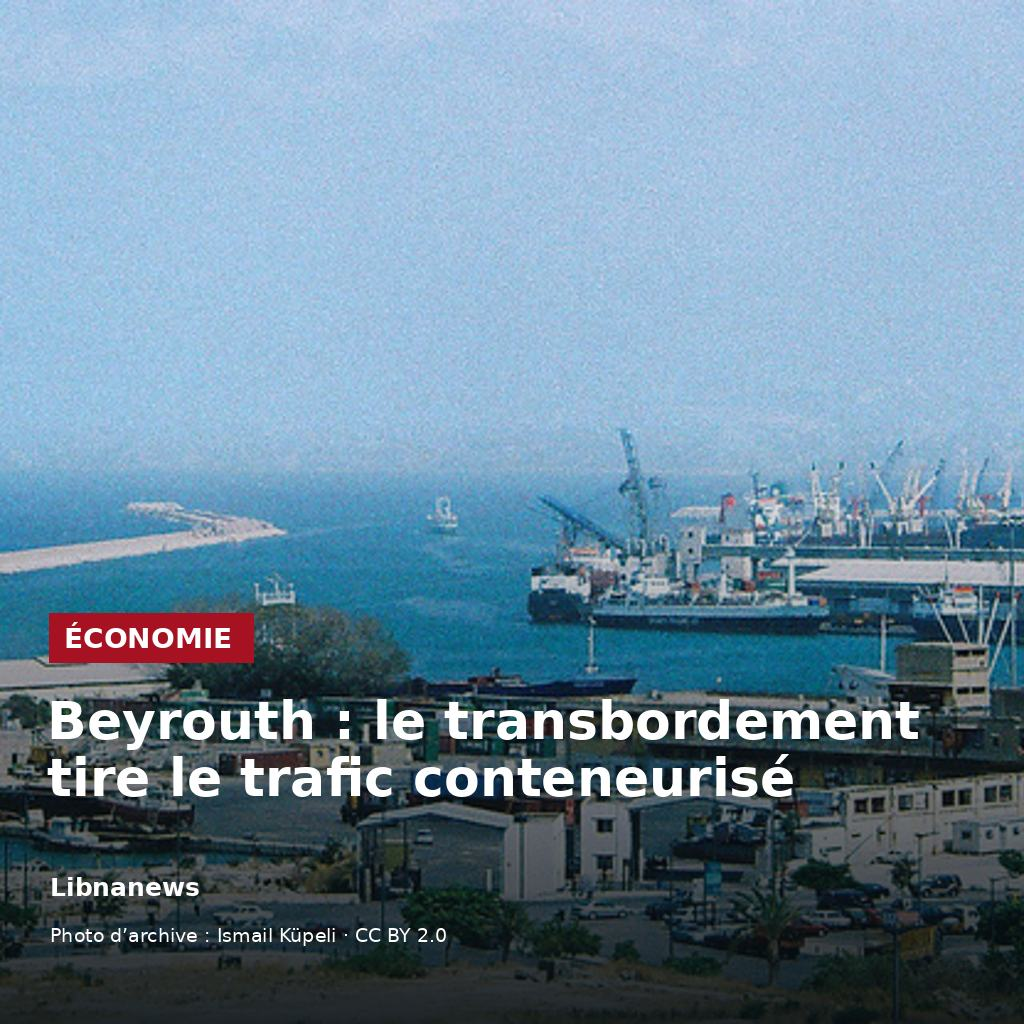
Cover: the port of Beirut in September 2003, photo of Ismail Küpeli, framed and dressed by Libnanews.Original photolicensedCC BY 2.0.






Comments