

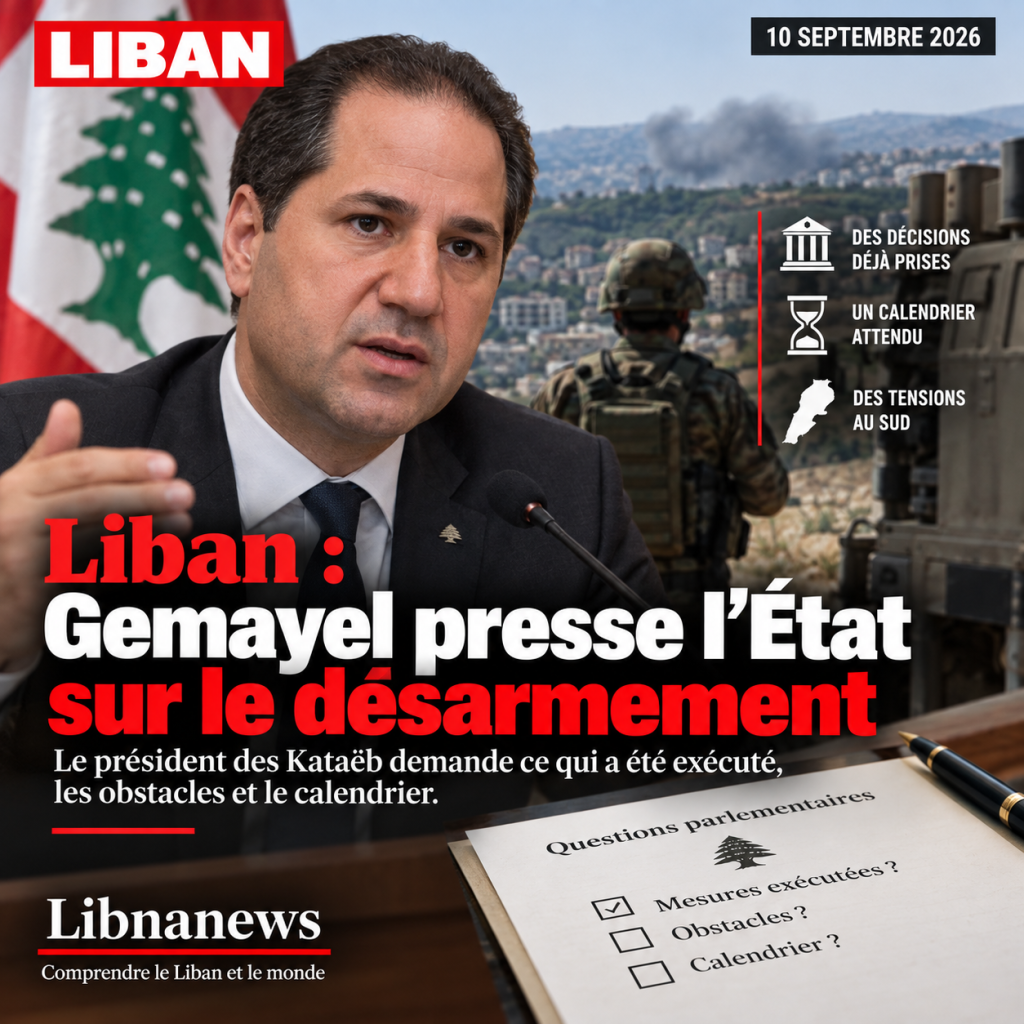
The President of the Kataëb, MP Sami Gemayel, placed the government before his own commitments on the arms monopoly on Thursday, September 10. In a formal parliamentary question addressed to the executive, he asked what had actually been implemented since successive Council of Ministers decisions on disarmament, what obstacles were in the way of their implementation and, above all, what timetable the State had set itself. Its intervention comes as Israeli operations intensify in southern Lebanon and the destruction of tunnels, depots and infrastructure attributed to Hezbollah feeds the fear of an extension of the strikes to other regions. For Gemayel, the problem is no longer the existence of government decisions, but their translation on the ground.
The leader of the Kataëb thus adopts a position both favourable to President Joseph Aoun and to the government of Nawaf Salam, and criticises the slowness of the execution. He recalls several decisions taken since the cabinet’s formation: the commitment contained in the ministerial declaration in favour of the state monopoly on arms, the decision of 2 March prohibiting Hezbollah’s military activities, the decision of 9 April concerning arms control in Beirut, and the decisions of 5 and 7 August on the preparation and implementation of an army plan. His question is deliberately simple: « What have you done, what do you intend to do and what is the timetable? »
Gemayel turns arms into parliamentary control
The initiative changes the nature of the debate. The Kataëb are no longer simply asking the government to speed up disarmament. Sami Gemayel now uses a parliamentary oversight instrument to obtain an official executive response.
He reproaches the House for not sufficiently discussing what is happening in Lebanese territory. The Kataëb had already requested a session on government policy. Gemayel nevertheless thanked the President of Parliament, Nabih Berri, for having postponed a sitting that would coincide with the anniversary of the assassination of Bachir Gemayel.
The approach now aims at forcing the government to make progress. Gemayel asked what had been implemented in the decisions of the Council of Ministers, what was the status of the military plan, what obstacles prevented its implementation and what deadlines had been set.
This distinction between decision-making and execution is the core of his political offensive. According to him, the content of government decisions is already sufficiently clear. It therefore does not call for a new declaration of principle on the sovereignty or monopoly of arms, but for measurable information on their implementation.
« Why not start with safe areas? »
One of Gemayel’s most specific issues concerns the geography of disarmament.
The Government and the army can invoke the military situation in the South, where Israeli operations, blasting and bombing make any action considerably difficult. Gemayel, however, asked why this difficulty would prevent the State from starting in areas not directly affected by the fighting.
It explicitly raises the question of the possible existence of tunnels and weapons depots in other parts of the country. His reasoning is to dissociate the case of the South from that of the rest of the territory: even if military conditions prevent full application in areas exposed to Israeli operations, the State could act in Beirut, Bekaa, Metn, Kesrouan or other areas relatively far from the front.
This approach directly targets Hezbollah. Gemayel used the terms of the government decisions which he interpreted as requiring the party to hand over its weapons to the state and entrusting the army and security services with responsibility for their execution.
The honourable Member therefore asks the government to explain what actually prevents him from starting.
The previous Ali al-Taher feeds the safe argument
Gemayel puts this pressure in the current military escalation. It refers directly to the tunnels and destructions observed around Ali al-Taher, an area located in the Nabatiyah area and recently subjected to repeated Israeli strikes.
For him, the possible presence of military infrastructure in inhabited areas is no longer merely a debate on sovereignty. It directly exposes civilian populations to Israeli strikes.
He asked a particularly serious question: are there « Ali al-Taher 2, 3 or 4 » in Bekaa, Beirut, Metn or Kesrouan?
The wording is intended to move the debate. The Kataëb no longer refer solely to disarmament as the implementation of Lebanon’s Constitution or international commitments. They present it as a measure of immediate protection of populations.
The argument is based on recent developments in Israeli operations. Strikes are no longer limited to a few border areas. Nabatiyah and its surroundings have been subjected to several attacks, while the Israeli army regularly claims to target tunnels, depots, fighters or Hezbollah infrastructure.
From Gemayel’s point of view, every military infrastructure located near a residential area can therefore become an Israeli objective and expose the surrounding inhabitants.
This analysis remains politically contested. Hezbollah and its allies believe that its arsenal is a defence capability against Israel and that disarmament under Israeli military pressure would weaken Lebanon. Gemayel reverses this logic: he believes that keeping arms outside the state now increases the risk of war and destruction.
The call from Nabatiyah takes on a political dimension
Sami Gemayel also welcomed a recent appeal in Nabatiyah by residents asking the State to impose its authority, send the army and prevent any non-State armed presence.
This reference is not insignificant. Nabatiyah lies at the heart of a region where Hezbollah historically has a major political and social settlement. Putting forward a local appeal for the arms monopoly allows Kataëb to argue that this claim no longer comes only from parties traditionally opposed to Hezbollah.
Gemayel even presents this request as that of « all Lebanese ».
This generalisation is obviously a matter of political discourse and is not a measure of public opinion. Hezbollah maintains an important base and its supporters continue to defend its military capability. But the existence of critical voices in areas directly exposed to bombing becomes an important political element.
The issue of disarmament is thus increasingly linked to the territorial cost of confrontation with Israel.
Government decisions are now the reference point
One of the major changes of 2026 is precisely the state’s position.
For years, Hezbollah’s opponents criticized successive governments for maintaining ambiguous formulations on the weapons of « resistance ». Gemayel believes today that this phase is outdated.
He claims that the state « is no longer an accomplice » of Hezbollah and stresses that the government itself has adopted decisions affirming the monopoly of arms.
This changes the Kataëb strategy. Their target is no longer the content of government policy, which they support in its principles, but its pace of implementation.
Gemayel takes care to specify that he does not seek to weaken Joseph Aoun or Nawaf Salam. On the contrary, he claims to support the President and the Government because they share the objective of a sovereign, free and independent State.
The pressure is therefore presented as a demanding support: since the government has made the decisions requested for years by the sovereignists, it must now demonstrate that they are applicable.
Calendar becomes the most difficult issue
It is probably on this point that the government’s response will be most expected.
Setting a precise disarmament timetable involves identifying the areas concerned, the means given to the army, the modalities for the recovery or destruction of weapons, the management of military infrastructure and the response to any resistance by Hezbollah.
This also means taking into account the war in the South.
The Lebanese Army itself asserts that Israeli operations hinder its deployment and missions. On 9 September, his command denounced the intensification of Israeli attacks, blasting and destruction of buildings, believing that they jeopardized existing arrangements and stabilization efforts.
The government is therefore caught between two imperatives which can come into conflict: to accelerate the application of the arms monopoly and to prevent an internal confrontation from erupting while the Israeli army continues its operations.
Gemayel refuses that this difficulty becomes a justification for inaction throughout the country. That is precisely why he insists on « safe areas ».
The spectre of civil peace at the heart of the disagreement
The most sensitive argument concerns the risk of internal conflict.
Opponents of an enforced and rapid application of disarmament have long warned that a confrontation between the army and Hezbollah could threaten civil peace. In a country marked by the war of 1975-1990 and several internal clashes since then, this concern weighs heavily on any security decision.
Gemayel, however, rejects the logic of abandoning the application of a State decision on the grounds that the group concerned could oppose it by force.
According to him, invoking civil peace is then tantamount to recognizing that an organization has an armed veto power over institutions.
« The rebellion, either we submit to it or we confront it, » he summarized, believing that the state has already chosen to enforce its decisions and cannot now step back from their execution.
This formulation places the debate on a particularly sensitive ground. The government must avoid internal confrontation while demonstrating that its decisions are not simply declaratory.
It is precisely the balance that Gemayel seeks to make politically more difficult to maintain.
Fear of negotiation that would bypass the state
The president of the Kataëb finally put forward another risk: that of the impotence of the state leading foreign powers to negotiate directly with the armed actors.
According to him, if the government appears unable to implement its own decisions, Israel and the United States could eventually discuss with non-State forces by bypassing Lebanese institutions.
This hypothesis serves its central argument: disarmament is not only intended to withdraw weapons from Hezbollah; It should enable the State to return to being the indispensable interlocutor in the negotiations on territorial security.
In this sense, failure to implement government decisions would have two consequences. It would allow for infrastructure that could be hit by Israel and simultaneously weaken Beirut’s political authority in the negotiations.
Gemayel thus speaks of a « fine step » for the country.
The parliamentary question now forces the government to answer
The interest of Thursday’s approach lies in its simplicity.
The government can no longer only recall that it is in favour of arms monopoly. It is precisely this position that the Kataeb recognize him.
He must now explain what he did.
In particular, the response should clarify the status of the military plan, the measures already implemented since the decisions of spring and August, the obstacles encountered and the possibility of beginning disarmament in areas not directly subject to Israeli operations.
It will also have to answer the question of the timetable.
It is on this ground that Sami Gemayel now places the political responsibility of the executive. The leader of Kataëb no longer asks the government to choose between Hezbollah’s weapons and those of the State: according to him, this choice has already been made in the official decisions. He asks him to state publicly when and how he intends to transform him into reality.
The next step will therefore be the government’s formal response. It will measure the gap between the sovereign decisions accumulated since the beginning of the year and their effective application on the ground.




