

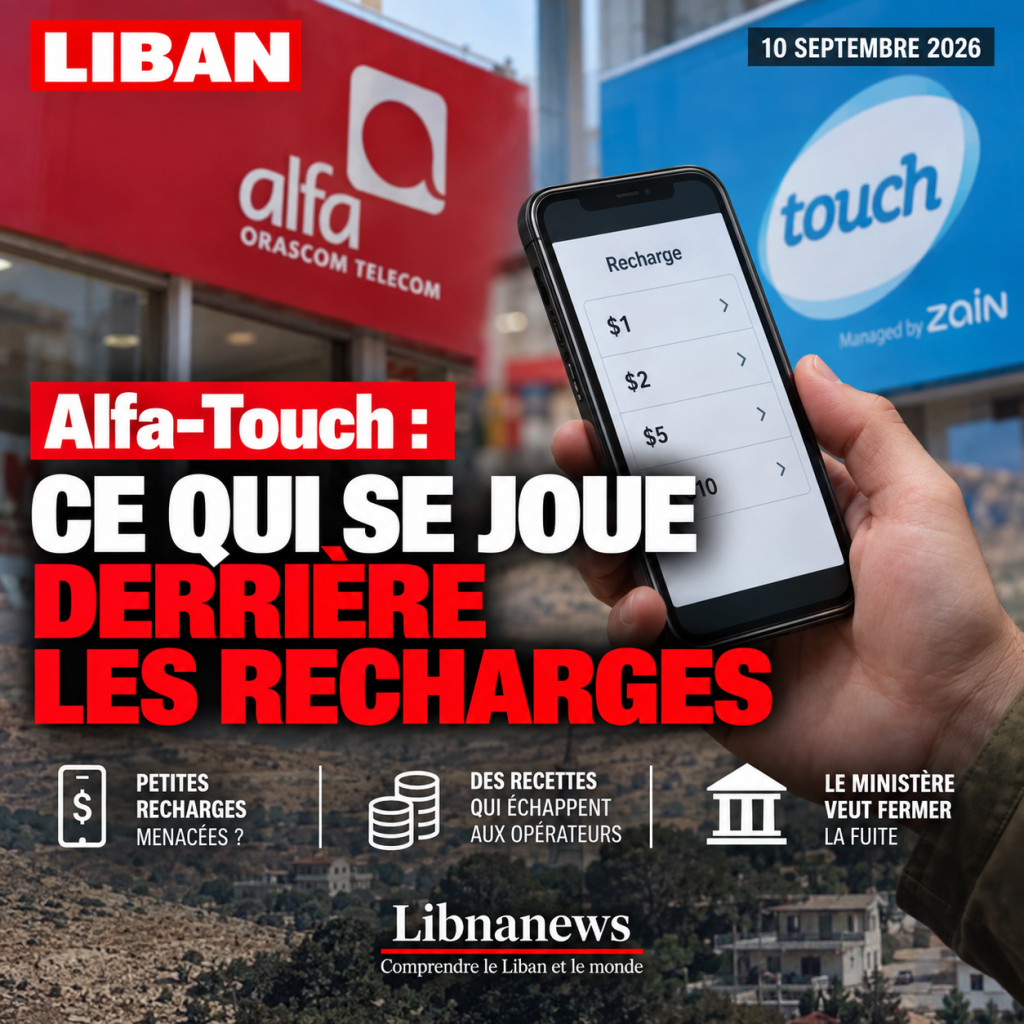
The polemic on Wednesday’s part news announcing the upcoming end of the transfers of dollars between Alfa and Touch lines quickly made it difficult to understand what is really decided. At this stage, no general abolition of small reloads, no « mandatory loading » by complete card and no entry into force on 1 October have been officially stopped. The Ministry of Telecommunications, on the other hand, has confirmed a specific problem: some of the sums paid by users in the prepaid charging circuit would not reach both operators and, therefore, the Treasury. Charles Hage asked Alfa and Touch to propose a mechanism to close this revenue leak, while ensuring that the balances currently on the lines remain with subscribers.
Nuance is essential. The file does not currently deal with a new mobile pricing. It focuses on the distribution ecosystem developed around prepaid lines and, in particular, on the commercial use of a service originally designed to allow a subscriber to transfer a small portion of his credit to another. In an economy where many households buy a few dollars or days of validity at once, this mechanism has become a form of micro-recharge. It is precisely this intermediate market that the ministry wants to take over. The risk is that by removing a financial anomaly, the reform also removes a flexibility that has become socially useful.
Information not yet formalized
On Wednesday, 9 September, several media and social media accounts announced that Alfa and Touch were planning to ban the transfer of dollars between prepaid lines from October onwards. According to this information, the subscriber could no longer purchase a few dollars of credit or days of validity separately and should rely on the cards or formulas predefined by the operators. The expression « mandatory charging » was quickly imposed.
This presentation created the impression that a final decision had already been taken. This is not what the ministry confirmed. Charles Hage explained that he had given instructions to both companies to deal with a « leakage » in prepaid recharging revenues. The minister says that citizens pay for the service but that part of the revenue does not reach the operators’ accounts or, ultimately, the public revenue. He asked Alfa and Touch to submit a full proposal within a specified time frame. The department will then decide.
The information on a removal of the transfer of dollars, separate days or micro-recharges therefore describes a reported scenario, but not yet a definitive regulation. The only principle is the desire to close a circuit that the department considers to be a source of profit outside the normal distribution framework. At the same time, Charles Hage guaranteed that the balances already present on the lines would be retained.
Charging card and credit transfer: two different operations
Much of the confusion arises from the particular operation of Lebanese prepaid lines. A charging card and a credit transfer are not the same operation. Recharging is a product sold by the operator: it credits a line according to a value and, depending on the product, a specified duration. The transfer of credit allows a subscriber already with a balance to move a small amount to another line.
Alfa officially confirms the existence of this service. A prepaid subscriber can transfer credit to another subscriber via SMS, USSD code, application or online service. The transferable amount is capped at $3 and the transaction costs $0.14. The service was therefore designed for small transactions between users, not as a parallel distribution network.
In practice, this feature has acquired another utility. Point of sale can meet a customer who does not wish to purchase a full standard charge. The consumer comes with a specific need: maintain his number, get a few extra days or add a small sum. This fragmentation of the product corresponds particularly well to a crisis economy where spending is often managed on a day-to-day basis.
This is where the heart of controversy lies. If the department only prohibits the abusive commercial exploitation of the transfer while maintaining official micro-recharges, the effect on the subscriber may remain low. If the reform eliminates both the transfer used commercially and the possibility of buying very small values, the consumer will have to pay a larger sum for each reload. The official rate will not necessarily have increased, but the minimum cost ticket will have increased.
A leak of revenue not yet public
The department’s argument is serious, but a central figure is still missing. Charles Hage states that some of the money paid by consumers does not come from Alfa and Touch. However, no specific public amount of this leak was disclosed in the available declarations. It is therefore impossible, at this stage, to measure its weight in the sector’s revenue or to determine whether it justifies economically a complete overhaul of the system.
This lack of encryption is important. Alfa and Touch are not two ordinary private companies that compete freely in a market. Both networks belong to the Lebanese State and their revenues have a budgetary dimension. A loss of revenue deprives operators of resources for maintenance and investment and reduces what may fall to the Treasury. In an area that needs to modernize its antennas, rebuild damaged sites and finance the extension of coverage, control of the revenue chain is a matter of public policy.
Alfa reported in early September that it had deployed 93 new sites since the launch of its programme under Charles Hage’s mandate, 46 of which have been since January 2026. These new sites transport 47 terabytes of data, or about 7% of the daily consumption of data on its network. More than half have been installed in areas where coverage needs to be improved. These investments remind us that mobile revenues must also fund an expensive physical network.
But the argument of investment is not enough to justify any reform. In order to assess the measure, it will be necessary to know the amount actually lost, the actors who capture this margin, the share from irregular practices and the proportion corresponding to the normal remuneration of distributors. Without this breakdown, the notion of « leakage » remains economically incomplete.
The real social stake: the minimum amount to keep your line
The most important question for consumers is much simpler than the debate on cards: what will be the minimum amount needed to maintain an active line after the reform?
For many users, especially those with low or irregular incomes, mobile phones are not paid in the form of a stable monthly subscription. The expenditure is adjusted to the cash available. A household can reload one line this week and another the following week, transfer a few dollars to a child or maintain a number with the minimum possible expense.
This practice is a direct consequence of the economic crisis. Since 2019, part of Lebanese consumption has become fragmented: households buy less at each transaction and arbitrate more between essential expenses. Mobile now belongs to essential services, as it provides access to communications, banking, administration, work and messaging applications. The flexibility of charging therefore has an economic value in itself.
A reform that maintains this granularity in the official network could be relatively neutral. Alfa and Touch could offer directly the small amounts that customers buy today from intermediaries. The consumer would continue to pay as needed while the transaction would be registered with the operator. The department would then achieve its traceability objective without imposing a higher expense.
Conversely, if the available values become significantly higher than the current micro-recharges, the reform will have a regressive effect. Households with comfortable incomes will see virtually no difference. The cost of the measure will focus on those who split their purchases precisely because they lack liquidity.
Why a parallel market has developed
The department describes the misuse of the system as a black market. The term refers to a possible revenue capture, but it must also be understood why this market exists. An intermediate market usually appears when an official product does not exactly match demand. Here, the subscriber sometimes wants to buy a smaller amount than the available standard formats or transfer part of his balance.
The intermediary responds to this request by splitting the product. He may charge a margin for this service. This margin becomes problematic if it is based on a misuse of the mechanism, on opaque prices or on an activity that is outside the rules imposed on authorised distributors. It does not mean, however, that the economic need it addresses is artificial.
Removing the intermediary without officially replicating its service can therefore move the problem rather than solve it. The consumer loses flexibility while the operator recovers more revenue per transaction. This is precisely what feeds the charge of « mandatory charging »: opponents of the project fear that the fight against the parallel market will, voluntarily or not, serve to increase the average value of each reload.
At this stage, this consequence is not established. It will depend entirely on the proposal of Alfa and Touch. Presenting the reform today as an already decided price increase would therefore be inaccurate, as would assert that it will have no effect on households.
Two public networks, a complex distribution chain
The controversy recalls a particular feature of the Lebanese mobile sector. Alfa and Touch form a public duopoly. The state owns the networks and controls the broad tariff orientations, but the marketing goes through multiple channels: operators’ shops, licensed distributors, applications, online services, banks and outlets.
The two companies had already had to remind, during previous card tensions, that the refills could be purchased at the official price from their shops, from their authorized distributors and electronically. This insistence already revealed the problem of the multiplication of intermediaries and the price differences encountered by consumers.
The proposed reform may therefore have a broader justification: to reconcile the payment made by the subscriber with the actual accounting of the operators. In a fully traceable system, each dollar of recharging should correspond to a recorded revenue, minus only official distribution fees. The department would then have better visibility of revenues and operators could better predict their investments.
But this rationalisation implies not to confuse traceability with rigidity. A modern digital network can sell micro-recharges without using physical maps. Alfa and Touch applications, USSD codes and electronic platforms technically offer a fine range of sizes. The issue is therefore less technological than commercial and regulatory.
What is confirmed, and what remains to be decided
The confusion of the last 24 hours is due to the way in which the file came out in the public debate. Unofficialised information first presented as practically acquired the abolition of transfers from October onwards. Social networks then transformed this measure into a general obligation to purchase complete cards. The department responded by confirming the revenue problem, but without publishing the mechanism it wished to adopt.
Several different proposals thus circulate as if it were a single decision. However, removing the transfer of credit between individuals, prohibiting its commercial use, removing the separate purchase of days, removing micro-recharges and forcing the purchase of a standard card are five different measures. They have neither the same objective nor the same economic impact.
Charles Hage’s answer clarifies two points: existing balances will not be confiscated and the ministry wants to recover revenues that are currently not in the official circuit. For the rest, Alfa and Touch still have to submit their proposal.
This proposal will have to answer three questions which will determine the real impact of the reform. Will transfer between two individuals be possible? Will subscribers still be able to purchase very small credit or validity values? Above all, what will be the minimum amount to pay to keep an active line?
As long as these answers are not known, talking about a « new mandatory card » as a decision is confusing. But the concern of subscribers is not unfounded: if the fight against revenue leakage leads to the elimination of split purchases without creating equivalent official alternatives, the real cost of telecommunications will increase for users who have the least means.
The next concrete element will be the proposal that Alfa and Touch must submit to the ministry. It will allow us to know whether the reform is only about regaining control of a parallel market or whether it really changes the way prepaid subscribers manage their telephone budget.




