

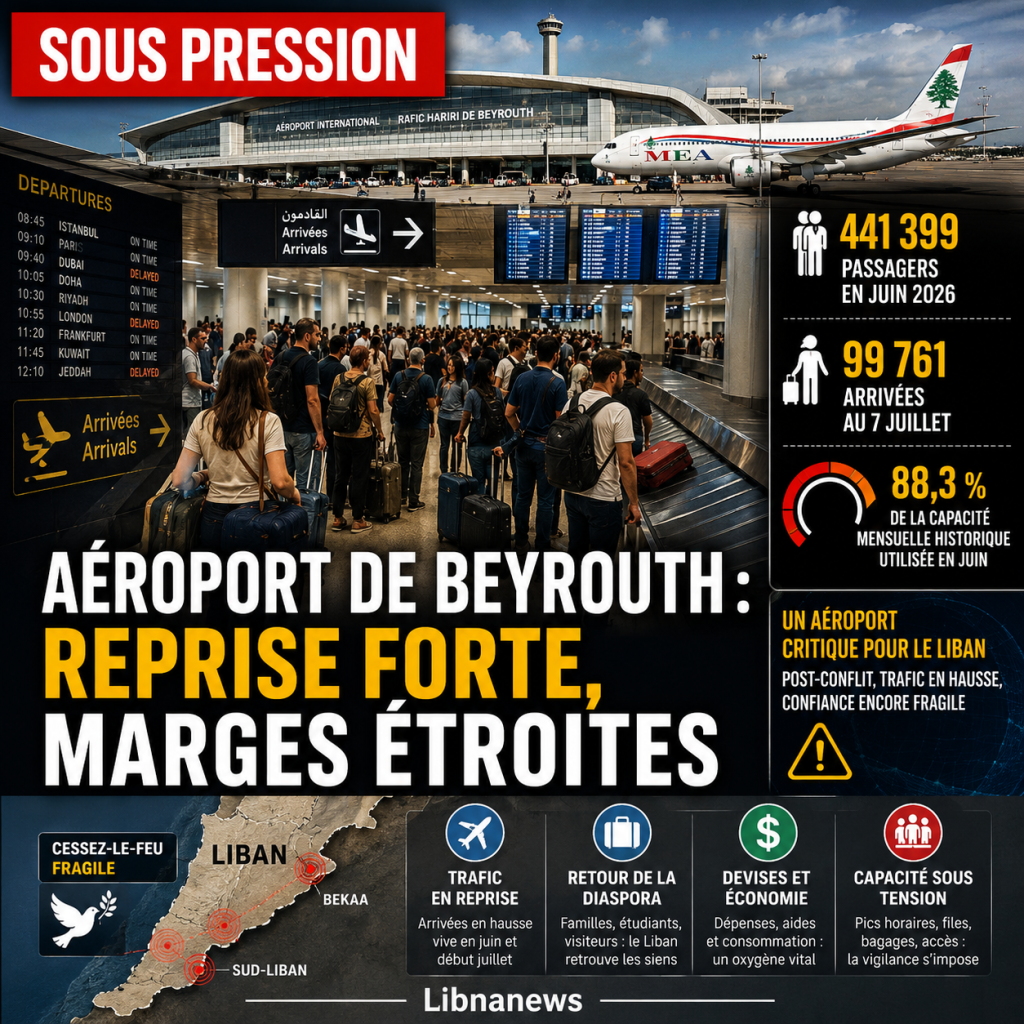
The return of travellers again places Beirut airport in the center of the Lebanese summer season. In June 2026, the platform recorded 254,027 arrivals and 187,372 departures, or 441,399 passengers on the move over a month. The beginning of July further accelerates, with 99,761 arrivals recorded until 7 July. These data confirm a visible rebound after several months of contraction. They also require a more cautious reading. Traffic is returning to Lebanon, which is still marked by conflict, destruction in the South and the Bekaa, airline doubts and the fragility of a recent ceasefire.
This movement is therefore not limited to a postcard of reunions at the exit of the luggage. He says something deeper: the diaspora returns as soon as the perceived risk decreases, even partially. It also shows that the airport remains the most sensitive economic infrastructure in the country. Each flight carries passengers, as well as currencies, reservations, purchases and family decisions. The central question then becomes simple: can Rafic-Hariri airport absorb this recovery without falling back into the weaknesses that have already brought it closer to its limits?
A rebound after a rough start to the year
June figures are only meaningful when compared to previous months. Between January and May 2026, Beirut airport had welcomed 1,585,526 passengers, compared with 2,409,618 during the same period of 2025. The decrease was 34.2%. It affected the entire air chain: arrivals, departures, rotations and freight.
This stall directly reflected the climate of war. Travellers have postponed their stays. The companies have reduced their frequencies. Reservations were made later. The tourism sector has lost visibility even before the launch of the summer. The month of May illustrated this breakdown: only 338,772 passengers had been recorded, compared with 560,713 a year earlier. The monthly decrease was close to 39.5%.
The month of June therefore marks a clear inflection. With a total of 441,399 passengers, it exceeded the May level by 30.3%. Arrivals alone reach 254,027 people. They account for 57.6% of the month’s passenger traffic, compared with 42.4% for departures. This imbalance is typical of an early summer season. It translates the arrival of expatriates, families, students and some Arab or foreign visitors.
| Indicator | Figure | Reading |
|---|---|---|
| Passengers January-May 2026 | 1 585 526 | Reduction of 34.2% over one year |
| Passengers May 2026 | 338 772 | Month still depressed |
| Arrivals June 2026 | 254 027 | Net recovery of inflow |
| Departures June 2026 | 187 372 | Outputs below arrivals |
| Total traffic June 2026 | 441 399 | 30.3 per cent increase from May |
| Arrivals as at 7 July | 99 761 | Early summer acceleration |
June: 254,027 arrivals and a marked incoming balance
Incoming balance in June reached 66,655 people. This figure is important. It means that Lebanon welcomed many more travelers than it saw during the month. For an economy that lacks internal growth, this balance creates an immediate effect. The incoming passengers consume on site. They use taxis, rental services, restaurants, hotels, shops, telecommunications and family tours.
The daily average confirms the change in pace. June has 8,468 arrivals per day and 6,246 departures. Total traffic is 14,713 passengers per day. These averages remain compatible with normal operation, but they do not say everything. Operational tension is mainly involved in peak hours. A few arrivals concentrated in the same time slot are enough to saturate the check lines, luggage mats and road access.
The return of passengers must therefore be read with two levels of analysis. The first is economic. He’s positive. The second is operational. He calls for vigilance. Beirut can absorb high volumes, but not without cost for the quality of service if human, computer and logistical means do not follow.
July speeds up, but data is still incomplete
The 99,761 arrivals recorded until July 7 are the strongest signal of the season. In seven days, the airport has already received 39.3% of the total volume of arrivals in June. The daily average climbs to 14,252 arrivals. It exceeds the June daily average by 68.3%. At this rate, arrivals alone would reach about 441,800 passengers in July.
This projection must remain cautious. The first days of a summer month can focus on returns related to school holidays, weddings, family holidays and deferred reservations. The pace can then slow down. But it can also be reinforced by a catch-up effect if the companies add frequencies and if the security perception continues to improve.
Most of the data is missing: the number of departures over the same period in July. Without this figure, the total traffic for the current month cannot be calculated. The capacity of an airport is measured on all passengers, not only on arrivals. This is a major limitation of current communication. Authorities and operators should publish complete daily series, with arrivals, departures, transit, rotations, delays and baggage processed.
Capacity used: two readings, one warning
The capacity of Beirut airport is subject to two references. The design capacity of the reconstructed terminal is often set at 6 million passengers per year. Some recent presentations point to a current capacity of about 8 million passengers, linked to the successive adaptations and the actual operation of the platform. To avoid a biased reading, the two ratios must be calculated.
On the basis of 6 million passengers per year, the theoretical monthly capacity reaches 500,000 passengers. June traffic to 441,399 passengers represents 88.3% of this monthly capacity. The level is high. It does not mean that the airport was saturated every day, but it shows that the monthly margin was already limited.
On the basis of 8 million passengers per year, the theoretical monthly capacity reaches about 666 667 passengers. June traffic then accounts for 66.2% of this capacity. The diagnosis seems less alarming, but it does not remove the problem of peaks. An airport may have a moderate monthly rate and severe congestion at certain hours.
| Basis of calculation | Monthly capacity | June traffic | Rate of use |
|---|---|---|---|
| Design capacity: 6 million per year | 500,000 | 441 399 | 88.3% |
| Current capacity: 8 million per year | 666 667 | 441 399 | 66.2 per cent |
| First half, base 6 million | 3 000 000 | 2,026,925 | 67.6% |
| First half, base 8 million | 4 000 000 | 2,026,925 | 50.7% |
The most critical figure therefore remains that of June at 6 million: 88.3%. It shows that the airport is quickly approaching its historical reference capacity as soon as the season returns. The rate of 66.2%, calculated on 8 million, indicates that the platform still has a margin if one retains an expanded capacity. But this margin depends on the quality of the organization, not just the size of the terminal.
Previous years show old pressure
The capacity debate was not born in 2026. By 2025, the airport had registered 7,011,129 passengers over the year. Compared to a capacity of 6 million, this represents 116.9% of annual use. In other words, the platform has already operated above its design capacity. Compared to a capacity of 8 million, the rate fell to 87.6%, which remains high for infrastructure subject to seasonal peaks.
By 2024, traffic had reached 5,622,358 passengers. The utilization rate was 93.7 per cent on the basis of 6 million and 70.3 per cent on the basis of 8 million. The decrease of 2024 was due to war, flight suspensions and the collapse of several months of activity. It did not erase the background trend: Beirut airport remains in demand beyond what its original architecture allows to absorb comfortably.
These comparisons make the first half of 2026 more readable. At 2,026,925 passengers from January to June, the half-yearly utilization rate reached 67.6% on the basis of 6 million passengers. It remains below the theoretical limit. But this average masks the accordion of activity. The first five months were weak. June bounced. July could focus the real tension.
Post-conflict: a recovery in precarious calm
The current context does not look like a normal return to the tourist season. Lebanon is emerging from a phase of acute conflict, with strikes in the South, in the Bekaa and around sensitive areas. The ceasefire reduced the immediate risk for some of the travellers, but it did not establish a consolidated peace. The inhabitants of the affected areas still live with destruction, displacement, security uncertainties and economic losses.
This point changes the nature of the recovery. The arrivals of June and early July do not only signal the attractiveness of Lebanon. They also report the return of a population linked to the country by family, heritage, necessity and attachment. Many travellers do not only come for a holiday. They come to check a house, support relatives, settle cases, participate in a delayed marriage or reconnect with a country that has undergone a new crisis.
Trust remains conditional. Airlines can restore flights, but they can also reduce them quickly. Insurers may review their terms and conditions. Families can cancel at the last moment. Tourists without family ties to Lebanon remain more sensitive to travel alerts than expatriates. This is where the euphoria of the arrival halls can deceive.
Diaspora, currencies and real economy
The return of expatriates supports the economy quickly. Expenditure starts on arrival. Drivers, renters, cafes, restaurants, shops, gas stations, hotels and furnished rentals benefit from the influx. Families also receive direct assistance, often in foreign currency. In a country that is still deprived of a fully functioning banking system, this physical circulation of money counts a lot.
The diaspora also acts as a social stabilizer. It finances care, school fees, repairs, purchases of durable goods and marriage expenses. A two-week stay may trigger payments that remote transfers do not fully replace. Air traffic therefore becomes an indicator of consumption, not just mobility.
But this dependency is fragile. An economy cannot rely on the courage or loyalty of its expatriates. It must offer reliable services, transparent prices and a minimum of security. If the ticket becomes too expensive, if flights change at the last moment, if queues continue or if access to the airport deteriorates, some of the demand will be directed to other destinations.
A single airport, therefore a national vulnerability
Lebanon remains almost entirely dependent on Rafic Hariri Airport for its international civilian traffic. This centralization creates an advantage in normal times. It focuses on companies, customs, security, services and correspondence. It also creates a major vulnerability. When the airport is threatened, slowed down or saturated, the whole country loses its doorway.
Middle East Airlines’ role has shown during the most difficult times. The national airline maintained the air link when several carriers reduced or suspended their flights. This continuity has been important for families, students, the sick, expatriates and businesses. It must not mask the risk: when a country is so dependent on a single strong operator and a single platform, resilience depends on few actors.
The project to revive the René-Muawad airport in Qlayaat is part of this debate. A second air gate can offer useful redundancy, support the North and reduce pressure on Beirut. But it does not respond to the July emergency. A secondary airport requires complete security, controls, customs, equipment, roads, companies and a clear business model. It is not enough to announce it to absorb a season.
The risk of confusing inflow and tourism recovery
Critical reading begins here. The figure of 254,027 arrivals in June is encouraging. It does not yet prove a solid tourism recovery. Available data do not distinguish sufficiently between expatriates, Arab tourists, European tourists, family travel, business travel and forced returns. However, this distinction is essential to measure the real economic impact.
An expatriate staying with his parents does not produce the same expense as a tourist booking a hotel. A visitor who comes to check a property after the conflict does not have the same behavior as a family who spends three weeks on the coast. A passenger arriving for a medical or administrative emergency does not reflect the same confidence as a leisure traveller. Without fine ventilation, the country may overestimate the strength of the rebound.
Governments should therefore publish more detailed data. Origin of flights, nationalities, average length of stay, hotel occupancy rate, delays, cancellations, rotations, baggage processing: this information would allow professionals to act. Restaurants hire on forecasts. Hotels adjust their rates on reservations. The companies programme their seats several weeks in advance. An economy undergoing reconstruction cannot be content with global figures.
Summer will be a governance test
The 2026 season comes at a delicate moment. The ceasefire reopened a window. Travelers come back. Companies take over programs. The halls are filling up. But Lebanon must now prove that it can convert this flow into sustainable confidence. This requires strict management of lines, luggage, controls, parking, taxis and passenger information.
The utilization rate of 88.3% in June, calculated on the historical capacity of 6 million, should be treated as a warning. The rate of 66.2%, calculated on a current capacity of 8 million, provides a more reassuring reading. But the two figures tell the same thing: the platform can absorb the recovery only if it retains real operating margins. These margins are measured in corridors, not in press releases.
Official communication should avoid triumphalism. Yes, the travelers are coming back. Yes, the diaspora is responding. Yes, the economy receives oxygen. But the country remains in a fragile post-conflict phase. Destruction does not disappear with summer arrivals. Security alerts do not dissipate with a few extra flights. The companies do not program their aircraft on a lasting basis on the emotion of the reunion.
What future figures should say
The next step will be the full release of July data. They will have to show not only arrivals but also departures, transit, rotations and the level of delays. If arrivals keep pace with the first seven days, July will become the real month of the year. If departures increase sharply in parallel, the pressure on capacity will be much higher than only the arrivals suggest.
Beirut airport remains Lebanon’s most visible post-conflict barometer. Its figures measure both the return of the diaspora, the partial confidence of companies, the state of tourism, the circulation of currencies and the state’s ability to maintain critical infrastructure. June showed a rebound. July will tell if this rebound can become a recovery, or if there will remain a fragile catch up in a country still exposed to the tremors of the southern border, the decisions of the carriers and the next wave of travellers in front of the luggage mats.




