

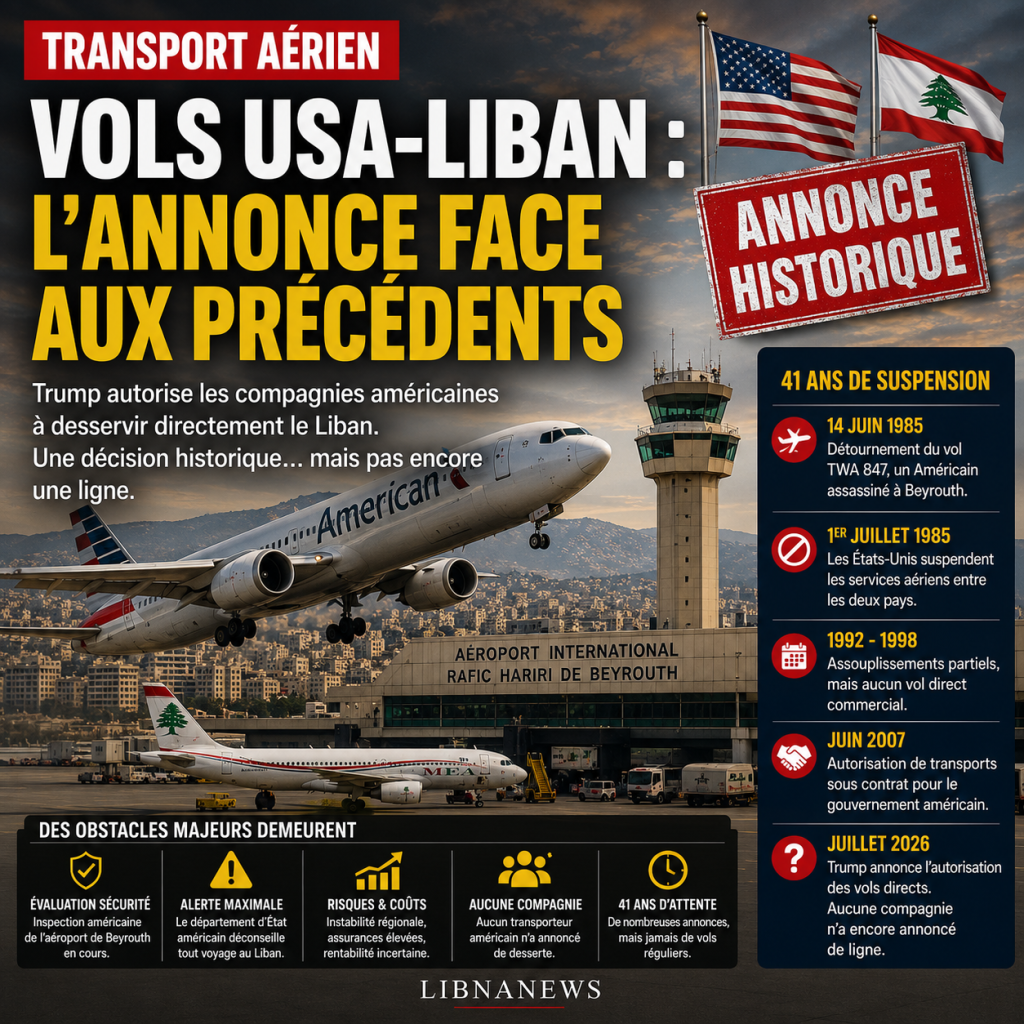
Donald Trump’s announcement authorizing US companies to serve Lebanon directly was welcomed in Beirut as a major political gesture. It intervened forty-one years after the suspension of direct air links between the two countries and at the end of the meeting between the US President and Joseph Aoun at the White House. The U.S. Head of State presented his decision as a way to make it easier for U.S. travellers to travel to Lebanon. However, this formulation is confusing between a presidential authorisation and the effective opening of a commercial line. No carrier has yet announced service, no schedule has been published and no launch date has been set. A U.S. security assessment of Beirut airport has yet to be conducted. Recent history therefore calls for caution: since the 1990s, several flexibilities, political announcements and initiatives have led to a return of direct flights without ever leading to a regular connection between Beirut and the United States.
The 1985 diversion of the suspension
The suspension originated in the diversion of TWA 847 on 14 June 1985. The aircraft, which linked Athens to Rome, was hijacked shortly after take-off and then forced to make several rotations between Beirut and Algiers. The kidnappers held the passengers for seventeen days and murdered Robert Stethem, an American naval diver. His body was thrown at the tarmac of Beirut airport. Ronald Reagan’s administration considered that the Lebanese authorities were not in a position to guarantee the safety of civil aviation or to meet international requirements for combating hijacking. On 1 July 1985, Washington suspended air services between the United States and Lebanon. This decision was not limited to a particular company or route. It established a lasting legal and security lock, at a time when the Lebanese civil war, the abduction of Westerners and the collapse of state authority made any trade recovery highly unlikely.
Relaxation without direct flights
The end of the civil war did not result in the immediate lifting of the ban. In 1992, the US administration changed the original regime without restoring scheduled direct flights. A new development occurred in 1998 under Bill Clinton when Washington relaxed certain travel and transportation restrictions. These measures were sometimes presented in Lebanon as the beginnings of a return to the United States. However, they did not permit a normal commercial service comparable to those operated in Paris, London or Frankfurt. The US scheme remained based on a negative assessment of the safety, control capacity and protection of carriers. It also distinguished several categories of services: passenger transport, connecting, company-to-company trade agreements, charter flights and government contract operations. Each relaxation could therefore produce an optimistic title without removing the main obstacle. This difference between partial opening and full resumption explains part of the misunderstandings that accompanied the case for four decades.
A further step was taken in June 2007. George W. Bush authorized U.S. companies working under contract with the federal government to transport passengers, baggage, humanitarian goods and other cargo to or from Lebanon. This decision was adopted in the name of peace and security, after the 2006 war and in a context of strong American support for the Lebanese government. Here again, the term partial recovery has fed into the idea that a commercial line was close. In fact, the text concerned operations supervised by the US administration, including governmental and humanitarian needs. It did not create a service open to all travellers and did not require any company to sell tickets between New York and Beirut. The year 2007 illustrates the mechanism which subsequently repeated itself: a real but limited regulatory measure was interpreted as the beginning of wider standardisation. The second stage, that of regular service, was not followed.
Several periods of hope without results
Following the Syrian withdrawal of 2005, the Doha Agreement of 2008 and several periods of relative stability, Lebanese officials regularly referred to the possibility of re-establishing direct liaison, particularly between Beirut and New York. The Lebanese diaspora in North America was a powerful argument. Hundreds of thousands of potential travellers were then to travel through Paris, London, Frankfurt, Istanbul, Doha and Dubai. Middle East Airlines also had a symbolic and commercial interest in finding a route interrupted during the war. However, discussions never went beyond declarations, studies or exploratory approaches. The US authorities continued to demand guarantees on the airport, passenger control, cargo, access to sensitive areas and aircraft protection. On the company side, the potential demand was not sufficient to offset the risk. A long-haul line requires an available aircraft, crews, slots, insurance and regularity that Lebanese crises made difficult to guarantee.
Beirut airport in the centre of the reserves
Beirut airport remained at the heart of American reserves. Washington long considered that its safe environment did not fully meet the standards expected for direct liaison with the United States. Questions were raised about access control, cargo inspection, area separation, reliability of controls and Hezbollah influence in neighbouring neighbourhoods. The Lebanese authorities have regularly announced improvements, the installation of new equipment and increased cooperation with foreign partners. These efforts have enabled the airport to maintain connections with many capitals and to host international companies. However, they were not enough to lift the American lock. For Washington, a company directly serving US territory must meet a specific level of valuation. A favourable political decision may speed up this procedure, but it does not replace technical inspections or the requirements of the Federal Aviation Administration, the Department of Transport and Security Services.
Crisis has pushed back every attempt
The successive crises then pushed back every prospect of recovery. The 2006 war led to the closure of the airport after Israel destroyed runways. The May 2008 clashes in Beirut showed the fragility of the internal situation. The war in Syria, beginning in 2011, brought the threats to the Lebanese border closer together and reinforced regional risks. The financial collapse of 2019, the explosion of the port of Beirut in 2020 and institutional paralysis weakened the capacity of the state. From October 2023 onwards, the confrontation between Israel and Hezbollah again led to massive cancellations, temporary suspensions and a reduction in foreign services. The fighting of 2025 and 2026 further aggravated this trend. In such an environment, no American company had any interest in hiring aircraft and crews on a road that could be interrupted overnight. The case thus remained legally blocked and commercially unattractive.
What Trump’s announcement really changes
The July 2026 announcement, however, differs from the previous one on one point: Donald Trump says he wants to allow all US carriers to fly directly to Lebanon. It therefore seems to go further than the exceptions adopted in 1992, 1998 or 2007. But it still does not mean that a plane will soon take off from New York, Washington or Detroit to Beirut. The administration must translate the presidential inquiry into specific regulatory acts. The old restrictions must be formally amended or repealed. The US authorities must then complete their airport security assessment. Companies, for their part, must seek the necessary authorizations, negotiate slots, obtain insurance and integrate the road into their programs. This channel can take several months or more. It may also interrupt if the security situation deteriorates or if the technical assessment concludes that certain conditions are not met.
An announcement contradicted by the American Alert
The most visible paradox comes from American politics itself. As Donald Trump encourages travel to Lebanon, the State Department keeps the country at the highest level of alert, with a recommendation not to go there. This is based on the risk of armed conflict, terrorism, abduction, disturbance and the presence of mines. In February 2026 Washington also ordered the departure of non-essential government personnel and the families of diplomats from the embassy in Beirut. An airline carefully examines these signals. It cannot ignore that another service of the same administration considers the country too dangerous for American travellers and reduces the diplomatic presence. This contradiction does not make recovery impossible, but weakens its immediate credibility. As long as the alert is not lowered and restrictions on US employees remain strong, the opening of a hotline will retain an essentially political dimension.
Companies remain free not to come
The economic obstacle is just as important. An authorization does not require American Airlines, Delta or United to serve Beirut. Each company decides on the demand, performance, costs, risks and availability of its aircraft. The Lebanese diaspora offers a real market, especially in the areas of New York, Detroit, Boston, Washington and Los Angeles. But a large part of this clientele travels during holidays and seeks competitive prices. European, Turkish and Gulf companies already offer many connections. A direct line should therefore attract sufficient passengers all year round, including in business class and freight, to make a long-term flight profitable. It should also bear high insurance premiums and possible detours related to regional airspace. Recent experience shows that U.S. carriers quickly suspend their routes from the Middle East as the threat increases, including to larger markets such as Tel Aviv or some Gulf hubs.
Middle East Airlines also faced with obstacles
Middle East Airlines could theoretically carry part of the project, but its case remains separate. The decision announced by Donald Trump is aimed primarily at American carriers. In order for a Lebanese company to operate a direct link to the United States, it must obtain proper authorizations, comply with United States controls and have the necessary operational capabilities. MEA already served New York via Paris in the early 1980s, before the end of the war and American measures. Today, its long-haul fleet and network are organized mainly around Europe, Africa and the Middle East. Opening a transatlantic route would require appropriate aircraft, business strategy and agreements. Cooperation with a partner company could reduce risk, but would not remove security requirements. The symbol of a return from MEA to New York would be strong. However, it would depend on industrial decisions which cannot be taken solely on the basis of a presidential announcement.
Why previous openings failed
Previous attempts have therefore failed for cumulative reasons rather than because of a single refusal. The 1985 legal lock survived in several forms. The relaxations of 1992, 1998 and 2007 remained partial. Security assessments have never allowed for complete standardization. The Lebanese wars and crises have regularly interrupted the discussions. Companies did not find a sufficient balance between demand and risk. Finally, Lebanese announcements often preceded the final agreement of the US administrations or the commitment of a carrier. This past explains the current scepticism. It does not prove that Donald Trump’s initiative will fail in turn, but it requires that three steps be distinguished: lifting the ban, certifying the security conditions, and then convincing a company to open the road. So far, these three conditions have never been met simultaneously since 1985.
The next signs to watch
For Lebanon, however, a direct link would have real scope. It would reduce travel time for part of the diaspora, facilitate economic exchanges and symbolically strengthen the country’s return to international networks. It could also support tourism, investment and high value-added freight. But these benefits require regular, reliable and assured service over several years. An open line and then suspended after a few weeks would mainly produce a communication effect. The Lebanese Government will therefore have to work on the technical aspects rather than multiplying the declarations. It will have to cooperate with US inspections, publish improvements at the airport, respond to access concerns and ensure business continuity. Washington, for its part, must align the presidential decision, the opinion of the State Department and the rules of the air authorities. The next crucial information will not be a new promise, but the name of a carrier, a date, frequency and actual opening of reservations.




