

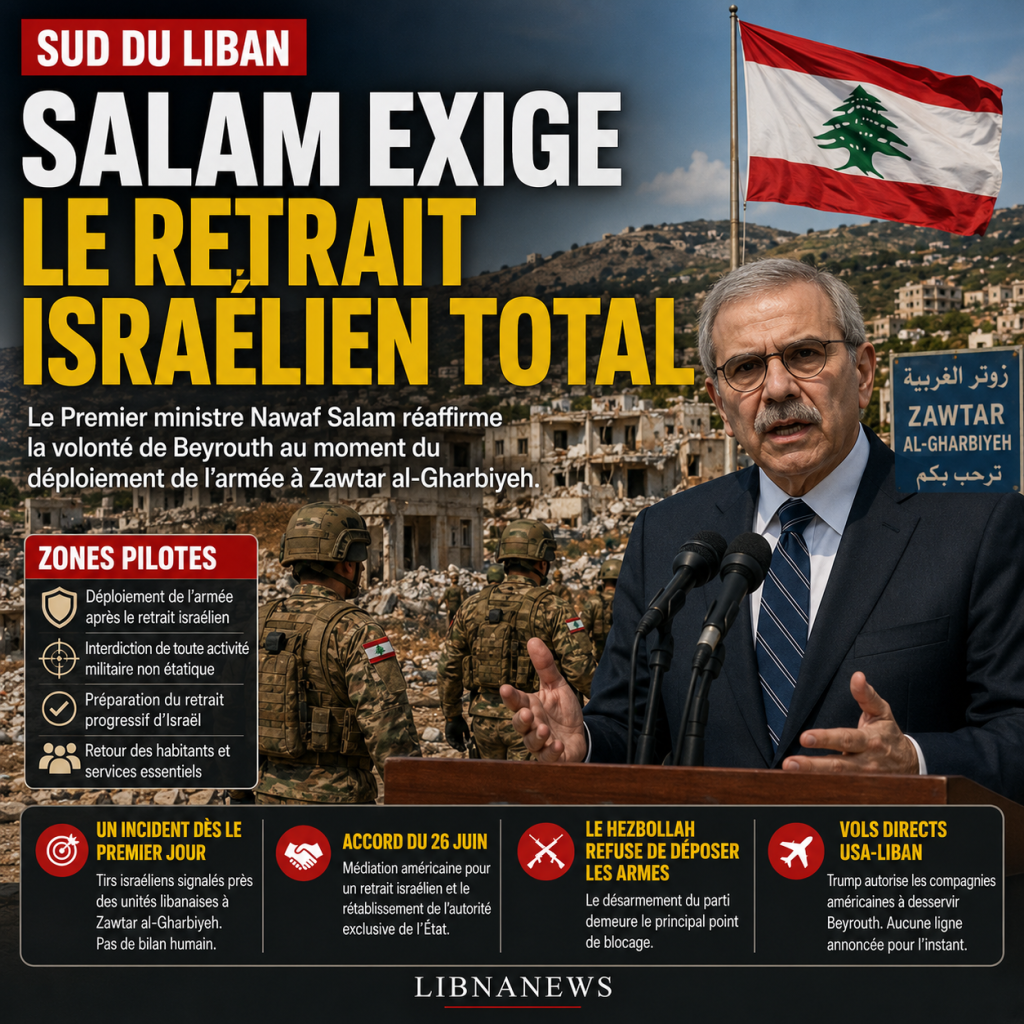
Lebanese Prime Minister Nawaf Salam reaffirmed on Wednesday 22 July Beirut’s determination to secure a complete Israeli withdrawal from Lebanese territory. He spoke in Zawtar al-Gharbiyeh, in the south of the country, the day after the start of the Lebanese army’s deployment to that town heavily affected by the fighting. This visit comes at a time when Lebanon is trying to transform a negotiated agreement under American mediation into concrete progress on the ground. The scheme is based on the establishment of pilot zones, in which the army must restore exclusive State authority, prohibit any unofficial military activity and prepare for the gradual withdrawal of Israeli forces. However, implementation remains fragile. Israeli fire reported near Lebanese units has already caused controversy over the exact perimeter of the deployment.
Nawaf Salam puts Israeli withdrawal at the forefront
In Zawtar al-Gharbiyeh, Nawaf Salam gave political scope to an operation initially presented as military and technical. He assured that the Government would continue its political and diplomatic efforts to achieve a « full Israeli withdrawal » from southern Lebanon. This formula takes up one of the constant requests of the Lebanese authorities since the beginning of the indirect discussions conducted with the support of Washington. Beirut considers that the return of the army to the villages concerned cannot be a lasting solution as long as Israeli soldiers remain present in the national territory.
The Head of Government also wanted to link sovereignty to reconstruction. After raising a Lebanese flag in the village, he announced the continued opening of roads, the clearing of rubble and the restoration of essential services. The stated objective is to enable people to return in safe and dignified conditions. This civilian dimension remains central. Several locations in the South have suffered massive destruction, while electricity, water, telecommunications and access roads remain damaged or cut off.
The presence of Nawaf Salam on site also meets a symbolic expectation. For months, the people of the South have been demanding that the State not limit its action to diplomatic declarations. The deployment of the army, the rehabilitation of infrastructure and the return of administrations must show that the institutions are regaining a long-standing foothold in a region that has been subjected to confrontation. The government seeks to combine three priorities: Israeli withdrawal, the state monopoly of arms and the return of displaced populations.
Zawtar al-Gharbiyeh, first pilot zone test
Zawtar al-Gharbiyeh is one of the localities selected to test the « pilot zones » mechanism. It is intended to enable the Lebanese army to deploy after the withdrawal of Israeli forces, to control access, to search for unauthorized weapons and military infrastructure, and to prevent the return of any armed formation. The experiment should serve as a model for other sectors in southern Lebanon, if the first operations take place without major incidents.
The Lebanese army started entering the village on Tuesday. Israeli forces were previously on its periphery. According to the agreed pattern, the transition must be coordinated to avoid a security vacuum or face-to-face between the two armies. This coordination involves exchanges on maps, schedules, travel axes and positions to be evacuated. Any inaccuracies can cause an incident, especially in an area where the control lines have changed over the course of the fighting.
The first day revealed precisely this vulnerability. The Lebanese army reported that Israeli forces had opened fire near its units. It considered that this episode might hinder deployment. The Israeli army presented another version. It claimed that it had fired warning shots in the air after the entry of Lebanese soldiers into an area that, according to it, was not part of the pilot perimeter. No human results were reported.
Thus, the difference is not only about the nature of the shooting. It also concerns the delimitation of the authorized sector. This misinterpretation underlines the need for a specific operational mechanism. A pilot zone cannot function if the parties do not have the same cards or if the limits are not clearly indicated. The Lebanese authorities want to prevent this type of incident from becoming a pretext to slow down the withdrawal or limit the freedom of movement of the army.
Military coordination still incomplete
The Washington-supported mechanism provides for coordination between Lebanese, Israeli and American teams. It is not a question of direct political cooperation between Beirut and Israel, but of an indirect mechanism to manage military movements. Lebanon and Israel remain officially in a state of war. In this context, American mediators play an essential role in conveying positions, resolving disagreements and verifying the steps of withdrawal.
Discussions in Rome in mid-July had focused on ways to confirm that the areas concerned no longer contained Hezbollah weapons or facilities. They also discussed the timetable for the entry of Lebanese troops and the exit of Israeli units. Initial operations show that agreements in principle still need to be translated into common procedures. The most sensitive issues are controls, patrolling and verification procedures.
For the Lebanese army, the stakes go beyond Zawtar al-Gharbiyeh. Success would strengthen its credibility with residents, foreign partners and the government. Failure, on the contrary, could fuel doubts about its ability to provide security alone. The institution must operate in a destroyed environment, marked by mines, unexploded ordnance, damaged roads and political tensions. It must also avoid confrontation with Israel while affirming Lebanese sovereignty.
The June 26 agreement against Hezbollah’s refusal
The framework agreement concluded on 26 June under American mediation provides for progressive implementation. In pilot areas, the Lebanese army must prohibit any military activity carried out by a non-State group. This provision directly targets Hezbollah, even when the movement is not named in some official formulations. In return, Israel must withdraw its forces from the sectors concerned, before the mechanism could be extended to other territories.
Hezbollah has rejected this agreement and reiterates that it will not lay down its weapons. The movement regards its arsenal as a means of resistance against Israel. This position conflicts with the government’s desire to impose the exclusive authority of the State. It also complicates the timetable set by the mediators. As long as the party rejects the principle of disarmament, every local breakthrough can generate political or security tensions.
Until now, Hezbollah has not engaged in open military action against deployment in the first pilot areas. However, such restraint is not acceptable. The party maintains a strong social and political presence in the South, as well as an ability to influence local communities. The authorities must therefore prevent the application of the agreement from being perceived as an operation directed against part of the Shia population. They portray deployment as a restoration of sovereignty and not as a partisan campaign.
The issue of weapons remains the main blocking point. The army must be able to inspect sectors, remove illegal military equipment and prevent relocation. These operations require strong information, strength and political coverage. They also require a guarantee that Israel will honour its own commitments. The Lebanese authorities fear that unilateral disarmament will be followed by a lasting continuation of Israeli forces or further strikes.
The arms monopoly, a difficult promise to implement
The government of Nawaf Salam has made the state’s arms monopoly a major focus of its programme. This orientation has significant international support. It also corresponds to the demands of a part of Lebanese society, which believes that decisions on war and peace must be made by the institutions. However, the application of this principle does not depend on a simple administrative decision.
Hezbollah has a structured military organization, stockpiles of weapons and underground networks developed over the decades. The recent war has destroyed some of its capabilities, but it has not removed all of its apparatus. The movement also maintains a parliamentary representation and a popular base. Any attempt at forced disarmament could lead to an internal crisis that the Government is trying to avoid.
Beirut therefore favours a gradual approach. Pilot zones must provide a limited, verifiable and verifiable framework. The government hopes to demonstrate that the army can replace armed actors without causing chaos. It also aims to convince foreign partners to increase their military and financial assistance. However, success will depend on the regularity of the Israeli withdrawal and on the ability of the authorities to provide services to the people in a timely manner.
Joseph Aoun Seeks Donald Trump’s Support
Nawaf Salam’s visit to the South took place the day after a meeting between President Joseph Aoun and his US counterpart Donald Trump at the White House. The Lebanese Head of State stated that he had insisted on the urgency of a total Israeli withdrawal from Lebanese territory. He called on the United States to use its influence with Israel to ensure the implementation of the agreement and support the army.
This meeting gave an international dimension to the first operations in the pilot areas. Washington remains the main sponsor of the mechanism. The United States has a capacity to exert pressure on Israel and has long provided significant assistance to the Lebanese army. The Lebanese leadership sought political guarantees, but also material means to deploy more soldiers, secure villages and control the territory sustainably.
Donald Trump presented the beginning of the Israeli withdrawal as a sign of progress. He also promised American support for Lebanon, without detailing all the modalities. For Beirut, the challenge is to convert these declarations into specific commitments. In particular, the government is awaiting pressure on Israel in the event of delays, enhanced assistance to the army and an international contribution to reconstruction.
Joseph Aoun’s visit was the first meeting of a Lebanese president in the White House since 2009. It intervenes at a time when Lebanon is trying to restore more stable relations with its partners. The government seeks to convince that institutions can regain control of the territory, lead reforms and provide a reliable interlocutor. The success of the pilot zones is a political as well as a military test.
Human and material costs weigh on schedule
The war that began after Hizbullah’s attack on Israel on 2 March, in support of Tehran, triggered a large-scale Israeli offensive. Air strikes and land invasion have affected many Lebanese regions, especially in the South and the Bekaa. According to the Lebanese authorities, more than 4,300 people have been killed since March. Thousands more were injured, while entire neighbourhoods were destroyed.
More than one million people had to leave their homes at the height of violence. The United Nations estimates that more than 700,000 internally displaced persons have returned to their region in recent weeks. However, this return movement remains uneven. Some families find damaged homes, waterless villages or still dangerous land. Others cannot return because of military presence, destruction or lack of public services.
Israeli forces have demolished dozens of buildings in the south. These destructions complicate the resumption of local life and fuel Lebanese accusations of violation of sovereignty. Clearing is a long and costly project. The stability of structures must be verified, explosive devices removed, roads restored and networks rebuilt. Municipalities have limited resources after several years of economic crisis.
Nawaf Salam therefore associated military deployment with immediate civilian action. The return of the Lebanese flag would be limited in scope without schools, clinics, water, electricity and road access. The government must show that the state can protect but also administer. This requirement explains the presence of civilian officials alongside the army and the attention paid to the rehabilitation of essential services.
The return of the inhabitants remains conditional
The sharp decline in violence since last month’s signing of a framework agreement between the United States and Iran, followed by the agreement between Lebanon and Israel, has facilitated returns. However, the reduction in strikes does not mean that the situation is stabilized. The incidents around the pilot areas, the shooting of seed and the disagreements on the maps show that the risk persists.
Families assess several factors before returning. They want to know whether the army is present, whether the roads are open and whether their housing remains accessible. They must also verify the presence of mines or unexploded ordnance. In some villages, lack of housing requires temporary accommodation. Finally, farmers must determine whether the land can be used safely.
Reconstruction could become a decisive factor for the sustainability of the agreement. If people do not see rapid improvement, confidence in the state may erode. Conversely, a visible return to service of the infrastructure would reinforce acceptance of the device. The authorities rely on external assistance, but donors call for guarantees of stability, transparency and control of expenditure.
Direct flights with the United States as an economic signal
The meeting in Washington also produced an announcement unrelated to the military record, but important for the Lebanese economy. Donald Trump has allowed US airlines to resume direct flights to Beirut, interrupted since 1985. The actual recovery still depends on safety assessments, administrative decisions and the commercial choice of carriers.
Nawaf Salam welcomed this announcement. It provides an opportunity to improve travel between Lebanon and the United States, strengthen ties with the diaspora and support the economy. Direct flights could facilitate family travel, business exchanges and tourism. They would also reduce passenger connections, often forced to transit through Europe or the Gulf.
However, the impact will not be immediate. Companies will have to assess demand, costs, insurance and safety conditions. Beirut airport will have to meet US requirements. The maintenance of official warnings on travel to Lebanon may also hinder the establishment of new lines. The announcement therefore constitutes first of all a political signal of rapprochement.
For the Lebanese authorities, this gesture complements the message sent from the South. The government wants to show that the restoration of sovereignty can pave the way for economic and diplomatic normalization. Investment, tourism and reconstruction depend largely on security. Each progress in the pilot areas could thus have effects beyond the military file alone.
A fragile mechanism expected in other villages
The next step will be to check whether the army can complete its deployment in Zawtar al-Gharbiyeh without further incident. Coordination teams will need to clarify the boundaries of the area and the permitted movements. The Lebanese army will then have to control infrastructure, secure access and establish a sustainable presence. Israel will be expected to respect the agreed withdrawal.
The results obtained in this locality will partly determine the pace of operations elsewhere. If the model works, other villages could follow. If disagreements persist, Washington will have to intervene to avoid a blockage. The credibility of the agreement is based on a series of verifiable steps, not on general statements.
The Lebanese government is therefore moving on a narrow line. He must demand Israeli withdrawal, contain tensions with Hezbollah, support the army and meet the needs of the displaced. It must also convince its partners that the State can assume security alone. In Zawtar al-Gharbiyeh, soldiers began to take positions while civilian teams assessed roads and buildings. The continuation of the deployment now depends on the resolution of the perimeter dispute and the forthcoming decisions of the coordination mechanism.




