

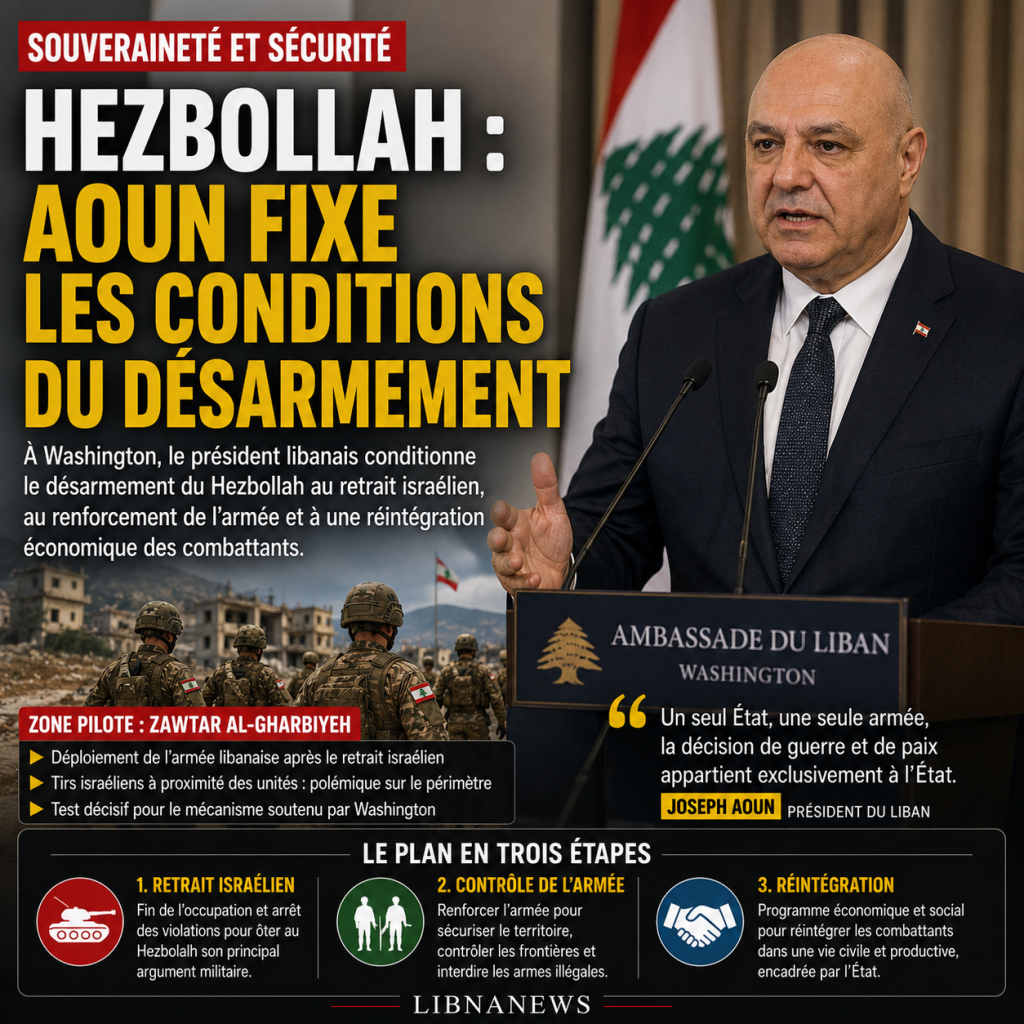
Joseph Aoun placed the disarmament of Hezbollah at the centre of his speech at the Lebanese Embassy in Washington, D.C., saying that this goal remained possible but that it required several political, military and economic conditions. The Lebanese President defended a three-step approach: the end of the Israeli occupation of Lebanese territory, the full transfer of operational control to the army and the reintegration of the movement into a state-run economy. He refused to present the case as a mere confiscation of weapons. According to him, Hezbollah is composed of Lebanese citizens who were shaped for forty years by ideological, social and military investment. This reality does not diminish the urgency of the state monopoly on weapons, but it makes the method decisive to avoid a new internal confrontation.
« A State, an Army » at the heart of the Aoun project
Since his arrival in the presidency, Joseph Aoun claims to pursue a single goal: one State, one army and the end of all armed groups operating outside public authority. In Washington, he presented the Lebanese army as the institution capable of carrying this transition. He stressed its national character, recalling that it does not depend on any community, party or faction. This choice is intended to address one of the main obstacles in the file. The disarmament of Hezbollah cannot be entrusted to a force perceived as hostile to the Shia community. The President therefore seeks to place the army above political divisions, while calling on the United States to provide immediate and unconditional support to build its capabilities.
The first condition imposed by Joseph Aoun concerns the Israeli withdrawal. The Head of State believes that the occupation of Lebanese territories remains the main justification put forward by Hezbollah to maintain its arsenal. As long as Israeli forces control localities, heights or axes in South Lebanon, the movement can present its weapons as an instrument of resistance. However, the President does not repeat the entire speech of Hezbollah. He claims that the decision on war and peace must belong exclusively to the State. But it considers that lasting disarmament cannot be achieved if Israel maintains a military presence or continues to strike on Lebanese territory. The sequence defended in Washington therefore combines Israeli withdrawal with the extension of Lebanese authority, rather than dealing with the two files separately.
Israeli withdrawal as a first condition
This is particularly important when the first pilot areas are being implemented in southern Lebanon. The mechanism provides for a gradual Israeli withdrawal, followed by the deployment of the Lebanese army in the evacuated areas. Fron, Srifa and Zutr el-Gharbiyé were selected to test this sequence. However, the Israeli fire reported near Lebanese units during their deployment to Zutr al-Gharbiyah immediately revealed the fragility of the device. For Joseph Aoun, this incident illustrates precisely the problem: the army cannot exercise exclusive control if it remains exposed to a foreign force capable of intervening in the area. The withdrawal must therefore be real, verifiable and accompanied by a halt to the firing, failing which the disarmament process would lose credibility with a part of the population.
The second condition concerns the means of the Lebanese army. Joseph Aoun is not just asking for political support. It called for resources to enable the armed forces to control borders, secure villages, dismantle non-State military infrastructure and prevent the rebuilding of clandestine depots. This mission requires additional troops, vehicles, communications equipment, demining equipment and monitoring capabilities. It also requires regular wages and logistical resources in a country whose institutions have been weakened by the financial crisis. The President therefore presented support for the army as a prerequisite for any serious operation. Without an institution able to occupy the ground sustainably, disarmament could create a security vacuum or move weapons to other regions.
A disarmament and reintegration strategy
Joseph Aoun then introduced a third condition, more rarely mentioned in the Lebanese debate: reintegration. He cited the experiences of the Revolutionary Armed Forces of Colombia and the Irish Republican Army in defending an approach to disarmament, demobilization and reintegration. With this in mind, the fighters do not only surrender their weapons. They leave a military structure, find a place in society and gain economic prospects. The president believes that a state-run reconstruction programme must create real jobs and reduce dependency on partisan networks. His reasoning is based on one observation: Hezbollah is not just an armed organization. It also has social structures, services, medical institutions, schools, support networks and an economic base in several regions.
The comparison with Colombia and Northern Ireland gives an international depth to the presidential project, but it must be handled with caution. The FARC signed a peace agreement in 2016 after several years of negotiations with the Colombian government, under international mediation. The IRA gradually abandoned the armed struggle as part of the process leading to the agreement on Good Friday in 1998, and then to the verified dismantling of its arsenal. In both cases, disarmament was based on political guarantees, institutional representation, external verification and reintegration programmes. However, Lebanon has a different configuration. Hezbollah has elected officials, ministers, an established social network and a strategic relationship with Iran. It also acts in a country that is subject to Israeli attacks and a deep economic crisis.
A break with the general formulas of the past
The choice of the disarmament, demobilization and reintegration model, however, marks a break in the official Lebanese discourse. For a long time, the issue of Hezbollah’s weapons was addressed through general formulations on national defence strategy or internal dialogue. Joseph Aoun now proposes a structured method, with a sequence and identifiable objectives. He’s not talking about a sudden military operation or an ultimatum. It envisages a process that gradually transforms an armed group into a political and social component without an autonomous military capacity. This approach seeks to avoid a civil war, but requires the agreement of Hezbollah. It also presupposes that Lebanese institutions can provide credible guarantees and that foreign partners comply with the announced steps.
The main obstacle remains the position of Hezbollah itself. The movement has consistently stated that its weapons will remain necessary as long as Israel occupies Lebanese territory, violates airspace or threatens the country. It also regards its arsenal as an element of regional deterrence and as a component of its alliance with Iran. An Israeli withdrawal could weaken one of its arguments, without resolving the whole issue. The party will have to decide whether it agrees to transform its military role, to surrender its heavy weapons and to place its fighters under a state framework. He will also have to convince his base that this evolution does not mean surrendering or abandoning the Shiite community. No detailed official reaction to the method presented by Joseph Aoun had yet been made public within the first hours of the speech.
Reconstruction entrusted exclusively to the State
The success of the project will also depend on reconstruction. The President explicitly links reintegration to a programme managed solely by the State. This clarification is intended to prevent the reconstruction of the South from further strengthening parallel networks. After the previous wars, Hezbollah had often been central to compensation, housing repair and family assistance. This capacity had strengthened its local legitimacy and financial dependence on Iran. Joseph Aoun wants to reverse this logic. The State should become the main interlocutor of the inhabitants, allocate aid, restore services and create jobs. This will require considerable international funding and sufficient transparency to convince donors.
This ambition is met by the historical weakness of the Lebanese administration. Institutions suffer from lack of resources, corruption, political divisions and slow procedures. An exclusively public reconstruction programme can only succeed if the State rapidly improves its capacity to execute. It will have to identify damage, compensate families, repair infrastructure and support the local economy without political discrimination. The Colombian example shows that the decline in violence does not automatically lead to economic improvement when the State does not replace the armed structures in the regions concerned. Joseph Aoun seems to integrate this lesson by placing reconstruction and professional opportunities at the heart of reintegration. The challenge will be to transform this principle into mechanisms that are funded, controlled and accessible to people.
Border control as a condition for a lasting result
The issue of borders is another essential aspect. The President recalled that the State should exercise its authority over the whole territory and control its borders alone. Hezbollah has long benefited from supply routes through Syria, with the support of Iran and networks linked to the former Damascus power. The political changes in Syria have changed these circuits, without removing them entirely. To make disarmament sustainable, the Lebanese army will have to prevent the arrival of new weapons and monitor official passages such as underground roads. This mission requires cooperation with the Syrian authorities and significant technical resources. It also affects trafficking in drugs, fuel and people, who sometimes use the same logistics networks as weapons.
Finally, the Washington speech aims to establish the responsibility of international partners. Joseph Aoun is not just asking Hezbollah to change. He called on Israel to withdraw, the United States to support the army and donors to finance reconstruction. Its project is based on reciprocity: the Lebanese State applies the arms monopoly, while external actors suppress the conditions that fuel parallel military logic. This approach allows the President to present disarmament as a national project rather than as an American or Israeli requirement. However, there is a risk. If Israel delays its withdrawal, if funding does not arrive or if the army lacks resources, Hezbollah will be able to assert that the announced conditions are not met and maintain its arsenal.
The monopoly of war and peace
The reference to the monopoly of the decision of war and peace is the strongest political point in the discourse. Joseph Aoun states that the state must be the only actor capable of engaging the country in conflict. This position directly targets military decisions taken by Hezbollah without government authorization. It also responds to an old demand from a large part of Lebanese society, which refuses to involve the country in regional wars. The President, however, seeks to apply this principle through a negotiated transition. It does not propose a confrontation between the army and the movement. It wants to create a balance of institutional forces in which Israeli withdrawal, international aid and reconstruction make the maintenance of weapons less defensible.
Implementation will also require a Lebanese legal framework. The surrender of arms, the status of former combatants, possible amnesties and the integration of certain personnel into public institutions cannot be based on informal arrangements. Parliament and the Government will have to establish rules applicable to all armed groups in order to prevent the process from appearing against a single community. A monitoring mechanism should verify the destruction or transfer of arsenals, while justice should distinguish between individual crimes and acts covered by a political agreement. This dimension remains absent from the presidential speech. However, it will become central as soon as the principles are transformed into decisions, budgets and verifiable obligations.
In Washington, therefore, Joseph Aoun presented more than a promise of disarmament. He outlined a political architecture based on Israeli withdrawal, the rise of the army, the closure of supply chains and economic reintegration. This method provides a more precise framework than previous calls for dialogue, but it does not yet address operational issues. No public timetable has been announced for the handing over of arms, the possible integration of combatants or the dismantling of military structures. No independent verification mechanism was detailed. The next step will depend on the responses obtained from Washington, the pace of Israeli withdrawal, the means granted to the army and the position of Hezbollah against a project that directly affects its military status.




