

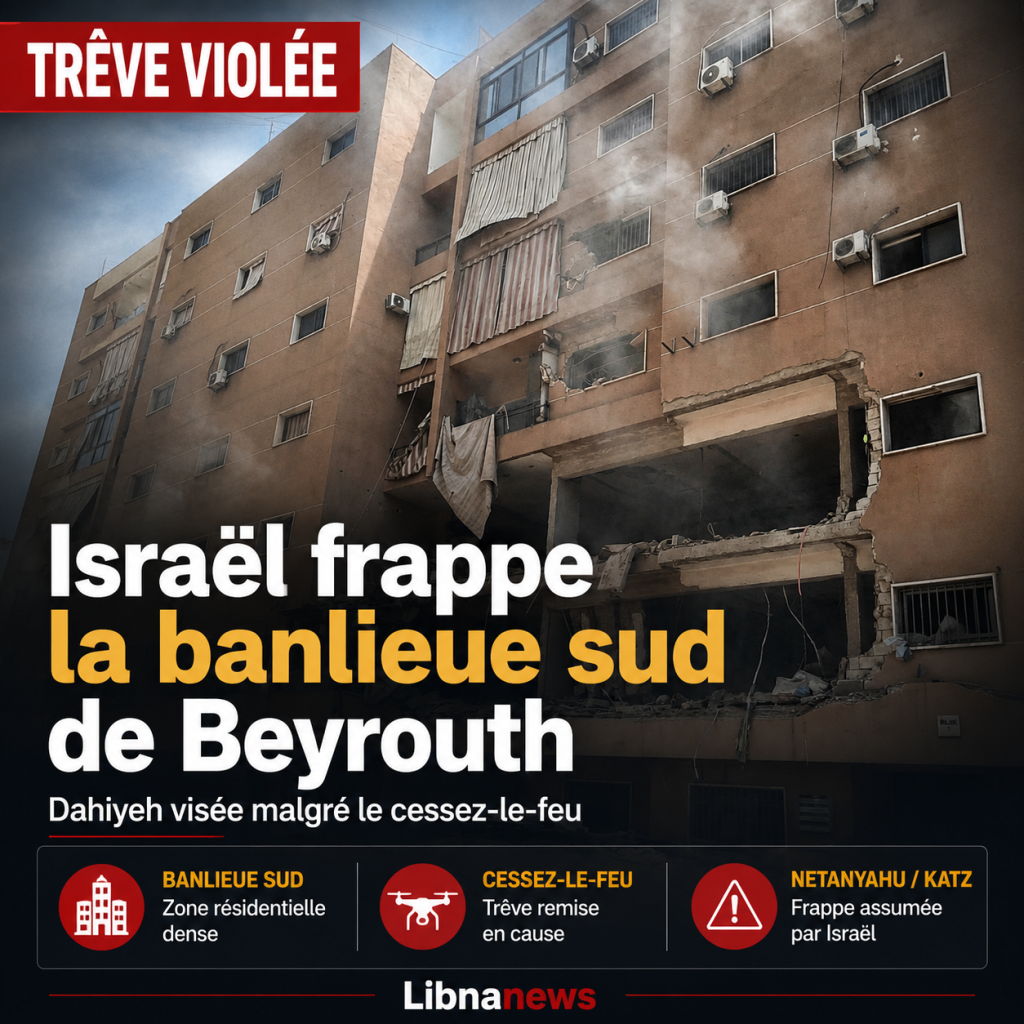
An Israeli strike targeted the southern suburbs of Beirut on Sunday, 7 June 2026, despite the ceasefire presented in recent days as a framework for de-escalation. The Israeli Prime Minister Benjamin Netanyahu’s office assumed the attack, stating that the army was acting on instructions from Netanyahu and the Israeli Defence Minister Katz, in response to Hezbollah’s fire on Israeli territory. This official formulation confirms that the southern suburb remains treated by Israel as a direct military lever, despite the urban density, the presence of civilians and the truce commitments mentioned by the mediators.
The attack immediately put Beirut back in the war. Israeli drones had overflew the capital and its surroundings in the previous hours, putting a perceptible tension in several quarters. In the southern suburbs, the inhabitants again experienced the familiar sequence: alarm rumors, slow traffic, closed shops, families seeking to reach their relatives and ambulances ready to deploy. The human and material record was still to be consolidated by the Lebanese authorities at the time of the initial dissemination of the information, but the political significance of the strike was already clear. The announced truce does not protect the capital when the Israeli government decides to suspend its effects.
The southern suburbs again targeted
The southern suburbs of Beirut is not an empty space on a military map. It is a dense area of residential buildings, shops, schools, clinics, garages, busy roads and neighbourhoods where tens of thousands of civilians live. Israel regularly presents it as a stronghold of Hezbollah. This qualification does not nullify the presence of the inhabitants or their rights. It does not turn every street into a military goal. Every strike has immediate consequences for civilian life, even when Israel claims to be targeting infrastructure or Shiite leaders.
The Netanyahu office statement gives a key to reading the sequence. It does not refer to an isolated incident, but to a political and military decision taken at the top of the Israeli state. By directly linking the strikes on the southern suburb to Hezbollah fire on Israel, Netanyahu and Katz impose a punitive equation: if northern Israel is targeted, Beirut can be hit. This logic places a Lebanese urban population under threat of the decisions of armed actors and reprisals decided since Tel Aviv. It empties the ceasefire from its primary meaning, which should be to reduce attacks and protect civilians.
The ceasefire announced under United States mediation had generated a cautious expectation in Lebanon. It should at least prevent an expansion of attacks on Beirut and open a negotiating space on southern Lebanon. However, Israeli strikes continued in several areas, including roads, southern localities and positions where the Lebanese army was present. The southern suburbs are now returning to the target area assumed. The agreement thus appears not as a guarantee, but as a conditional break, dependent on the Israeli interpretation of events on the front.
A fragile and unilateral ceasefire
This fragility had been reported in the early hours of the truce. Israeli officials have maintained their right to strike what they call threats. Hezbollah, for its part, refused to place itself in a logic of disarmament or setback as long as Israel continued its operations and maintained positions in Lebanon. Between these two lines, the Lebanese State attempts to defend the sovereignty of the country without having the military means to impose the silence of weapons. This Sunday’s strike shows that civilians remain the first to be exposed to this impasse.
The resumption of a strike on the southern suburbs also has a psychological dimension. Beirut is a capital already marked by crises, the explosion of the port, the economic collapse and the succession of security tensions. When Israeli drones return to their neighbourhoods, collective memory immediately reacts. People don’t expect the official balance sheet to understand the danger. They hear the aircraft, see the panic movements, receive contradictory messages and question the rest. The war is not just about the moment of the explosion. It also starts waiting for the strike.
In the southern suburbs, this expectation has a daily cost. Schools can close without notice. Shops lose hours of work. Families hesitate to stay or leave. Older people cannot always leave their apartment. Patients must choose between safety and access to care. Children learn to recognize the noise of drones before they even understand political communiqués. A truce that does not prevent this climate of threat does not fulfil its function. It becomes a diplomatic word, far removed from the experience of the inhabitants.
Civilians caught in the Israeli equation
The Israeli justification refers to Hezbollah’s firing at Israeli territory. These shots exist as part of the ongoing confrontation and also expose civilians to the north of Israel. But their invocation does not give Israel an unlimited right to strike densely populated areas in Lebanon. International humanitarian law imposes rules even in times of war. It imposes a distinction between combatants and civilians, proportionality of response and precautions to avoid civilian casualties. A capital cannot become an instrument of pressure without testing these principles.
Israeli vocabulary often seeks to reduce the southern suburbs to Hezbollah-controlled space. This reduction is dangerous. It erases people who have no military function. It erases workers, families, traders, students, caregivers and displaced persons. It also erases the complexity of an urban fabric that is not confused with a single organization. By striking the southern suburbs, Israel strikes a real civilian environment, even if the declared objective is military. This reality must remain at the heart of journalistic processing.
The Lebanese Government is again facing a clear violation of its sovereignty. Lebanese territory is hit by a foreign army, outside any international mandate and despite a cease-fire intended to limit hostilities. The Beirut authorities will have to document the damage, take stock, seize the international interlocutors and recall that the truce agreement cannot be a one-way mechanism. Sovereignty is not only defended by communiqués. It is also defended by the construction of a precise file, hour by hour, struck by strike.
Mediators face their contradictions
Lebanon’s international partners also bear political responsibility. They cannot welcome a truce one day and watch the next day the southern suburbs be struck without measuring the consequences. If the guarantor or mediator States do not impose any diplomatic costs on violations, the ceasefire will lose credibility. The inhabitants judge the agreements to their effects, not to the formulas used in the capitals. For them, a truce means the absence of explosions, the end of drones over buildings and the possibility of moving without fear of a strike.
The Israeli strike against the southern suburbs also came after a series of attacks against the Lebanese army. The death of several military personnel, including Brigadier General Wissam Sabra, has already caused shock in the country. However, the Lebanese army is the institution that the mediators say they want to place in the centre of a future stabilization mechanism. Hit her, then hit the capital again, weakens the very architecture that these mediations claim to build. Lebanon is being called upon to restore State authority in a territory that continues to be dislodged by Israeli strikes.
For the people of Dahiyeh, diplomatic debates often seem distant. The residents want to know whether their building will be targeted, whether their street is mentioned in an alert, whether their children’s school will open the next day, whether the neighbouring hospital will be able to receive the wounded. War results in ordinary and difficult decisions. Leaving implies a cost, a dwelling, a safe road and sometimes the abandonment of essential goods. Remaining imposes fear of drones and explosions. This permanent constraint is already a form of violence.
Beirut under the threat of a new sequence
The southern suburbs also bear a special memory of past wars. In 2006, it had been heavily bombed. Since then, every new Israeli threat has reactivated this memory of destruction and displacement. The reconstructed buildings, the reopened shops and the returned families do not remove this trace. On the contrary, they make it more lively. People know what an extended air campaign means. They know that the first strikes can announce others. The statement of the Netanyahu office, assuming the offensive in response to Hezbollah fire, reinforces this concern.
The risk is now that violations will be normalised. A strike is presented as an answer. Another as an exception. A third like a warning. Gradually, the ceasefire ceased to be a rule and became a mere diplomatic reference. The South Lebanon has already experienced this slide. The villages are still hit in spite of the announcements of accalmie. Roads remain dangerous. Civilians, first aid workers and military personnel were killed there. The southern suburbs could be driven in the same logic if no clear limits are imposed.
This situation increases pressure on Lebanese institutions. The government must avoid two pitfalls. The first would be to be content with general denunciations, without concrete follow-up. The second would be to let the issue of the southern suburbs be dealt with only as a Hezbollah-related matter. Beirut must recall that the security of its neighbourhoods is the responsibility of the State and that Lebanese civilians must be protected, regardless of where they live. The distinction between internal political disagreement and national protection is essential.
A capital suspended from future decisions
Hezbollah’s response will also be scrutinized. Any response could result in a new sequence of Israeli strikes. Any lack of response could be interpreted as a restraint calculation or a tactical adaptation. In both cases, residents remain suspended from decisions that do not belong to them. This is one of the toughest features of this war: civilians experience the consequences of military choices taken by others, in a space where security margins narrow daily.
The economic impact should not be underestimated. The southern suburbs are a dense area of activity. Thousands of families depend on small businesses, workshops, services, transportation and daily incomes. Every firm alert of shops, interrupts deliveries, discourages customers and increases uncertainty. In a Lebanon already hit by the monetary crisis and the fall of purchasing power, these repeated stops exacerbate insecurity. Visible material destruction is only part of the cost. The rest is measured in terms of lost income, repulsed debts and forced departures.
Relief must intervene in an uncertain environment. After a strike, you have to reach the site, secure the surroundings, check the risks of collapse, evacuate the wounded, avoid crowding and fear a second strike. This method of work under threat exhausts the teams. It also puts people at risk when they gather around an affected place by reflex. In dense neighbourhoods, each intervention becomes a delicate operation. The ceasefire had to reduce that pressure. This Sunday’s strike resettles it in the heart of Beirut.
The statement of the Netanyahu office finally leaves a lasting threat. If Israel considers that every Hezbollah fire can justify an attack on the southern suburbs, then the Lebanese capital remains exposed at any time. This doctrine creates permanent instability. It expands the theatre of confrontation and makes it almost impossible to return to a normal life. It also puts mediators in the midst of an emergency: to define whether the truce is binding or can be suspended from every Israeli decision.
In the coming hours, attention will be paid to Lebanon’s balance sheet, damage, possible evacuations and official reactions. Most of the residents will be interested in whether more strikes are expected. Drones in the sky will sometimes say more than press releases. The southern suburbs of Beirut, once again struck despite the ceasefire, became the place where the reality of the truce is measured: not in the statements of the leaders, but in the concrete capacity of civilians to stay at home without waiting for the next explosion.




