

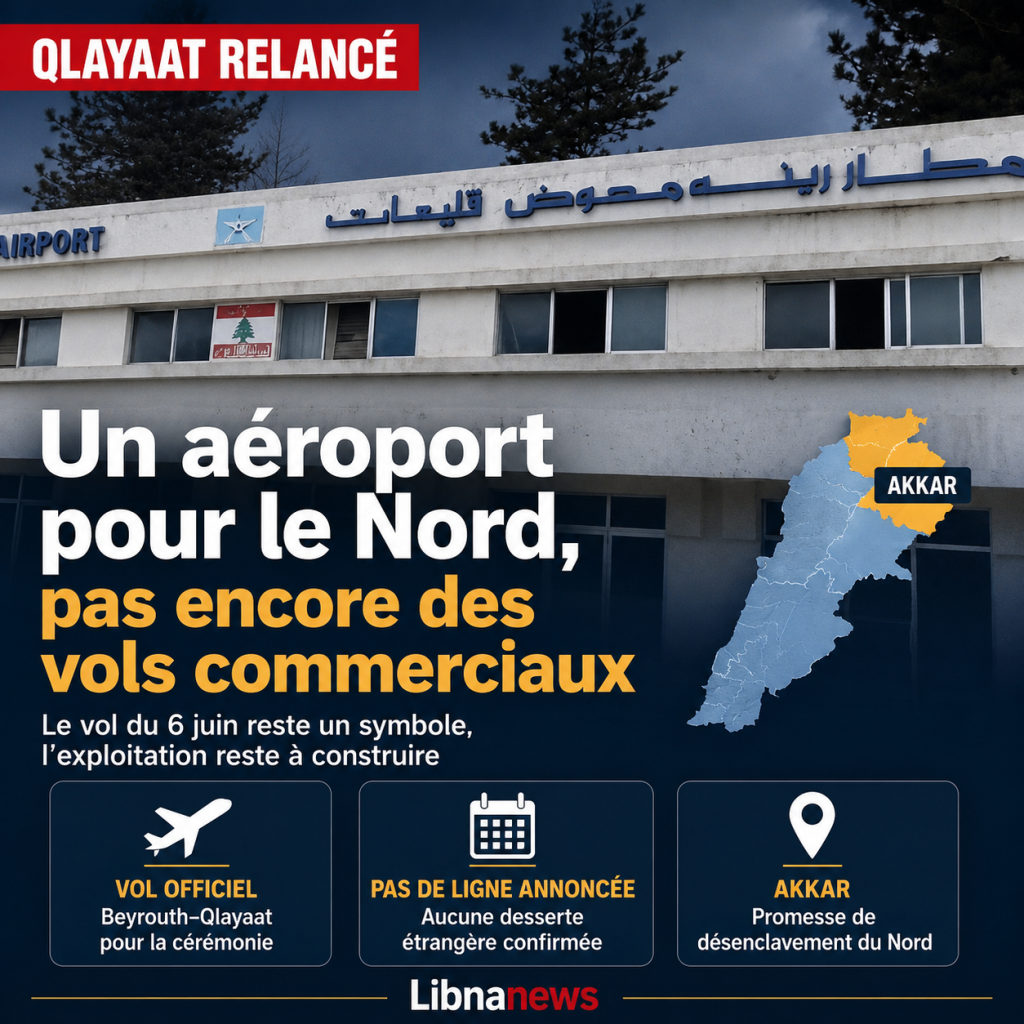
The airport of Qlayaat returned Saturday 6 June 2026 to the center of the Lebanese scene with the official launch of the development and operation project of the René-Muawad airport in Akkar. The ceremony, organized on the site of the northern terminal itself, brought together Prime Minister Nawaf Salam, Minister of Public Works and Transport Fayez Rasamny, ministers, security officials, elected officials, local representatives and diplomatic personalities. A special flight between Beirut and Qlayaat marked the event. It is not at this stage a commercial resumption of flights or a regular passenger service.
This precision is central. Saturday’s flight connected Rafic Hariri International Airport from Beirut to Qlayaat Airport to take the officials to the venue of the ceremony. The day before, the arrival of an aircraft had a technical function, designed to test the site’s capabilities and verify track parameters. For the time being, no foreign airline has announced a regular service to Lebanon from Qlayaat. The image of an aircraft on the runway therefore has a political and symbolic scope. It should not be confused with the opening of an international flight schedule.
The Qlayaat airport is being staged again
The morning began in Beirut, where Nawaf Salam travelled to Rafic Hariri International Airport before boarding for Qlayaat. He was accompanied by Minister Fayez Rasamny. Other officials, including the Ministers of Defence and Interior, joined the site by military helicopter. On-site security measures were strengthened from the southern entrance of the Akkar to the airport perimeter. Helicopters overflew the vicinity of the site, while official delegations, elected representatives and municipal representatives were gradually arriving to attend the launch.
The arrival of the aircraft carrying the head of government gave the event its main image. After decades of promises, a civilian aircraft would again land on this vast northern platform. But the officials present wanted to put the sequence in a schedule of work. The government is launching a phase of development, rehabilitation and supervised exploitation. It does not proclaim the immediate opening of a second commercial airport. The site must still receive equipment, security services, terminal facilities, control devices, and procedures for navigation and handling of passengers.
The aim of this scoping is to avoid overpacking. Lebanon has often announced major projects without completing them. Qlayaat precisely symbolizes this repetition of promises. For more than thirty years, his name has been in the debates on decentralization, aviation safety, the northern economy and excessive dependence on Beirut airport. Each crisis reacts to the idea of a second civilian airport. Each period of appeasement pushes back the file. The ceremony on June 6 is intended to transform an old claim into a visible site, but it also opens a verification phase.
A ceremony worn by the North
The choice to hold the ceremony in the Akkar is not neutral. This region remains one of the most marginalized in Lebanon. Infrastructure is weak, employment is lacking and young people often go elsewhere to look for what their territory does not offer. For local elected officials, Qlayaat Airport represents more than one runway. It embodies a promise of freedom, transport, services, freight, tourism and jobs. It can also bring the North closer to its diaspora, particularly in the Gulf countries, Turkey and Europe, if commercial conditions are ever met.
Local officials welcomed the launch as an expected step. In recent months, several personalities from the Akkar and the North have increased their calls to put the project at the top of national priorities. The dossier had also been discussed at the Council Presidency with municipal delegations and economic representatives. The ceremony therefore served as a political response to an old demand. It showed that the government wanted to include the North in a national transportation strategy, not leave it out of infrastructure decisions.
In his speech, Nawaf Salam emphasized this dimension. The Prime Minister presented the recovery of Qlayaat as a political, economic and social choice. He recalled that Akkar should no longer remain outside the priorities of the State. He also linked the Northern issue to the situation in the South, stating that the country could not recover if certain regions remained threatened, forgotten or deprived of investment. This reconciliation gives the project a national scope. It places the airport in a broader view of sovereignty, territorial balance and state reconstruction.
Nawaf Salam’s speech
Nawaf Salam presented Qlayaat Airport as one of the pillars of a Northern Recovery Strategy. He recalled that his Government had committed itself, in its ministerial declaration, to restarting René-Mouawad Airport because of its importance for development. It has also placed the project in a set of four dossiers: the operation of Qlayaat, the activation of the special economic zone of Tripoli, the revival of the Rachid-Karamé exhibition centre and the development of the Tripoli port. The aim is to create an economic chain in the North, not isolated equipment.
The Prime Minister focused on the social figures of Akkar. He mentioned very high poverty, lower labour market participation and high unemployment. These data have been used to support the idea that the recovery of the airport is not a luxury. It must respond to an ancient territorial injustice. In this reading, Qlayaat becomes an instrument of equality between regions, just as a road, port or industrial zone. The speech thus sought to move the debate: it is not just aviation, but access to opportunities.
Nawaf Salam also recalled the steps taken by the government. A scoping study and a master plan were entrusted to Dar al-Handasah. A specification was then prepared. A competition procedure was initiated before the project was awarded to a private operator. The Head of Government wanted to show that the case was progressing in administrative, legal and technical stages. This reminder responds to a strong concern in Lebanon: transparency in public procurement and the State’s ability to protect its interests.
The speech finally emphasized the historical dimension of the site. Qlayaat bears the name of President René Mouawad, elected in November 1989 in the wake of the Taif agreement, then murdered a few days later. The airport is thus linked to a decisive moment of the end of the civil war. Nawaf Salam wanted to give the project an institutional meaning by evoking this memory. Relaunching the airport, according to this approach, means reviving the idea of a state able to rebuild, decide and allocate investment between regions.
The words of Fayez Rasamny
The Minister of Public Works and Transport, Fayez Rasamny, carried the operational part of the ceremony. He presented the project as a sign of capacity recovered from the state. According to reports from the local press, he pointed out that the airport was not only in the Akkar or the North, but in all Lebanon. This is intended to avoid strictly regional reading of the file. Qlayaat must be thought of as a national tool, able to complement Beirut and provide the country with an additional margin in normal times as well as in times of crisis.
The Minister also referred to the gradual entry of the airport into an execution phase. He spoke of the short lead times and the first phase of air transport. Destinations such as Mersin, Istanbul or Dubai were mentioned in the public sequence. However, this is not an announcement of lines confirmed by foreign companies. To date, no foreign airline has published a regular program to Qlayaat. The Lebanese State will still have to obtain the necessary trade commitments, operational agreements and authorizations before turning these destinations into flights sold to passengers.
This distinction is essential for travellers. Saturday’s flight was not a regular commercial flight. He transported those responsible from Beirut to Qlayaat, no more. It does not automatically open a possible reservation for the public. Nor does it mean that international companies will start their rotations in the coming days. The reality of the project will be measured by other indices: actual start of work, terminal equipment, recruitment, security, customs, passport control, aviation certification, publication of schedules and signing of agreements with carriers.
A symbolic flight, not a commercial service
The confusion around the planes laid at Qlayaat is understandable. After years of waiting, each movement on the track can be interpreted as an opening. But in the air sector, a technical test, demonstration flight or official flight is not worth operating. On the eve of the ceremony, the arrival of an aircraft responded to a verification logic. The track, approaches, motion conditions and some basic devices had to be tested. This type of operation precedes operating decisions. He’s not replacing them.
The flight of June 6 played another role. It gave a strong image to the political revival. The Prime Minister and his Minister of Public Works have chosen to arrive by air, to show that the platform can receive a civilian device in a framed setting. This gesture has a value of communication and mobilization. It shows that the project leaves the language of the press releases alone. But it does not guarantee the final schedule or the level of traffic. For the moment, Qlayaat remains a construction site to launch, not a fully operational commercial airport.
This caution does not remove the importance of the day. On the contrary, it protects the project from unrealistic expectations. The North needs tangible results, not illusions. The people of Akkar have heard too many promises to settle for a symbol. They will wait for the first gears, published contracts, visible works, temporary terminal, security equipment and initial recruitment. The success of the project will depend on this continuity, more than on the image of an aircraft on a runway on the day of launch.
Strategic infrastructure in a vulnerable country
The recovery of Qlayaat takes place in a heavy security environment. Israeli strikes, threats to infrastructure and the country’s dependence on Beirut airport have revived the debate on the need for a second civilian air access. Lebanon cannot depend indefinitely on a single platform, located in the capital and exposed to regional tensions. An airport in the North could offer a complementary solution for emergencies, freight, certain routes and continuity of public services. It would not replace Beirut, but it would reduce the vulnerability of the country.
The issue is also economic. Qlayaat is located near Tripoli, the port, the future special economic zone and a large population pool. If the project succeeds, it can stimulate services, hotels, logistics, maintenance, road transport and small businesses. It can also facilitate the movement of northerners, often forced to cross much of the country to reach Beirut airport. The gain is not only measured in kilometers. It is measured in terms of time, cost, security and dignity for areas long held at a distance.
But there are still many conditions. An airport is not a runway. Reliable access roads, lighting, parking, emergency facilities, perimetric security, immigration and customs services, freight management, computer systems and procedures compatible with international standards are required. We must also attract companies. Without carriers ready to sell tickets, the platform will remain under-used. Without a sound economic plan, it risks becoming another political showcase.
Transparency issues
The selection of the private operator is one of the sensitive issues. The project was awarded to Sky Lounges Services, a Lebanese company active in private aviation services and operating in the Beirut airport ecosystem. The economic press mentioned a four-year contract, a state share of 8 per cent of net profit and a minimum annual guarantee of $200,000. These parameters raised questions about future profitability, revenue sharing, operator obligations and public control of the project.
These questions should not be swept away. They naturally accompany a case of infrastructure in a country with a lack of confidence in public procurement. The State should publish the essential elements of the contract, clarify investment obligations, detail the timetable and explain how the income will be controlled. The revival of Qlayaat cannot succeed if it reproduces the ambiguities that have undermined so many Lebanese projects. It must be exemplary, because it affects both sovereignty, public money and the development of a marginalised region.
The announced interim terminal will also need to be closely monitored. Its surface, capacity, equipment and timing will give an initial indication of the real ambition of the project. A minimum terminal may be sufficient to launch limited operations, but it will not be able to carry a sustainable national transport strategy. The government will therefore have to explain the difference between the first phase and subsequent developments. Northerners must know what is expected in three months, one year and beyond.
A promise to test the calendar
The day of June 6 will remain as a political step. The airport of Qlayaat was removed from the logbook of forgotten files to enter an announced execution sequence. The speeches gave direction. The officials arrived at the scene. The plane from Beirut provided the expected image. Northern elected officials got a signal. But the real test starts now. Lebanon will have to demonstrate that it knows how to turn a ceremony into work, then work into operation, and then operate into regular services.
The government plays an important part. If he succeeds in advancing Qlayaat with method, he will show that the state can still produce a useful infrastructure despite the war, the financial crisis and the mistrust. If he fails, he will add one more promise to the long history of unfulfilled ads. The Qlayaat airport therefore has a broader expectation than that of air transport. He would say whether the North could finally get a structural investment and whether Lebanon could reduce its dependence on a single air entry point.
In the coming days, the expected signs will be concrete. Residents will see if the works begin, if the documents are made public, if the state services settle down, if the equipment arrives and if airlines actually announce flights. For the time being, no foreign services have been confirmed. Saturday’s flight was a trip between Beirut and Qlayaat, linked to the ceremony. The day before, the aircraft arrived on site was subject to a technical test. Between the image of the inauguration and the opening of a civilian airport, there remains a site that the state will now have to make visible.




