

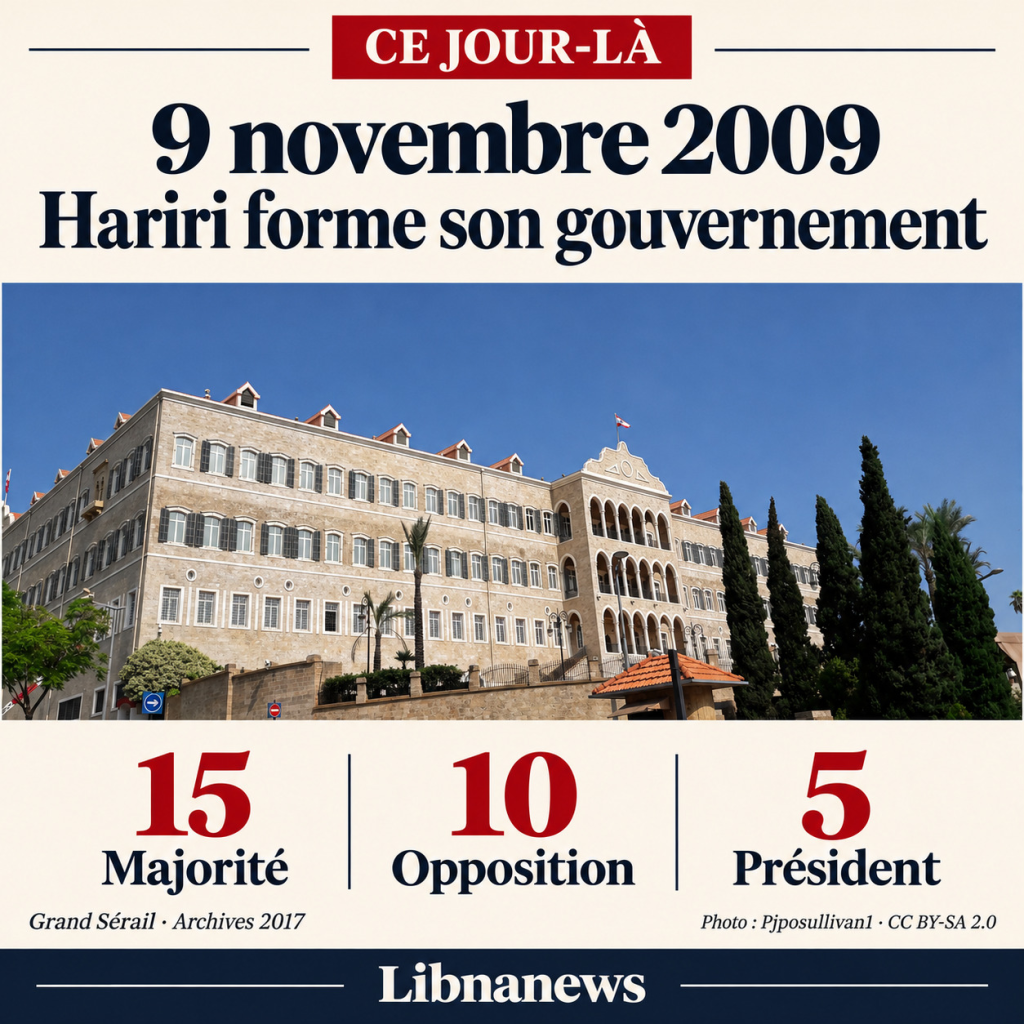
On 9 November 2009, the government of Saad Hariri was established in Lebanon five months after the general elections. Michel Sleiman and the Prime Minister signed the decree which established a team of thirty ministers. The breakdown summarizes the compromise: fifteen seats for the parliamentary majority, ten for the opposition and five allocated to the President of the Republic.
This formula, known as « 15–10–5 », gives a central place to the ministers chosen by the Head of State. It deprives the opposition of the eleventh seat which would allow it, alone, to drop the cabinet by resignation. It also obliges the parliamentary majority to seek additional support for major decisions. Behind the birth of a government of national union is therefore a negotiation on how to decide and block.
Three decrees end five months of negotiations
The elections were held on 7 June 2009. The result of the ballot box, however, is not enough to produce an executive immediately. Political leaders negotiate the names, portfolios and weights of each camp for several months. 9 November marked the end of this process, not the holding of a new ballot.
Three successive texts, dated Baabda, organize the transition. Decree 2837 considers the government of Fouad Siniora to be resigned. Decree 2838 appoints Saad Hariri as President of the Council. Decree 2839 finally lays down the composition of the new team. This succession distinguished the departure of the previous cabinet, the appointment of its successor and the formation of the government.
Saad Hariri thus for the first time joined the Council of Ministers. But the 30 members do not belong to a single coalition. The majority share the executive with their opponents and with the personalities appointed to the presidential side. The electoral victory leads to a participation agreement, rather than to a government composed solely of the winning camp.
Saad Hariri government is based on three groups
The parliamentary majority receives fifteen seats, exactly half the cabinet. The opposition obtains ten, or one third. The other five returned to personalities chosen by Michel Sleiman. The President therefore has a larger share than in the previous union government.
The cabinet formed on 11 July 2008 followed another division: sixteen ministers for the majority, eleven for the opposition and three for the president. In 2009, the first two sets each lost a seat. The presidential share wins two. The total number of ministers remains the same, but each group’s position on constitutional thresholds changes.
The five presidential ministers are Elias Murr, Ziyad Baroud, Adnan Kassar, Mona Ofeich and Adnan Sayyed Hussein. In particular, they occupy the defence and interior, while several exercise as ministers of state. Their connection to this part describes the training agreement. It does not constitute a guarantee of joint voting for the entire duration of the cabinet.
Why ten seats are not worth eleven
Article 65 of the Constitution establishes two thirds of the members of the Council of Ministers. Twenty ministers must be present in a team of thirty. If ten members are absent, the remaining twenty may still reach that quorum. If eleven are missing, only nineteen remain available.
The same article requires the agreement of two thirds of the government on fundamental issues. Budget, war and peace, international treaties or electoral law are included in this category. We need 20 votes in favour. Fifteen majority and five presidential ministers can reach this threshold together.
For other decisions, the Constitution favours consensus and then majority voting if the agreement fails. Form 15–10–5 therefore does not replace the decision rules. It allocates seats from which political forces can apply them, negotiate or try to prevent their use.
A second mechanism explains the importance of the eleventh minister. Article 69 considers the government to be a resignation if it loses more than one third of its members. Ten departures represent exactly one third of a firm of thirty. Eleven over this threshold. Thus, the opposition alone does not have the number of seats necessary to bring about this collective resignation.
Portfolios distributed among opponents
The decrees make this sharing concrete. Elias Murr holds the Vice-Presidentship of the Council and Defence. Ziyad Baroud keeps the interior. Raya Haffar al-Hassan takes over finance, while Ali Chami receives foreign affairs. Gebran Bassil runs Energy and Water, and Charbel Nahas manages Telecommunications.
Hussein Hajj Hassan obtained the Agriculture and Mohammad Fneich portfolio in charge of administrative development. Hezbollah has two ministers on this team. Other officials include the Courant du Futur, the Amal movement, the Free Patriotic Current, the Lebanese Forces or the Progressive Socialist Party. The main camps sit on the same executive.
Two women are among the thirty members: Rayah Haffar al-Hassan and Mona Ofeich, Minister of State. Their presence doubles that of the previous cabinet, which had only one woman. Nevertheless, it leaves twenty-eight positions for men. The political enlargement of the team is therefore only accompanied by a limited change in women’s representation.
Training precedes parliamentary confidence
November 9 does not end all institutional steps. The government has yet to present its ministerial declaration to the House and gain confidence. Article 64 provides for the presentation of this programme within 30 days of the training decree. Prior to trust, the exercise of its prerogatives remains limited to the dispatch of current affairs.
The firm presented its statement on December 8. On 10 December 2009, he obtained 122 votes in favour. Four Members are absent, one is abstinent and one refuses trust. This result reflects the extent to which parliamentary groups participate in government. It does not remove their differences over future decisions.
The compromise is also welcomed abroad. On November 9, Nicolas Sarkozy congratulated Saad Hariri. The French President insists on the reforms expected and the Paris III commitments. The formation takes place in a context of rapprochement between Saudi Arabia and Syria, which facilitates Lebanese negotiations.
Balance reached its limit on 12 January 2011. Ten opposition ministers resigned, joined by Adnan Sayyed Hussein, from the presidential side. Departures reach eleven out of thirty: these resignations lead, according to the threshold laid down in the Constitution, to the fall of the government.





Comments