

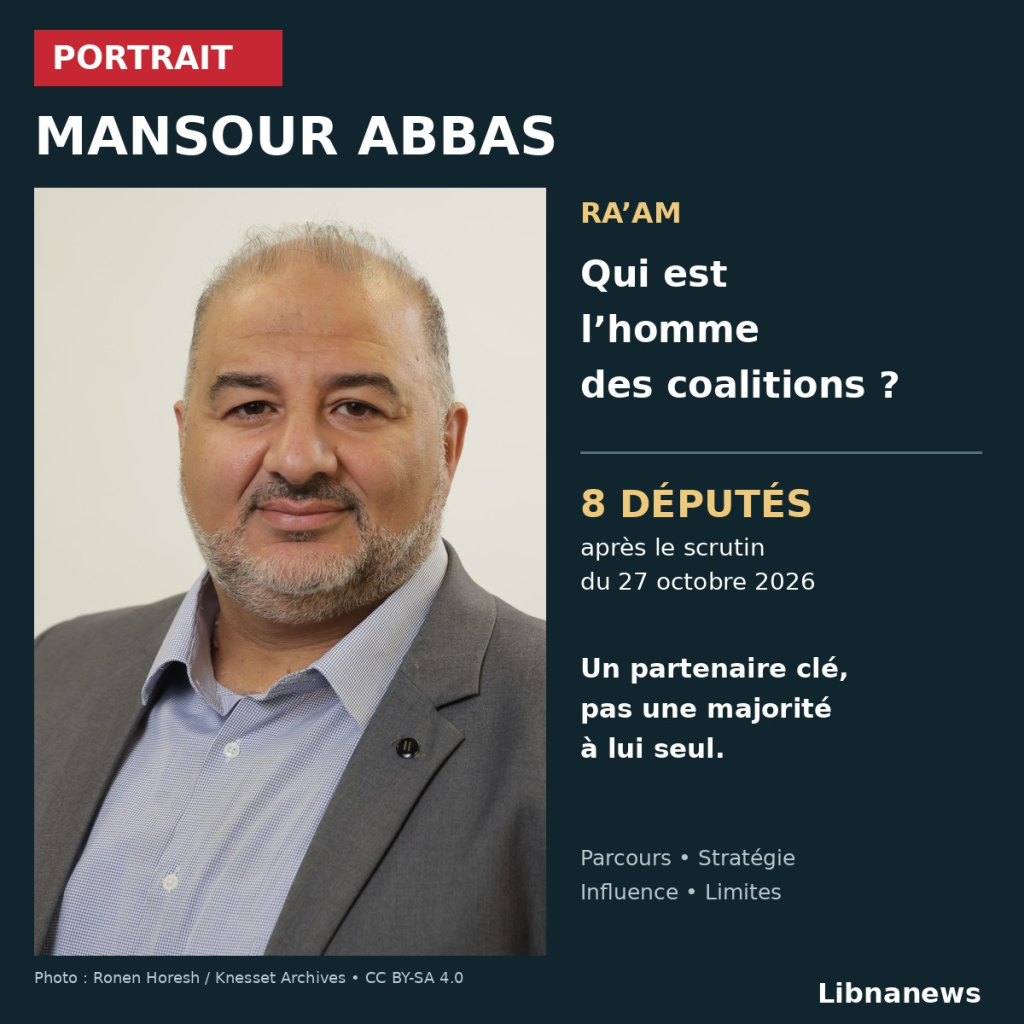
Mansour Abbas returns to the centre of Israeli negotiations after the elections of 27 October 2026. His party, Rasam, won eight seats. This trained dentist, a member of the Islamic movement, has been defending Arab participation in government coalitions since 2021. But its influence is limited: its elected officials are not enough to give a majority to Benjamin Netanyahu’s opponents.
Abbas Mansour, from Galilee to Knesset
Born on 22 April 1974 in Maghar, Galilee, Mansour Abbas is 52 years old. It belongs to a Muslim family in a locality where several communities live. He studied dental surgery at the Hebrew University of Jerusalem, as his parliamentary biographical record. His political commitment grew during his academic years, when he led the Arab student committee.
His journey then passes through the Islamic Movement in Israel. He has responsibilities within Ra This branch chose to participate in the Israeli elections, unlike the northern branch. The United Arab List (UAL) has historically represented this religious and conservative trend.
First elected to the Knesset in 2019, Abbas quickly became a national interlocutor. His name should not be confused with Mahmoud Abbas, President of the Palestinian Authority. Mansur Abbas acts as an Israeli citizen and leader of a parliamentary party. It does not represent the Palestinian Authority or all Palestinians.
In 2021, the choice to participate in power
Its singularity is less related to its origins than to its method. It intends to negotiate concrete results for Arab citizens by participating by a majority. He thus assumes to discuss with parties far from his positions, rather than to remain systematically in the opposition.
In 2021, Ra With four MPs, Abbas signed the coalition agreement between Naftali Bennett and Yair Lapid. At that time, Ram became the first independent Arab party to join an Israeli government coalition.
This alliance brings together eight formations with very different orientations. It replaces Netanyahu, but its majority remains narrow. The experiment ended in 2022. For Abbas, however, it demonstrates that a Judeo-Arab political partnership can exist at the state summit.
It exposes this logic when public interview in february 2022. In his view, participation can address disagreements within a partnership. It also requires parliamentary discipline and compromises, including decisions contested by its electorate. This responsibility is precisely the rupture which he claims with a limited presence on the opposition benches.
Budgets, security and local recognition
Its strategy is first measured on domestic issues. Abbas highlights infrastructure, education, housing and the fight against criminal organizations. In 2020, he already chaired a special Knesset commission on crime in Arab society. He then called for a government programme with defined objectives.
Under the Bennett-Lapid coalition, the government adopted the so-called « resolution 550 » economic program in October 2021. Its announced envelope reaches approximately Shekel 30 billion for the development of Arab society. It focuses in particular on reducing economic and social disparities. A separate crime control programme accompanies this effort.
These amounts refer to multi-year programmes, not an amount paid personally to Abbas or Rasam. Nor does their adoption prove that all the appropriations have been spent. The distinction counts in the evaluation of its balance sheet: securing a budgetary commitment and transforming living conditions remain two different stages.
Prior to the 2026 election, Abbas still cites daily security as his priority. He also insists on the unrecognized Bedouin villages of the Negev, the missing equipment and demolitions. His electoral argument is that participation in government is linked to the ability to address these issues.
A pragmatism that also provokes criticism
There is no consensus on this approach. His Arab adversaries accused him of favouring governmental compromises to the detriment of Palestinian national rights. The controversy became particularly strong in December 2021 when he claimed that Israel was born and will remain a Jewish state. The Palestinian Presidency then publicly condemns its statement.
Abbas presents this recognition as the starting point for a claim to citizen equality. In his public interventions, he maintains his Palestinian and Arab identity. It also advocates a two-State solution. He thus distinguished his mandate as an Israeli MP from the settlement of the Israeli-Palestinian conflict.
Following the Hamas attack of 7 October 2023, he condemned the violence against civilians. At the end of November, he called on Palestinian armed groups to favour a political path with the Palestinian Authority. Next, it states that the end of their weapons is in the perspective of the creation of a Palestinian State. This precision avoids reducing its position to a formula detached from its context.
Nor does his political pragmatism transform him into a historically secular or liberal leader on all subjects. Rasam retains a religious and conservative heritage. In december 2025, Abbas announces want to separate the party from its religious council and strengthen its civic character. This announcement marks a desire for evolution; it alone is not enough to establish every institutional change.
Eight elected, but no automatic majority
The election of 27 October 2026 gave this trajectory a new meaning. From five to eight seats are increased from Ra The Common List obtains eleven. The two Arab formations therefore have 19 deputies, but they remain distinct in their history, priorities and relation to government participation.
Abbas also placed Yoav Segalovitz second on his list. This former senior police officer, a Jew, has an experience in the fight against crime. His election resulted in the opening claimed by Rasam to an electorate and partners exceeding its traditional base.
Arithmetic explains why Abbas counts today, but also why he does not decide alone. The Netanyahu Block has 53 seats. The non-Arab opposition, led by Gadi Eisenkot, counts 48. With the eight elected members of Rasam, it would reach 56 seats: five fewer than the absolute majority of 61.
So an alliance with Abbas doesn’t solve the whole equation. It would require further support, another political combination or a broader parliamentary agreement. The addition of seats does not make it possible to assume acceptance of a common programme.
A recommended Gadi Eisenkot on 5 November, with its eight elected. On 8 November, Anadolu, quoting Haaretzreports that the party is considering supporting an Eisenkot government even without a coalition agreement. The Agency states that Ra的am did not immediately comment on this information. Recommending a candidate, supporting an outside firm and joining a coalition remain different commitments.
Cover : Abbas Mansour, photograph of 15 November 2022, Ronen Horesh / Knesset Archives, via Wikimedia Commons. Photo and dressing under CC BY-SA 4.0. Resize and titration, without retouching the face.






Comments