

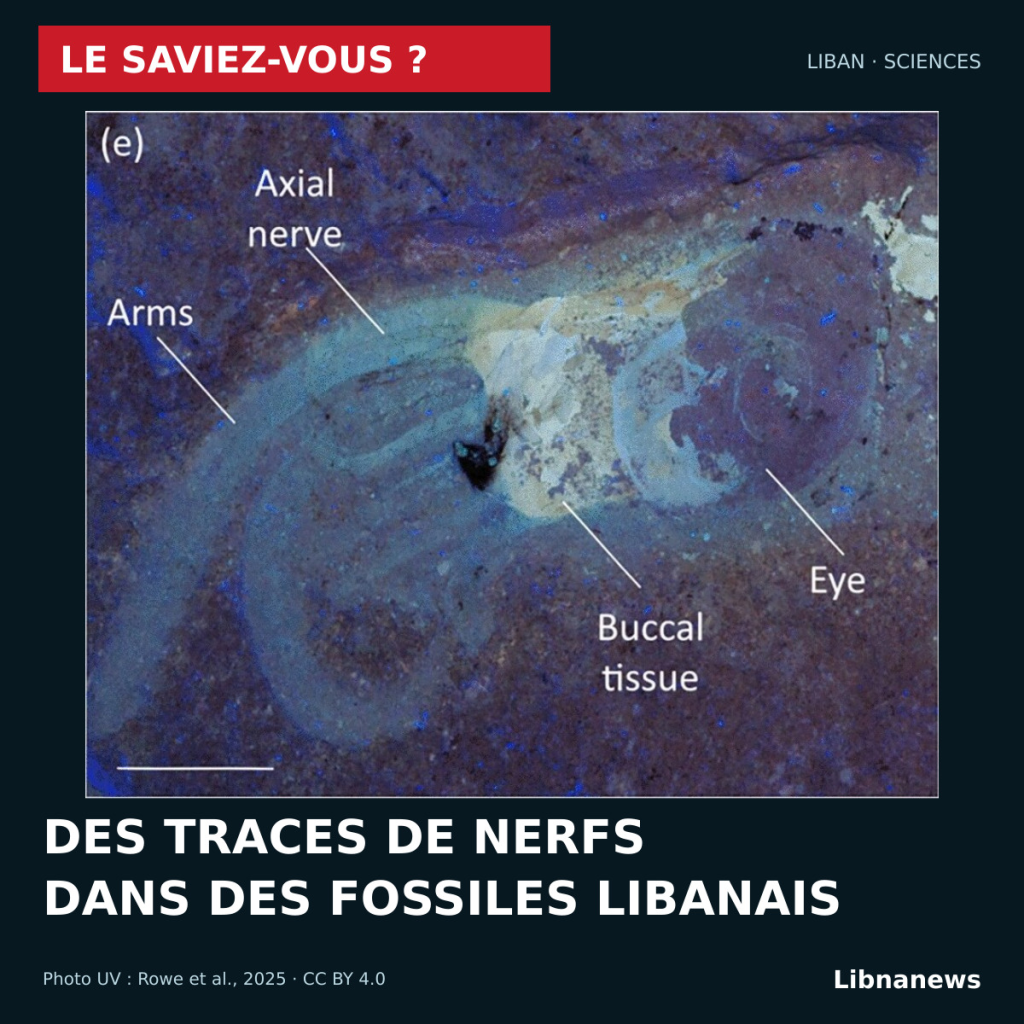
Did you know that?In Lebanon, some fossils do not only show the figure of an animal. They keep traces quite fine enough for researchers to recognize structures interpreted as the nerves of his arms. This is the case withDorateuthis syriaca, a Cretaceous cephalopod studied in the deposits of Haqel, Hjoula and Sahel Aalma. Two works published in 2024 and 2025 shed light on this exceptional conservation. The living tissues have disappeared, but part of their anatomical organization remains legible in the stone.
Traces of nerves in Lebanese fossils
The anatomical study led by Alison J. Rowe, published on December 19, 2024, re-examined 54 individuals. It includes researchers from the National Museum of Natural History, Sorbonne University and CNRS. Their work covered a species described in 1883. The novelty therefore lies not in the discovery of an unknown animal, but in a more precise reading of fossils already identified.
Three specimens present structures that the team interpret as axial nerves. These cords follow the axis of the arms. Their position and shape allow comparison with the anatomy of current cephalopods. Eight individuals also show elements interpreted as suction cups. These are rare details: not all fossils studied retain the same set of organs.
The scientific photograph used for this article shows a specimen of Haqel, inventoried BHI 5814, under ultraviolet light. The authors identify one eye, the oral region, the arms and a trace of axial nerve. The image comes from the work published on August 28, 2025. Its UV colour is not that of the living animal: this light is used to bring out structures that have become difficult to distinguish.
Photo Credit:Rowe et al., 2025, Figure 2e,CC BY 4.0. Isolated panel of the original board, annotations and ladder retained; Libnanews clothing added.
The shape remains, not the living tissue
Talking about fossil nerves can give a misleading image. These are not nerve fibers that have remained fresh for millions of years. Most of the researchers describe a process of mineralization: minerals, mainly calcium phosphate, replace fragile tissues. The original material disappears, while part of its form can be reproduced.
This distinction separates anatomical information from a biological tissue that is still functional. The trace allows to discuss the organization of the arm. It does not deliver its nerve activity, nor the sensations of the animal. Neither do the two studies report DNA discovery. Their object is morphology: the forms, their respective positions and the transformations undergone after death.
Fossilization remains selective. The ink pocket or portions of the muscle coat are much more often visible than the nerves of the arms. A fossil can therefore give a detailed picture of one region and almost no information about another. The absence of a trace alone does not establish that the organ was missing in live animals.
Multiple lighting for the same stone
The researchers combine several non-destructive techniques. The natural light photograph documents the appearance of the specimen. Ultraviolet highlights some fluorescence mineralized tissues. Another process, called reflective transformation imaging, combines photographs taken from different lighting angles. It helps to examine the small reliefs of the surface.
X fluorescence completes this observation by mapping chemical elements. Differences in composition can thus make a structure more visible from the surrounding rock. However, a chemical map is not enough to name an organ. Its location, shape and comparison with other specimens remain necessary to support identification.
This combination explains why an old collection can still provide new results. It is not always necessary to discover an additional fossil. Different methods of observation may reveal a detail that remains discreet and then allow to test an earlier interpretation on several individuals.
Eight arms, rather than a squid with ten appendages
The 2024 review strongly supports an eight-arm anatomy. The authors do not find convincing evidence in favour of two additional specialized tentacles. They also challenge some of the old identifications of hooks or pockets intended for these tentacles. The distinction counts: an elongated silhouette is not enough to classify this animal with the current squid.
It would be equally reducing to present it as an unchanged modern octopus.Dorateuthisincludes a gladius, an internal support structure whose form occupies an important place in its identification. The team analyses its variations between individuals. Fossils thus provide a more complex evolutionary history than just a resemblance to the species we know today.
Observed remains go beyond the arms. Structures attributed to the digestive, circulatory and respiratory systems complete the picture. An individual even retains elements attributed to an ingested fish. These observations support the interpretation of an active predator, without allowing each of its behaviours to be reconstructed.
Three deposits, different archives
The second work, published in August 2025, changes scale and question. It compares the preservation of 71 individuals: 52 from Hjoula, six from Haqel and thirteen from Sahel Aalma. This set includes 46 specimens already studied in 2024 and 25 additional. It is therefore not necessary to add the two personnel as independent, nor to confuse the results of their analyses.
Haqel and Hjoula go back to the Cenomanian. Sahel Aalma belongs to a more recent episode of Cretaceous, the Santonian, located here around 83 to 85 million years ago. The three collections therefore do not constitute a photograph of the same moment. They also show different marine environments in ancient Tethys.
The statistical comparison indicates a more frequent retention of soft tissue in Haqel and Hjoula than in Sahel Aalma. The gap concerns in particular elements of the circulatory and respiratory systems. The authors emphasize the role of local conditions: apparently comparable limestone rocks do not necessarily retain the same information.
This reading has specific limitations. The numbers are uneven and the exact level of sample collection is not documented. The flattening and orientation of animals also influence what remains observable. For researchers, understanding these differences is essential: before interpreting an anatomical absence, it is necessary to know what each deposit could actually preserve.





Comments