

By Bernard Raymond Jabre
In wars, we look at missiles, planes, aircraft carriers, sanctions, losses, territories. We count men and billions. Yet there is a weapon that no one can produce and that no army can destroy: time.
And in today’s confrontation between Donald Trump’s United States and the Islamic Republic of Iran, perhaps the key question is no longer who is the most powerful?
The answer to that is obvious.
The real question is:
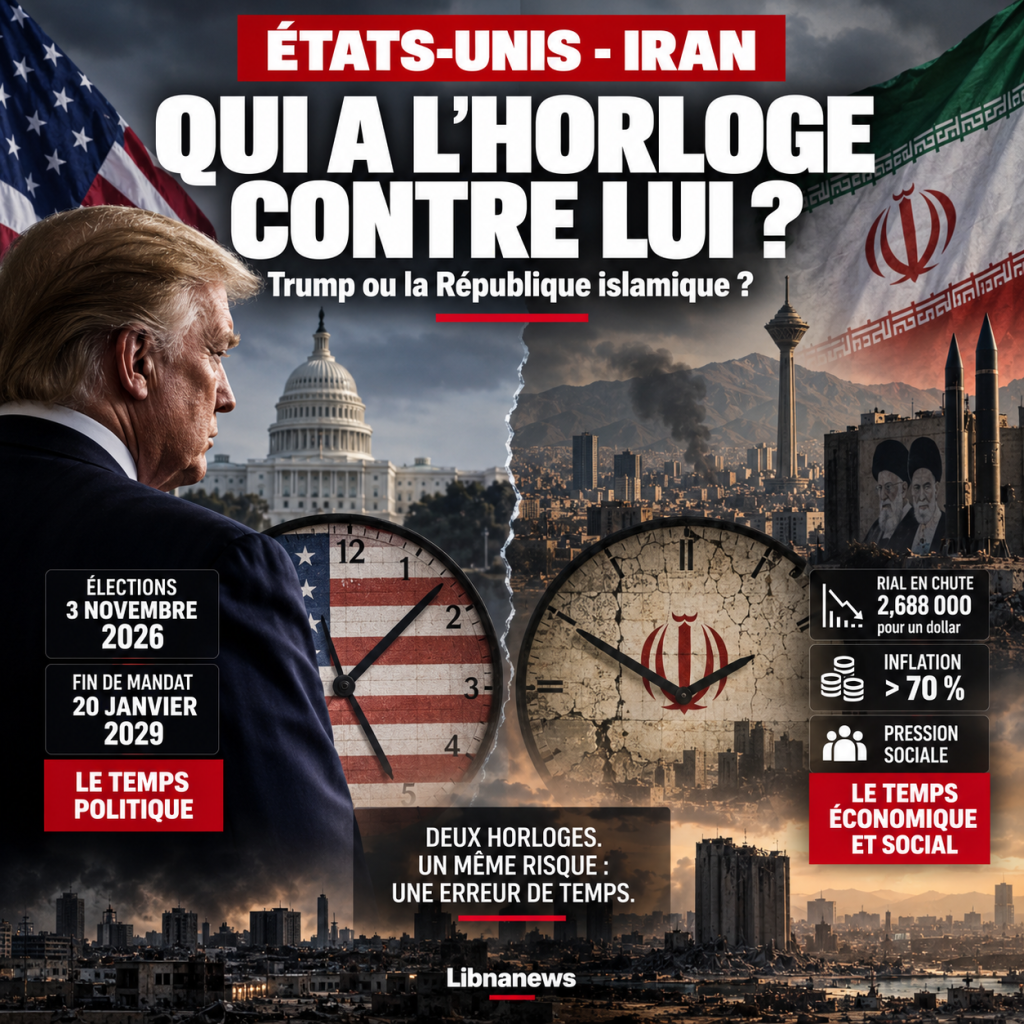
Who has the clock against him?
Because Washington and Tehran don’t live at the same time.
Donald Trump lives in the time of American democracy: elections, polls, Congress, public opinion and, ultimately, the constitutional end of a term.
The Islamic Republic lives in another time: that of survival.
And a diet that seeks to survive doesn’t necessarily reason in months. He can reason in generations.
TWO HORLOGIES
Donald Trump has considerable power. But this power carries in it its own expiry date.
On November 3, 2026, the Americans will renew the entire House of Representatives and a third of the Senate. FEC.gov
Recent opinion polls show a difficult environment for Republicans. A September Reuters/Ipsos poll revealed an increase in support of a Congress controlled by the Democrats, along with a low presidential popularity. Reuters
This obviously does not predict the outcome of the elections. The American elections are decided district by district and state by state, and the national vote is not a forecast of the final composition of Congress.
But that is enough to understand the strategic problem.
Trump hears the tick.
Iran is trying not to hear it.
AMERICAN HORLOGY: GUING BEFORE POLITICAL TIME CHANGE
An American president is never only confronted with his external opponent. It is also confronted with its own internal calendar.
If he has a favorable Congress, his political capacity is important.
If he loses the House, the landscape changes.
Parliamentary investigations are increasing. Budgets are becoming more difficult to negotiate. Legislative initiatives face more obstacles. Control over the executive is increasing.
And if the opposition also obtained the Senate, presidential and judicial appointments would also become much more confrontational.
Trump would remain president. But the time of his political power would no longer be exactly the same.
Then comes a second clock, more distant and much more certain.
The United States Constitution provides that the presidential term ends at noon on 20 January following its constitutional term. For Trump’s current mandate, this means January 20, 2029, unless there is an exceptional constitutional event. Congress.gov
Tehran knows that date as well as Washington.
It’s fundamental.
To defeat a U.S. president politically, it is not always necessary to beat him militarily.
Sometimes you just have to survive.
IRANIAN ART OF ENDURANCE
The Islamic Republic is now extremely weakened.
The disappearance of Ali Khamenei and several senior military officials could have caused the collapse of power architecture. Yet, despite the losses suffered, the central institutions and especially the apparatus of the Revolutionary Guards continued to function. Reuters was still describing in March a system that showed a surprising resilience after the beheading of a significant part of his command. Reuters
This does not mean that the regime is solid.
It means something else, much more important:
he knows how to survive injured.
And it is probably the essential quality of all the revolutionary regimes that last.
They gradually learn to distinguish what is indispensable from what can be sacrificed.
A minister can disappear.
A general can be replaced.
Infrastructure can be rebuilt.
A currency can collapse.
A population may become poor.
As long as three elements remain — the chain of command, the coercive apparatus and the ability to adequately fund those who defend the system — the regime can continue to exist.
It’s brutal, but it’s the logic of political survival.
BUT IRAN POSSIBLE HIM WITH A HORLOGY
Yet it would be wrong to believe that time necessarily plays for Tehran.
The Islamic Republic has its own time bomb.
It’s economical.
At the beginning of October, the Iranian rial fell around 2.688 million for a dollar, after losing more than half its value in a year. Reuters also reports inflation above 70%. Reuters
These are not just numbers.
Inflation of this magnitude destroys something much more valuable than a currency: confidence.
Trust in savings.
Trust in wages.
Trust in tomorrow.
And when citizens begin to turn their money into dollars or gold because they no longer believe in their own currency, there is a deeply political phenomenon: they are already voting silently against their state’s monetary system.
The Islamic Republic can resist American aircraft.
She can stop opponents.
It can rebuild infrastructure.
But it cannot indefinitely order a population to believe in a currency in which it no longer believes.
So this is the second clock.
Trump owns the electoral clock.
Iran has the economic and social clock.
And no one knows today which one will ring first.
TRUMP PARADOX
There is a remarkable paradox here.
The more Trump increases pressure on Iran to accelerate its weakening, the more economic cost this same confrontation may have in the United States.
Oil, gasoline, transport and inflation immediately enter the daily life of the American voter.
Reuters noted at the end of September that the conflict with Iran and rising energy prices were precisely a political problem for administration in the midterms approach. Reuters
This is the whole strategic paradox:
to shorten the Iranian clock, Trump can inadvertently speed up his.
A long war can impoverish Iran.
But a long war can also tire America.
And both societies do not politically support suffering in the same way.
Democracy quickly reflects its dissatisfaction with the elections.
A dictatorship seeks to repel this moment by coercion.
This does not make dictatorship stronger.
This simply means that its breaking mechanisms are different.
TEHÉRAN DOES NOT NEED TO GUY
This is probably the key strategic point.
Perhaps the Islamic Republic no longer needs to defeat the United States.
It must only avoid being destroyed.
Imagine his strategy as a largely dominated boxer who knows that the fight has a fixed duration.
He doesn’t necessarily look for KO anymore.
He’s hanging up.
He protects his vital organs.
He’s willing to lose rounds.
He’s waiting for the bell.
For Tehran, this « bell » can be November 3, 2026.
Then on January 3, 2027, when the new Congress took office.
Then 2028.
Then January 20, 2029.
The logic then becomes:
hold today to negotiate tomorrow with a different America.
This reasoning obviously does not guarantee the survival of the regime. The economic collapse, a fracture within the security forces, a massive revolt or an elite breakdown could upset the equation.
But he explains why endurance becomes a strategy in itself.
AND IF THE ISLAMIC REPUBLIC MOURED WITHOUT TOMBER?
Finally, there is a third possibility, probably the most interesting.
We too often imagine diets as buildings.
They exist.
Then they collapse.
History rarely works that way.
A diet can die while retaining its name.
The Islamic Republic could survive institutionally but change profoundly in nature.
Religious power could gradually yield more ground to the security and military apparatus.
The Guardians of the Revolution could become less the protectors of the Islamic Republic than the Islamic Republic itself.
Prior to Ali Khamenei’s disappearance, an assessment of the U.S. services reported by Reuters specifically envisaged the possibility of hard elements of the IRGC taking a decisive place in the power in the event of the disappearance of the Guide. It was only one scenario among many, not a certainty. Reuters
But it reveals something essential.
Perhaps the real question is not:
« Will the Iranian regime fall? »
It could become:
« What Iranian regime will survive? »
TIME AGAINST FORCE
Then we come to the heart of the question.
The United States has military superiority.
Iran has the historical depth of a state that has learned to live under pressure for decades.
Trump has an extraordinary ability to act.
But it governs in a system where each power periodically returns to the elector.
The Islamic Republic has much less power.
But she doesn’t organize her own alternation.
Thus, one has strength, but its time is constitutionally counted.
The other has much less strength, but tries to make its time indefinite.
And that’s where the real war begins.
Not only between missiles and air defences.
But between two conceptions of time.
America wants a result.
Iran wants to last.
Trump wants something to happen.
Tehran wants to prevent something from happening until Trump no longer has the same power to provoke it.
WHO’S GOT TO FIGHT HIM?
Both.
But not the same.
Trump hears the electoral tick.
The Islamic Republic hears the economic, social and perhaps revolutionary twitch.
The first knows exactly when certain deadlines will occur: November 3, 2026, January 20, 2027, and January 20, 2029.
The second does not know the day when its population, economy or own apparatus of power could pass a point of break.
Perhaps that is what makes this confrontation so dangerous.
Trump knows how long he owns politics.
The Iranian regime does not know how much historical time it has left.
And when a man in a hurry faces a besieged regime, each one can be tempted to accelerate the time of the other.
Then mistakes become possible.
For history teaches us one last thing:
powers often think they control the clock.
But in the end, it’s almost always the clock that controls the powers.





Comments