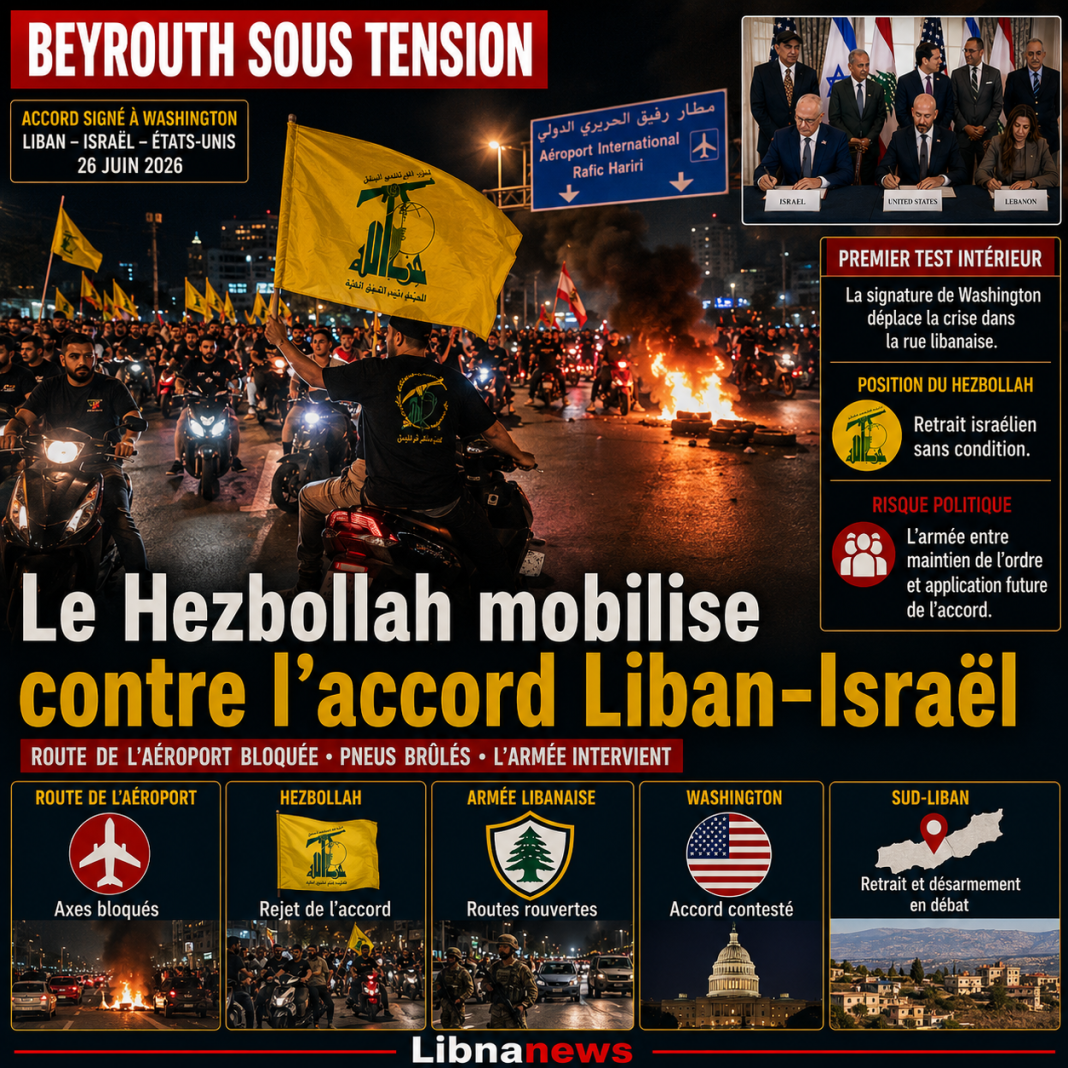







Lebanon had obtained a diplomatic framework, but not yet the guarantees it was seeking. The text does not lay down a total Israeli withdrawal, a final timetable or an immediate halt to the strikes. It places the Lebanese army at the centre of the scheme, while it lacks resources and risks being accused of indirectly securing an extended Israeli presence. The American guarantee, which is essential to move Israel, remains insufficient for Beirut, as Washington remains too close to Israeli priorities. For some of the southerners, the agreement is likely to be seen as a concession: the state was unable to protect them during the bombings, the army had withdrawn or could not maintain itself in several areas, and the text does not yet guarantee them full withdrawal, daily security or rapid reconstruction.
1. No total Israeli withdrawal guaranteed
Lebanon requestedcomplete Israeli withdrawal from Lebanese territory. The agreement does not guarantee this immediately. He talks about aprogressive redeploymentconditional on the disarmament of non-state armed groups and security verification.
This means that Israel retains an important margin. He can maintain his presence in the security zone as long as he believes that Hezbollah is a threat. For Beirut, this is a major concession: the original objective was total withdrawal, not a transitional Israeli presence without a clear deadline.
2. No final schedule
The text does not set a clear date for the end of the Israeli presence in Lebanon. This is one of the weakest points for Beirut.
Lebanon therefore accepts a framework where Israeli withdrawal depends on future conditions, without a firm deadline. This lack of a timetable can turn a transitional phase into a prolonged presence. It also gives Israel the opportunity to condition its departure on its own threat assessment.
3. No guarantee of immediate cessation of Israeli strikes
Lebanon wanted to stop the Israeli attacks. The agreement maintains the right of each party to defend itself.
Israel can therefore continue to invoke self-defence to strike targets that it presents as related to Hezbollah. This clause may prolong targeted strikes in South Lebanon even after signature. For civilians, this ambiguity is central: an agreement to restore security does not yet guarantee an end to the bombing.
4. Israeli security zone not removed
The Israeli position affirms that the army will remain in the safe area until Hezbollah’s disarmament. For Lebanon, this is a major concession.
Beirut wanted to regain all its territorial sovereignty. The agreement accepts in practice a residual Israeli presence, without immediate final settlement. This nourishes the idea among its opponents that the text envisions a partial occupation rather than abolishes it.
5. Return of internally displaced persons is not guaranteed everywhere
The agreement refers to the return of civilians to the pilot areas after the disarmament and deployment of the Lebanese army. But this does not automatically affect all the southern localities.
Displaced families do not yet have a general guarantee of return. Their return will depend on security, Israeli withdrawal, demining, infrastructure and decisions in each area. This stepwise logic can create a difference between villages: some would be integrated into the mechanism, others would remain waiting.
6. Reconstruction remains conditional
The agreement promises international mobilisation, but the funds will be subject to strict conditions. They should not benefit entities linked to non-State armed groups.
This can reassure donors, but also slow down aid in regions where municipal, social and political networks are intertwined. Lebanon therefore does not receive immediate, comprehensive and unconditional assistance. For affected residents, reconstruction may be suspended from political and security criteria that are difficult to apply on the ground.
7. Hezbollah is not party to the agreement
The deal directly targets Hezbollah, but the movement did not sign it. It is a structural weakness.
The Lebanese Government is committed to disarming non-State armed groups, but it does not necessarily have the political and military means to impose it without internal crisis. The text therefore creates a gap between the State’s commitment and the reality of the internal power ratio.
8. Lebanon does not get a really balanced guarantor
The main guarantee is American. But Washington is perceived in Lebanon as too close to Israel.
Europeans, notably France and the UN, do not play a central role in the agreement. This deprives Beirut of a diplomatic counterweight more acceptable to some Lebanese opinion. The American guarantee is useful to weigh on Israel, but it is not enough to reassure those who fear reading the text in favour of Tel Aviv.
Key weaknesses
Insufficient US guarantee
The American guarantee is useful because the United States is the only one able to put pressure on Israel. But it’s not enough.
Washington is structurally close to Israel on security issues. If Israel claims that a strike is self-defence, it is not certain that the United States will treat it as a violation. If Israel refuses a complete withdrawal on the basis of the threat of Hezbollah, Washington could accept this reasoning.
For Lebanon, this creates an imbalance. The main guarantor of the agreement is also Israel’s main strategic ally. This weakens the acceptability of the text in part of Lebanese opinion, particularly in the South.
A Lebanese Armed Forces carrying out a heavy mission
The agreement places the Lebanese army at the centre of the arrangement. It must control the pilot areas, prevent the return of armed groups, secure the ground and restore state authority.
But the Lebanese army lacks resources. It needs financing, vehicles, fuel, equipment, monitoring systems, communications and logistical capabilities. Without massive support, it risks being given an impossible mission.
She also runs a political risk. If it secures areas close to Israeli positions, it can be accused of indirectly protecting the Israeli army. If it does not do so, Israel may accuse it of not complying with the agreement.
A very negative perception in a part of the South
For many people in the South, the problem is deeper. The Lebanese State was not seen as a protective actor during the harshest phases of the conflict. The army withdrew or could not remain present in several exposed areas. The inhabitants suffered shelling, displacement, destruction of houses and interruption of essential services without feeling effective state protection.
In this context, the agreement can be read not as a return of sovereignty, but as a concession to Israel. Many southerners may consider that the state, absent or powerless during the attacks, returns today with a text calling for the disarmament of Hezbollah, accepts a transitional Israeli presence and does not guarantee any immediate total withdrawal or complete cessation of the strikes.
This perception is politically decisive. For these inhabitants, the state cannot only demand obedience to an agreement. He must first prove that he protects, rebuilds and achieves concrete results against Israel. Without visible withdrawal, without real security and without a rapid return of the displaced, the official discourse on sovereignty may seem abstract and even disconnected from local experience.
Significant civilian risk
Civilians in southern Lebanon remain the most exposed. The agreement does not immediately guarantee the end of strikes, nor the safe return to all localities.
Pilot zones can create differences between villages: some could benefit from a framed return, while others would remain under threat or out of reach. This may fuel local tensions.
Civilians can also be caught between several logics: the Israeli army that retains its freedom of action, the Lebanese army that tries to control the ground, the Hezbollah that rejects the agreement, and the donors that condition aid. In this configuration, the population of the South can again find themselves in the centre of a compromise decided above it, without immediate guarantee of security.