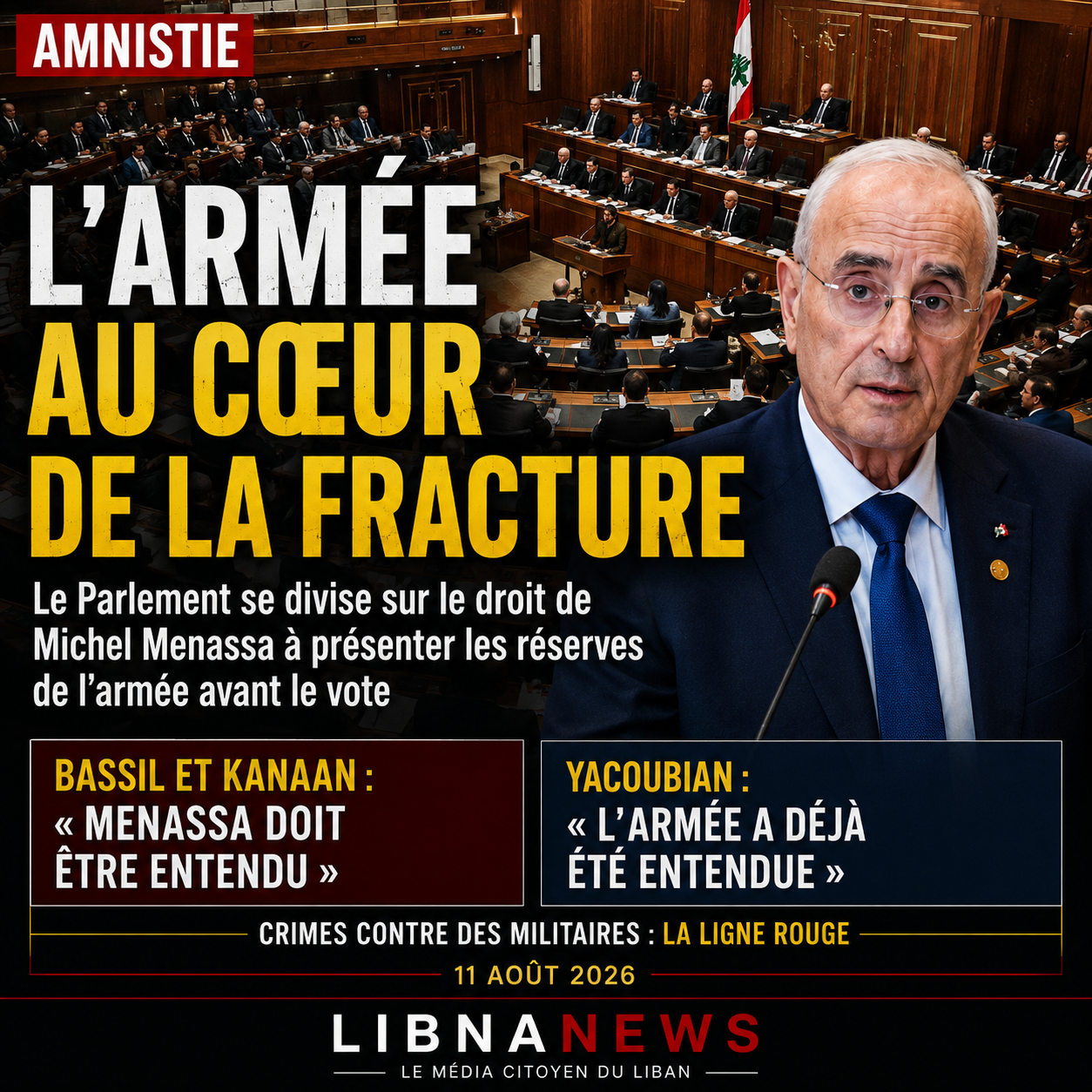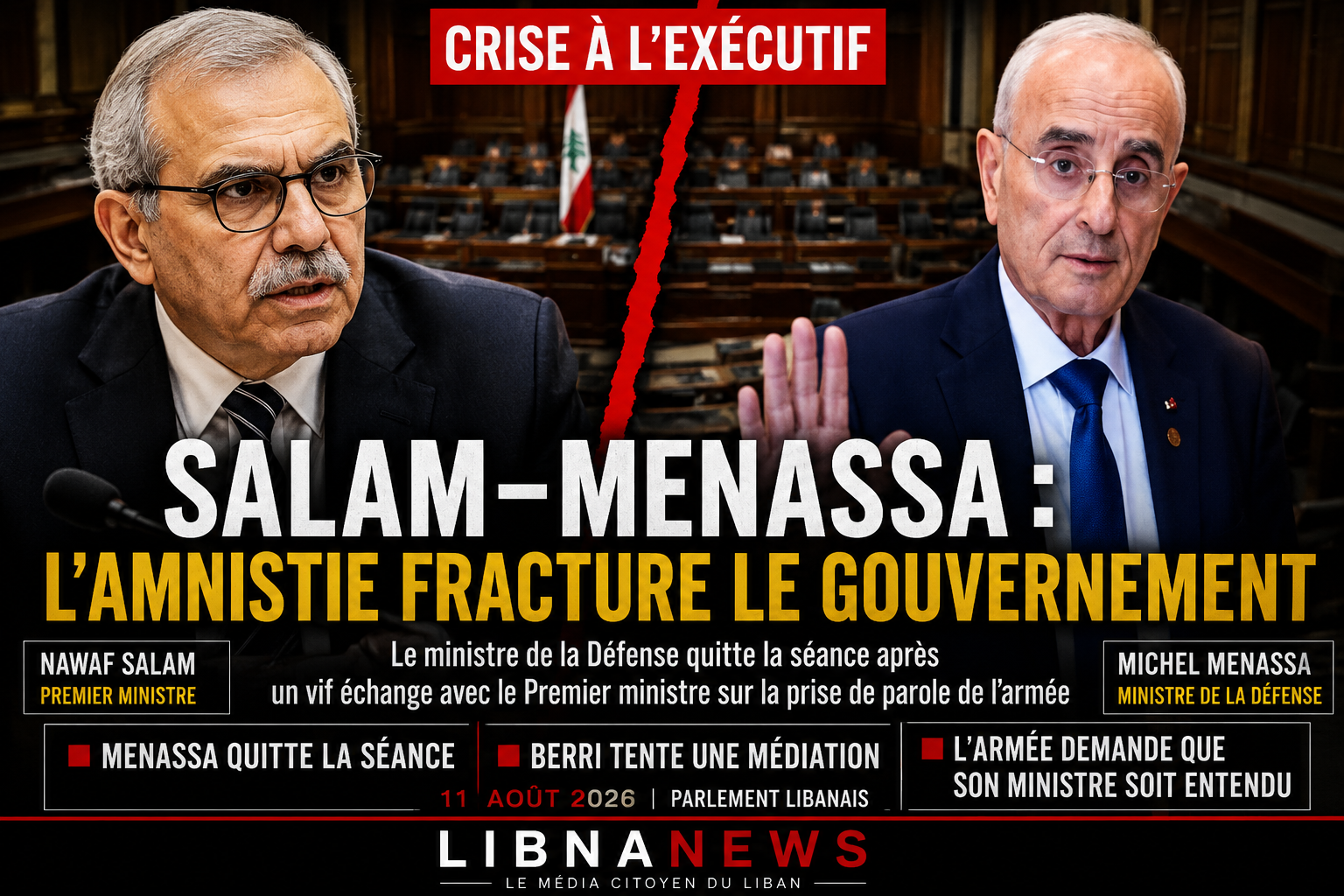
Prime Minister Nawaf Salam and Defence Minister Michel Menassa strongly opposed Parliament on Tuesday 11 August 2026 on the proposed general amnesty law, in an exchange accompanied by shouts that led Menassa to leave the sitting. The disagreement relates to the Minister’s willingness to present the Lebanese Army’s comments on the text to the MPs, while Salam felt that the Government’s political position should be expressed by the Head of Government. The incident, however, had been prepared since the previous day: Menassa had submitted to the Vice-President of the Chamber, Elias Bou Saab, a document containing the army’s remarks on the amendments to the amnesty. According to LBCI, the dispute then became so large that the army command intervened to insist on the Minister’s right to pronounce his intervention. Nabih Berri initiated mediation before the resumption of work, while several Members threatened not to return to the Chamber until Menassa could be heard.
Menassa came with the military’s written observations
The dispute did not improvise on Tuesday morning in Parliament’s corridors. As early as Monday, 10 August, Michel Menassa had transmitted to Elias Bou Saab the written comments of the Lebanese Army concerning the amendments to the proposed general amnesty law. The minister also met with the Speaker of the House, Nabih Berri.
The full content of these comments has not been made public. Their existence, however, established that Menassa did not only wish to intervene in a personal capacity. He had come to Parliament with a prepared position on a text that directly concerns the military institution, especially when the amnesty affects persons convicted or prosecuted for clashes with the army and crimes against military personnel.
According to MTV, Menassa wanted to deliver a speech expressing « the position of the Lebanese Army ». LBCI indicated that it wished to address a personal and institutional intervention to the military at the beginning of the legislative session.
That’s when Nawaf Salam intervened. According to consistent reports from several Lebanese television stations, the Prime Minister believed that the government’s position should be carried by the head of government and not presented separately as that of the army.
Exchange quickly degenerated. Salam reportedly asked Menassa to go out of the Chamber with him to discuss. The tone was set between the two men and the Minister of Defence finally left Parliament without speaking.
Why Amnesty Causes Army Reaction
The core of the conflict lies in the political content of the general amnesty. For several months, parliamentary discussions have sought to determine which categories of prisoners will benefit from the legislation and which offences will have to be excluded.
One of the most sensitive issues is the case of persons prosecuted or convicted for acts related to terrorism and clashes with the Lebanese Army. Military personnel were killed in several security episodes, including during the 2013 Abra and Ersal clashes in 2014. Families of killed soldiers refuse to allow an amnesty to lead to the release of persons found responsible for crimes committed against the army.
Michel Menassa has already adopted a restrictive position on this issue in previous discussions. In particular, the Ministry of Defence and the Army are seeking to prevent a law presented as a means of resolving old judicial situations or excessively long detentions from benefiting persons involved in the death of military personnel.
It is this distinction that makes Menassa’s intervention politically important. The minister did not necessarily challenge any form of amnesty. The issue is the exclusions, categories of convicted persons concerned and the protection of the rights of military victims and their families.
The text has been the subject of many compromises in previous work. Discussions included the length of sentences, cumulative sentences, fugitives and various categories of prisoners. But crimes against the army remain a particularly sensitive line.
The conflict also concerns the place of the army in the political debate
Nawaf Salam’s position introduces a second question, distinct from the content of the amnesty: can the Lebanese Army present a specific position in Parliament on a legislative text?
For the Prime Minister, according to the version reported by MTV, it is the head of government who expresses the political position of the executive. This approach aims to prevent a minister or institution under the authority of the government from giving Members the impression of defending a different line from that of the Council of Ministers.
Menassa’s reasoning is different. The Minister of Defence considers that he must be able to transmit the observations of the institution directly concerned by the consequences of the law. The issue is particularly sensitive when the institution includes victims of crimes that could enter the debate on amnesty.
The dispute is therefore twofold. It deals with the substance of the text, but also with the boundary between the position of the government and that of a military institution whose minister wishes to raise concerns before the legislator.
This difference explains why the incident quickly exceeded a simple quarrel between two members of the government.
Army command reportedly intervened
One of the new developments reported in the afternoon concerns the intervention of the Lebanese Army command.
According to LBCI, tension has reached such a level that the command insisted that Michel Menassa be able to speak before Parliament. Several Members also demanded his return to the Chamber.
Some even threatened not to participate in the resumption of the meeting until the Minister of Defence was heard.
This information gives another dimension to the incident. If the army command has indeed requested that the minister can present his intervention, the disagreement no longer concerns only a personal initiative of Menassa. It directly affects the ability of the military institution to send its observations to MPs through its appropriate minister.
The document delivered the previous day to Elias Bou Saab reinforces this observation. The army’s remarks existed before the dispute and had already been forwarded to Parliament. The conflict therefore focused on their public expression in the Chamber rather than on their existence.
Jamil Sayyed accuses Salam of introducing the Sunni question
The most serious version of the exchange was given by MP Jamil Sayyed at a press conference in Parliament. His statements remain his account of the facts and have not been publicly confirmed by Nawaf Salam.
Sayyed said that a parliamentary majority was ready to vote on the proposal for a general amnesty before the incident. He states that the Prime Minister’s intervention is now likely to change this situation.
In particular, the MP claims that Salam accused Menassa of placing the Lebanese Army « in front of the Sunni community » if the amnesty law was not passed.
Such a sentence, if confirmed, explains the extreme tension of exchange. It would move the debate from an institutional disagreement over the minister’s speech to a confessional issue, in a case already marked by claims concerning several groups of inmates.
Jamil Sayyed claims that Menassa experienced this accusation very badly. According to his account, the minister recalled that he had served for forty years in the Lebanese Army and had never distinguished the military or citizens according to their Christian or Muslim affiliation.
Sayyed also claimed that Menassa had been assigned « to tears » by the words addressed to him. This description must also remain attributed to the MP, as the Minister of Defence has not yet publicly provided a detailed account of the incident.
Lebanon threatens to strengthen its position
The conflict immediately provoked a reaction from the strong Lebanon bloc. Sources of the group cited by LBCI claimed to reject completely Menassa’s ban on giving his opinion.
The bloc believes that preventing a minister from speaking on a matter directly within his responsibilities would create a precedent. Its sources announced that a tougher position would be taken if the ban was maintained.
Gebran Bassil also called the members of his bloc to a meeting on the sidelines of the meeting to discuss the incident.
This mobilization is not just about Menassa’s personality. The bloc now presents the dispute as a matter of ministerial prerogatives and Parliament’s right to hear the military’s comments before voting.
As a result, pressure shifted on Salam: maintaining his opposition to the Minister’s intervention could lead to the boycott of some MPs and complicate the continuation of the sitting.
Berri tries to bring Menassa back to Parliament
Nabih Berri then took over the mediation. Elias Bou Saab stated that the interruption of work was intended to resolve the dispute between Nawaf Salam and Michel Menassa.
The Speaker of the Chamber met with Salam. At the same time, NBN reported that he was communicating with Menassa in order to calm the situation and allow her to return before the scheduled legislative session resumed at 6 p.m.
Mediation had become necessary for reasons beyond the amnesties. The meeting was also to continue to consider other texts, including the media bill, which was itself postponed until the evening after the distribution of new amendments.
A blockade around Menassa could therefore affect the entire work of the Chamber.
In particular, the resolution of the dispute must determine whether the Minister will be able to return to the Chamber and present all or part of the text he wished to read.
The incident can now change the vote
The paradox of the day is that the argument to control the presentation of the government position could ultimately change the balance around amnesty.
Jamil Sayyed claims that a majority existed to vote the text before the incident. Several Members have since moved the debate towards defending Menassa’s right to be heard.
The intervention of the army command reported by LBCI reinforces this pressure. MPs now have to vote on a text, while the written observations of the military institution exist, but have not yet been publicly presented by the minister who is carrying them.
This situation makes it difficult to vote without prior resolution of the incident. A passing of the law without Menassa’s hearing could be presented by opponents of the text as a refusal to listen to the army on an amnesty for crimes committed against its members. On the other hand, a very critical intervention by the minister may change the voices of Members who have so far expressed support for compromise.
As the 6 p.m. resumption approaches, the decisive point is no longer just the content of the amnesty proposal. It is important to know whether Michel Menassa will return before the deputies, whether he will be able to read the observations prepared by the army and what response Nawaf Salam will bring to the accusations made after their exchange. It is from this sequence that the possibility of bringing back a debate that has become personal and religious to its original purpose depends: to determine precisely who can benefit from the amnesty and what protections must remain guaranteed to the military victims.