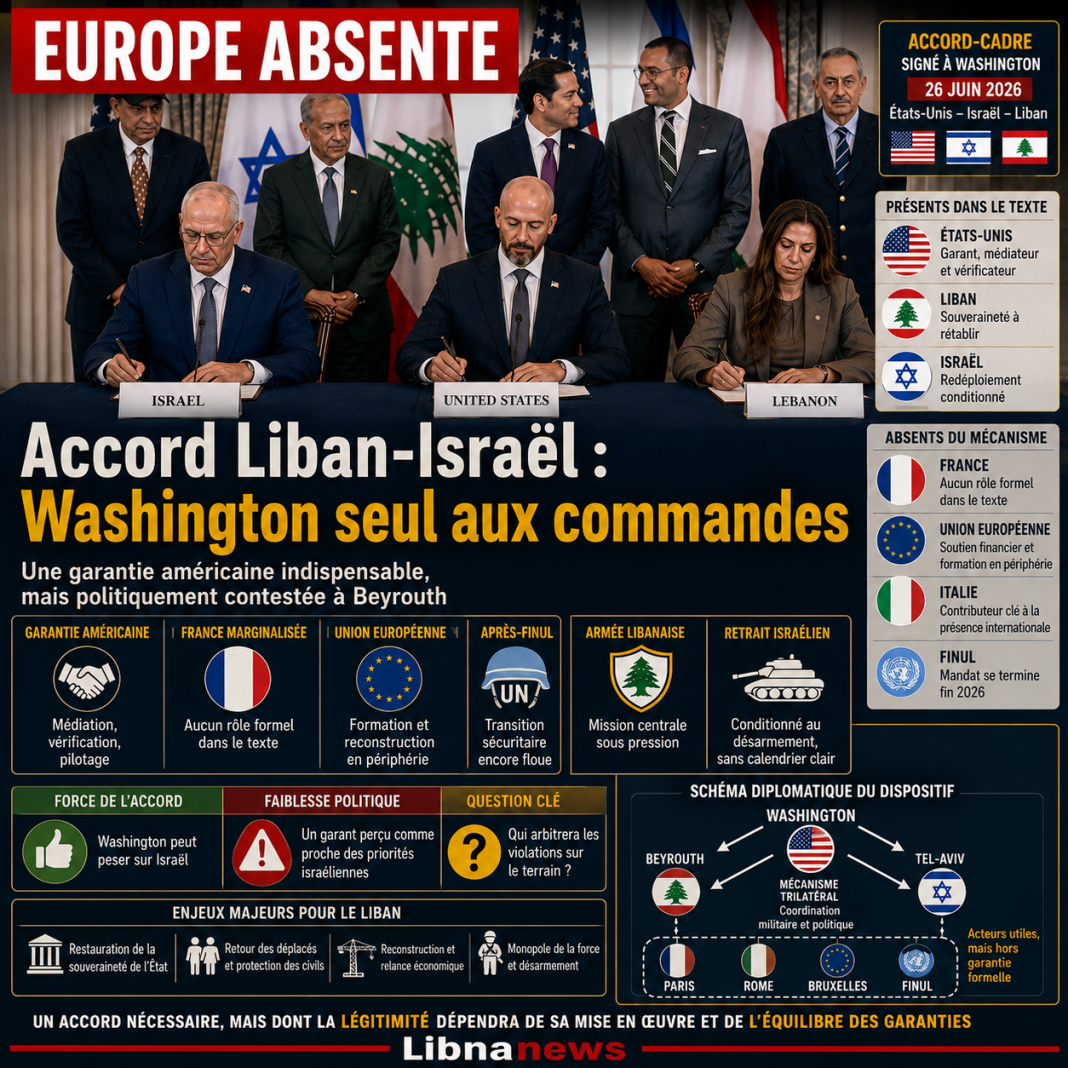






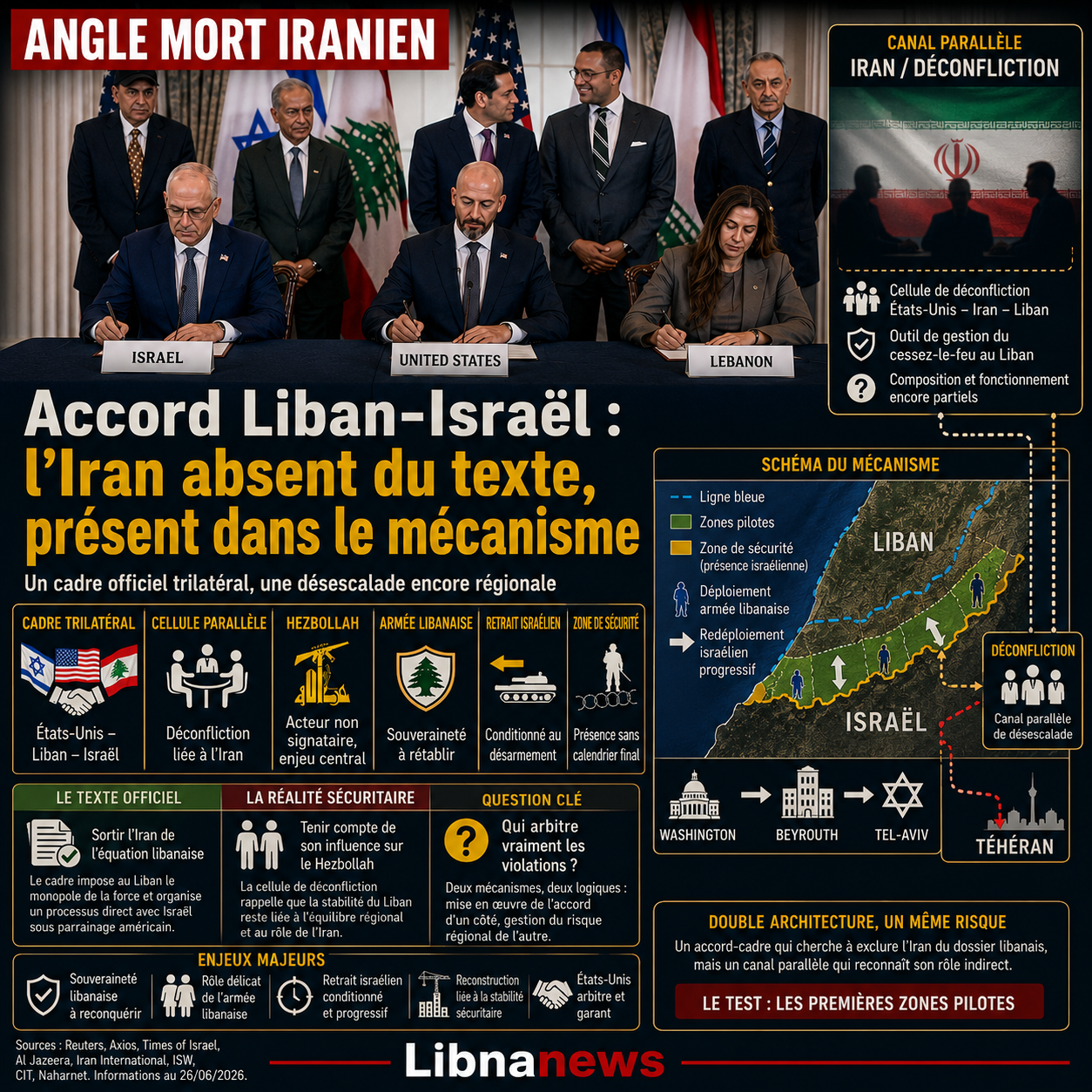
The text of the framework agreement signed in Washington between the United States, Israel and Lebanon sets out an ambitious diplomatic architecture, but it contains a major contradiction: it claims to organize the security settlement of South Lebanon in a trilateral framework officially excluding Iran, while a de-conflict cell linked to the ceasefire in Lebanon was mentioned in a parallel framework involving the United States, Iran and Lebanon. This double device creates a central voltage. On the one hand, Israel seeks to dissociate the Lebanese issue from the Iranian-American negotiations. On the other hand, the de-conflict mechanism recalls that Iran remains an indirect player in the Lebanese case, because of its influence on Hezbollah. Media sources and regional monitoring centres described the cell as a tool to monitor de-escalation in Lebanon, with still partial details on its composition and functioning.
The framework agreement does not explicitly mention this de-confliction cell including Iran. Rather, it organizes a direct process between Lebanon and Israel, under American sponsorship. It includes pilot areas, the gradual redeployment of the Israeli army, the deployment of the Lebanese army, the verified disarmament of non-State armed groups and the mobilization of international assistance for reconstruction. The text published and reproduced by several media presents the agreement as a trilateral framework signed in Washington on 26 June 2026.
This lack of explicit mention of Iran in the main agreement is a political choice. Israel can present the text as a way out Iran and Hezbollah from the Lebanese equation. Lebanon can defend it as a framework for restoring State sovereignty. The United States can see this as a way of bringing the Lebanese file back into an inter-State format. But the deconfliction cell introduces a parallel level. It suggests that the stabilization of Lebanon cannot be entirely separated from the regional balance with Tehran. This is one of the most sensitive points of the device.
The deconfliction cell, part absent from the text but central in the device
The fundamental point to be stressed is that the framework agreement does not directly refer to a de-conflict cell including Iran. The text mentions a « military coordination group » between Lebanon and Israel, with the support and participation of the United States. This group falls within the scope of the Framework Agreement. It is therefore trilateral in its architecture: the United States, Lebanon, Israel. It aims to implement the pilot areas, Israeli redeployments and the deployment of the Lebanese army.
The deconfliction cell involving Iran comes from another level. It is linked to the de-escalation mechanism resulting from the Iranian-American discussions on Lebanon. According to reports from several sources, this cell is intended to prevent the resumption of military operations in Lebanon and to manage incidents. Media reports refer to a structure involving the United States, Iran and Lebanon, with facilitating partners such as Qatar and Pakistan. Public details remain limited, which requires careful reading.
This coexistence of two mechanisms creates a two-storey architecture. The first floor is official, signed, visible: the Lebanon-Israel-United States framework agreement. The second is indirect, regional, and less transparent: the deconfliction cell linked to Iran. The first is to affirm that Lebanon and Israel can settle their disputes directly as sovereign States. The second implicitly recognizes that Hezbollah, and therefore Iran, remain indispensable for the effective management of the ceasefire.
This contradiction is at the heart of the case. Israel wants to make Hezbollah a Lebanese problem. The framework agreement goes in this direction, since it requires the Lebanese State to restore its monopoly on arms. But the deconfliction cell shows that Washington knows that no lasting stabilization can ignore Iranian influence. The Washington text seeks to get Iran out of the political equation. The parallel mechanism keeps it in the safe equation.
Dissociation sought by Israel
For Israel, the major interest of the agreement is to separate the Lebanese file from the Iranian file. The Israeli position is that Lebanon must respond as a State to everything that is happening in its territory. Hezbollah should no longer be treated as a regional force trading through Tehran. It must be treated as a non-State armed group that the Lebanese Government undertakes to disarm.
This logic appears in article 4, which speaks of complete and verified disarmament of all non-State armed groups. It also appears in article 6, which states that only the Lebanese government decides on war and peace. It still appears in article 7, which states that no third party may exercise the right of defence on behalf of Lebanon or Israel. In political language, this means that Hezbollah can no longer stand as Lebanon’s military defender.
The deconfliction cell complicates this reading. While Iran participates, even indirectly, in a mechanism for managing the ceasefire in Lebanon, this is tantamount to recognizing its ability to influence the armed actors concerned. Israel can accept this reality tactically, to achieve immediate calm. But strategically, it seeks to reduce this influence in the official text. Hence the separation between the public trilateral framework and the regional deconflict channel.
This dissociation also serves the communication of Benjamin Netanyahu. The Israeli Prime Minister can say that the agreement does not commit a compromise with Iran, but a mechanism that forces Lebanon to regain control of its territory. He can also argue that the Israeli army will remain in the security zone until Hezbollah is disarmed. This position allows him to respond to internal criticisms that refuse any withdrawal perceived as a concession to Hezbollah.
Lebanon caught between two executives
For Lebanon, the situation is more difficult. The government signs a framework agreement with Israel and the United States. He claims that the Lebanese State is the sole holder of sovereignty, legal weapons and the decision on war and peace. At the same time, the real stability of the cease-fire can depend on a de-conflict cell involving Iran, a power that retains a decisive influence on Hezbollah.
This dual architecture can be useful in the short term. It enables the Lebanese government to publicly defend state sovereignty, while benefiting from an indirect channel capable of reducing the risk of escalation with Hezbollah and its regional supporters. It also avoids immediate frontal confrontation between the Lebanese army and Hezbollah. But it creates a political contradiction. If the Lebanese State is sovereign, why does it need a mechanism involving Iran to guarantee calm in Lebanon?
This issue will be central to the internal debate. Supporters of the agreement will say that the deconfliction cell is a temporary tool to protect the transition. They will say that the goal remains to strengthen the Lebanese army and restore state authority. Critics will respond that the mechanism implicitly recognizes that the State does not yet have effective control of the territory. They will see it as proof that the sovereignty affirmed in the text remains conditional.
The Lebanese army is directly concerned. The text gives him responsibility for the pilot areas. It must ensure the absence of non-State armed groups. It must ensure the return of civilians. It must accompany the Israeli redeployment. But if a cell involving Iran manages de-escalation in parallel, the Lebanese army may find itself caught between American demands, Israeli pressure, internal balances and signals from Hezbollah.
An Israeli presence without a definitive timetable
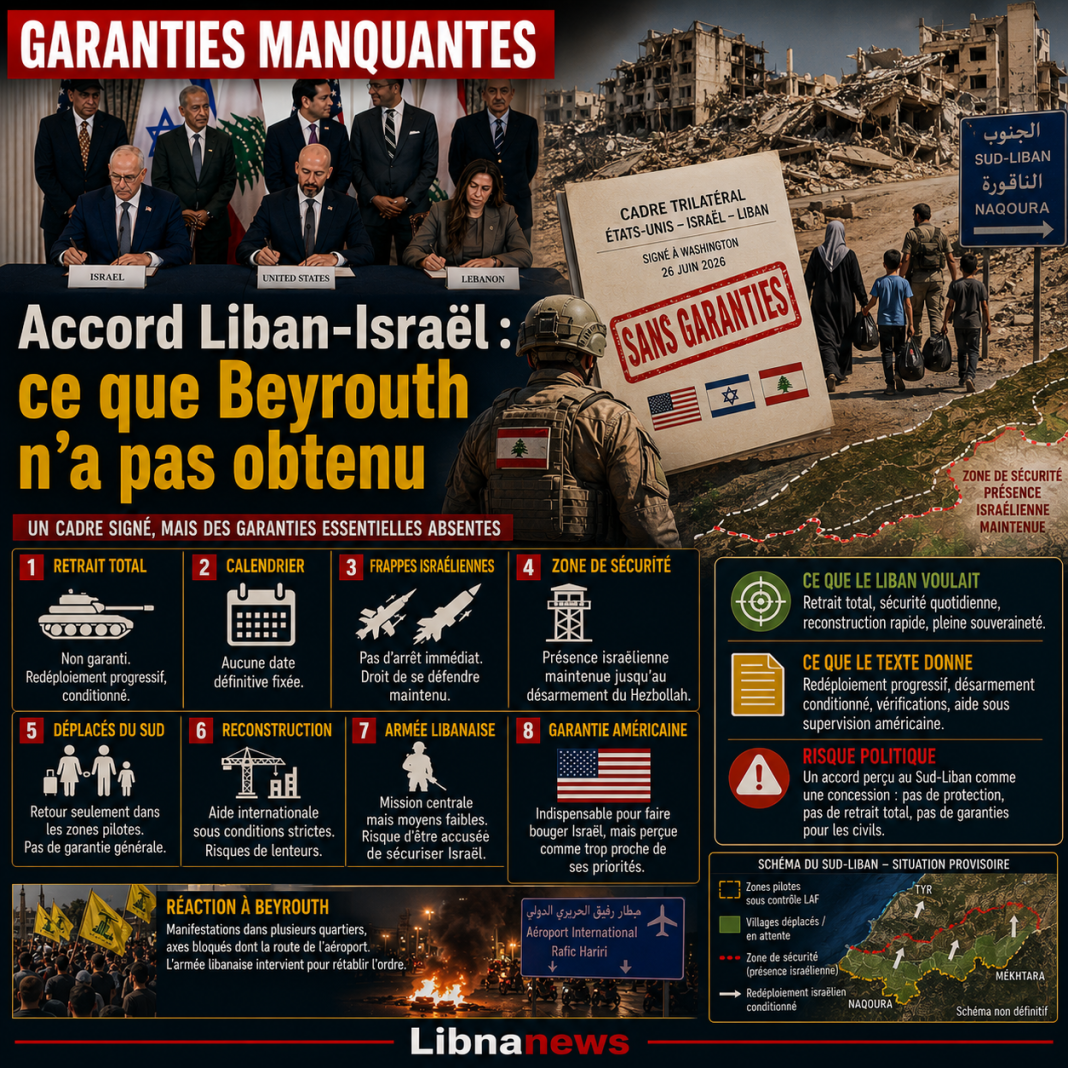
The Framework Agreement does not set a definitive timetable for Israel’s complete withdrawal. He speaks of a gradual redeployment from Lebanese territory, made possible by the disarmament of non-State armed groups and the security arrangements to be negotiated. This formulation is decisive. She does not say that Israel must leave on a given date. She said that Israel could redeploy once conditions were met.
Benjamin Netanyahu’s position reinforces this reading. The main point, according to him, is that Israel would remain in the safe area. Israeli media also reported that this presence would continue along the « yellow line » until the day that Hezbollah was disarmed and would no longer pose a threat from Lebanon. This condition is very broad. It may extend the Israeli presence indefinitely.
Lebanon therefore accepts an agreement that does not meet its initial requirement for immediate total withdrawal. He obtained the prospect of a gradual withdrawal. He obtained the principle of pilot zones. He gets an international framework. But it also accepts a transitional period during which Israeli forces will remain present, while the Lebanese army will have to assume security responsibilities in the transferred areas.
This situation can lead the Lebanese army to falsehood. If it prevents attacks against Israeli forces still present, it can be accused of protecting the enemy. If it does not prevent them, Israel can say that Lebanon does not respect the agreement. The text seeks to make the army the pillar of sovereignty. But in the transitional phase, it can appear as the guarantor of a security order defined under US and Israeli pressure.
Highlights of the agreement
The first strong point is the explicit recognition of the principle of a direct settlement between Lebanon and Israel. The text affirms that both countries must resolve their differences as sovereign States, with American mediation. This reduces the formal position of armed actors and regional sponsors.
The second highlight is the reaffirmation of the Lebanese state’s monopoly on the use of force. The text provides the Lebanese Government with a political and legal basis to assert that only the State decides on war and peace. This provision can strengthen Lebanese institutions if implemented in a progressive, consensual and credible manner.
The third strong point is the link between security, return of civilians and reconstruction. Pilot zones should allow residents to return to areas under the sole control of the Lebanese State. They must also pave the way for sustained international reconstruction efforts.
The fourth highlight is the US commitment to mobilize international partners. Lebanon will need significant assistance to repair infrastructure, support displaced families and revive the economies of the affected regions. The text recognizes this need.
The fifth highlight is the establishment of a military coordination group with American participation. If this group operates in a transparent manner, it can reduce the risk of incidents, clarify responsibilities and verify implementation steps.
Weaknesses of the agreement
The first weak point is the lack of a full Israeli withdrawal schedule. The text gives a perspective, but not a date. Israel therefore retains considerable scope for interpretation, especially if the threat of Hezbollah is broadly defined.
The second weak point is the very ambitious objective of total disarmament of non-State armed groups. The text exceeds the only South Lebanon. It commits the Lebanese Government to the entire territory. This objective directly affects Hezbollah and can cause an internal political crisis.
The third weak point is the delicate position of the Lebanese army. It must restore sovereignty, but it can be seen as applying the conditions of an agreement designed under US and Israeli pressure. This risk will be particularly high in areas where Israeli forces will remain.
The fourth weak point is the coexistence of two mechanisms. The public framework agreement excludes Iran. The de-conflict cell seems to recognize its role in the management of the ceasefire. This duality can blur the chain of responsibility and weaken the political clarity of the mechanism.
The fifth weak point concerns reconstruction. It prohibits funds from benefiting non-State armed groups or related entities. This condition meets American and Israeli demands. But it will be difficult to apply in a local environment where municipal, social and political networks can be intertwined.
The real test: who arbitrates violations?
The text provides for verification mechanisms, but details must be included in the security annex. This annex will be more important than several general clauses. It will have to say who checks disarmament, who confirms the dismantling of infrastructure, who observes Israeli withdrawal, who arbitrates disagreements and who responds to violations.
The deconfliction cell here raises a central question. Will it only intervene to prevent regional escalation? Or can it influence incident management in southern Lebanon? If it includes Iran, even indirectly, its role could be seen by Israel as a tactical concession, and by Lebanon as a guarantee of de-escalation. But it could also be seen as a recognition that Hezbollah cannot be neutralized by the Lebanese-Israeli framework alone.
The military coordination group provided for in the agreement and the de-conflict cell do not respond to the same logic. The first serves the application of the text. The second is regional risk management. The first strengthens the Lebanese state on paper. The second points out that regional actors retain a blocking power.
Peace framed by power relations
The agreement speaks of peace, but it remains dominated by power relations. Israel obtains the conditional continuation of its presence until the threat disappears. Lebanon obtains recognition of its sovereignty, but without a complete withdrawal schedule. The United States obtains a framework for mediators, auditors, potential financiers and political arbitrators. Iran does not appear in the text, but remains present in the safe environment by the deconfliction cell and Hezbollah.
The strength of the text is to create a process. His weakness is to leave open the most explosive questions. What does verified disarmament mean? Who decides that Hezbollah is no longer a threat? How long can Israel remain in the safe zone? Can the Lebanese army assume this role without losing its legitimacy? Is the de-conflict cell including Iran a safety net or a structural contradiction?
The answer will depend on the first steps. If Israel really withdraws from a pilot zone, if the Lebanese army enters without internal confrontation, if the inhabitants return and if the strikes cease, the agreement will gain credibility. If Israel maintains its freedom of action, if Hezbollah refuses the mechanism, if the Lebanese army is accused of collaboration and if the de-conflict cell becomes the real place to manage the crisis, the agreement will appear as an incomplete framework.
A decisive security annex
The security annex should specify the elements that the main text leaves in the blur. It will have to identify the first two pilot areas, the deadlines, the conditions for passage under Lebanese control, the criteria for disarmament, the modalities for reconstruction and guarantees of non-return of armed groups. It will also have to say how the military coordination group links up with the de-conflict cell.
This is a fundamental point. If both mechanisms are not coordinated, incidents will be inevitable. An attack, an Israeli strike, a suspected Hezbollah presence or a movement of troops can be interpreted differently by each channel. The trilateral group may accuse a party of violating the agreement. The deconfliction cell may seek to prevent escalation without treating the bottom. This superimposition can help avoid war, but it can also freeze ambiguities.
The framework agreement is therefore less a peace agreement than a transitional mechanism under surveillance. He is trying to turn Hezbollah into a problem of Lebanese sovereignty. He gives Israel security assurances. It gives the United States a central role. It gives Lebanon a promise of reconstruction and progressive return of the State. But it leaves Iran in the shadow of the mechanism, through a de-conflict cell that recalls that the Lebanese terrain remains connected to the regional power ratio.
The continuation will be played in this contradiction. The official text wants Iran out of the Lebanese file. The security reality still requires that its influence be taken into account. Lebanon wants to restore its sovereignty. Israel wants to keep the safe area until Hezbollah is disarmed. Washington wants to fly both levels. The first pilot areas will say whether this architecture can produce a real withdrawal, or whether it merely provides a diplomatic framework for a prolonged Israeli presence and Lebanese sovereignty that is still conditional.